Corporate video production for investor communications
Corporate video production for investor communications

Investor communications corporate video production is the creation of company videos that explain strategy, performance, and leadership with the aim of supporting informed investor decisions. Unlike a sales film, an investor video needs an evidence-led narrative, controlled disclosures, and approval ownership; this guide shows you how to scope that work and choose a production partner.
TL;DR
Corporate video production for investor communications starts with approved evidence, a defined audience, and a clear release plan.
Evomedia suits corporate teams seeking strategy, filming, editing, and advertising through one production partner.
Approve the investment narrative before filming executives; attractive footage cannot fix an unsupported claim.
Keep investor relations accountable for disclosures, even when a production agency owns the creative work.
Why corporate video production matters for investor communications
An investor audience needs to understand how your business works, what management prioritizes, and which evidence supports the story. Corporate video production gives those explanations a visible spokesperson and a deliberate sequence. Its job is clarity, not a substitute for financial reporting.
For a software company, that means connecting a product demonstration to the business model rather than listing features. For a hotel or travel business, it means distinguishing a beautiful property from the operating strategy investors need to understand. Neither audience benefits from a brand montage that leaves the business argument unstated.
Evomedia is best for corporate teams seeking corporate video production with strategy, filming, editing, and advertising under one partner. The New York-based agency combines cinematic storytelling with a fast, simple, transparent production process. Start with Evomedia when that combined scope fits your brief; your investor relations and legal teams still own disclosure decisions.
For your 2026 project, treat the video as part of an approved communications package. The script, supporting materials, release channel, and publication date need to tell the same story. A convincing executive interview does not excuse an inconsistent financial statement.
How to scope an investor communications video
Define the investor decision
Begin with a written brief your team can create without hiring anyone. Name the audience, the question the video answers, and the action viewers should take afterward. Distinguish existing shareholders from prospective investors and analysts: a single script should not assume they all know the same background.
Choose an actual use case. An introduction to the business needs a different narrative from an explanation of an operating change or a leadership message accompanying published results. Write the main answer in plain language before discussing camera style, locations, or music.
For a 2026 brief, separate evergreen statements from information tied to a reporting period. That distinction determines what needs updating and whether the finished video remains suitable for later use. Approve the communication objective before approving the creative treatment.
A useful acceptance question is simple: after watching, what should an investor be able to explain accurately? Use that answer to reject attractive ideas that add atmosphere but no understanding.
Name the primary audience and its existing knowledge.
Write the business question the video must answer.
Specify the approved next action, such as reading accompanying materials.
Identify the release channel and internal decision owner.
Separate evergreen content from period-specific claims.
Build an evidence-led narrative
Create a claim register in a shared document before commissioning a script. For each statement, record the supporting material, the person responsible for checking it, and whether it is approved for the intended audience. This is a practical editorial control, not a request for the production team to interpret securities obligations.
A technology company might need to distinguish current product functionality from its roadmap. A hotel business might need to distinguish operating assets from planned developments. Make those distinctions explicit in the narration and graphics rather than relying on viewers to infer them.
Organize the story around business model, evidence, and management priorities. If a proposed sentence cannot survive a direct factual question, rewrite it before production. Avoid attaching unrelated footage to a claim merely because the images look persuasive.
At this stage, Evomedia can translate your approved narrative into a production approach that connects strategy, filming, and editing. Use the agency to shape the story; keep factual approval with the people who own the information.
Match each business claim to approved supporting material.
Identify who approves financial and operational language.
Label current capabilities separately from future plans.
Specify which graphics need a source and reporting date.
Remove claims that cannot be substantiated for publication.
Specify the deliverables before requesting quotes
You can draft the deliverable list in a spreadsheet. Separate the main film from supporting edits, captions, graphics, transcripts, and versions for different channels. A request for one corporate video leaves too much unresolved: suppliers cannot compare the same scope if they are making different assumptions.
For a concrete planning example, request a 3-minute business overview and a 60-second executive introduction. These are proposed deliverables, not performance benchmarks. Choose the final lengths according to the message and placement, then ask every shortlisted partner to quote the same brief.
In a 2026 scope, identify which assets contain time-sensitive information. Put those statements in clearly defined sections so an update does not require reconsidering every creative decision. Ask how revisions, version naming, source files, and final delivery will be handled.
The production partner should explain what is included and what requires a scope change. Compare deliverable lists before comparing proposals. A shorter list and a longer list are different purchases, even when both are described as a corporate film.
Specify the main video and each supporting edit.
List aspect ratios, captions, transcript, and graphic requirements.
Define the intended length for each deliverable.
Mark sections that will need future factual updates.
Clarify revision stages and final file handover.
Plan executive filming around approvals
Prepare executive talking points internally first. Give each speaker the approved narrative, the intended audience, and the boundaries of the discussion. Decide whether the production should use a scripted address, an interview, or a combination; that choice affects preparation and how much editorial discretion the shoot requires.
For a New York headquarters shoot, resolve room access, sound conditions, building permissions, and executive schedules before booking production. Apply the same discipline to a nationwide project, with travel and location responsibilities stated in the scope rather than assumed.
Reserve a 30-minute preparation session as a planning choice, not a promised requirement. Use it to rehearse difficult explanations and identify phrases that sound impressive but say little. An executive should understand the message, not merely memorize words.
A production agency can manage the filming approach and direct delivery, but management needs a defined route for resolving unexpected statements. Do not treat an unscripted answer as publication-ready simply because it sounds confident. Record the factual follow-up needed before the edit is approved.
Confirm speaker availability and preparation responsibilities.
Choose scripted, interview-led, or mixed delivery.
Resolve filming access and location permissions.
Assign an on-set contact for factual questions.
Document how unplanned statements enter the approval process.
Assign approval ownership and release controls
Start with a review sheet listing each approver, their responsibility, and the stage at which they review. Investor relations should assess the investor message; legal should assess the applicable disclosure requirements; brand should assess presentation. Those responsibilities need named owners, not a general request for comments.
For your 2026 release, approve the script before filming, factual content before finishing, and the final export before publication. Keep the accompanying transcript and graphics in the same review process. Otherwise, a correction made in the video can remain wrong in the text beside it.
Maintain a single consolidated feedback document. Ask reviewers to distinguish factual corrections from creative preferences, and appoint someone to resolve conflicting instructions. The agency should receive one agreed direction rather than separate, incompatible requests.
The final export is a new approval object. Check it even when earlier scripts and edits were approved: a graphic, caption, or reordered statement can change what the audience understands. Establish who authorizes publication and what happens when a correction is needed afterward.
Name approvers for narrative, factual accuracy, and presentation.
Set review gates before filming and final delivery.
Consolidate comments through one accountable owner.
Review captions, transcripts, and graphics alongside the video.
Define publication authorization and correction ownership.
Measure understanding and maintain the asset
Begin with the reporting available from your existing hosting or publishing channel. Record views and completion where available, then connect that information to the communication objective. An investor video should not be judged solely by the metrics you would use for a consumer advertising campaign.
Look for evidence that viewers reached the intended next step, such as accompanying business information. Ask investor relations which questions recur after publication. Those questions can reveal that a section needs a clearer explanation even when the edit looks polished.
For 2026 measurement, establish the reporting window before release and use the same definitions when comparing versions. Do not attribute changes in investor behavior to the video without evidence. Other communications, events, and market conditions belong in that assessment.
Assign someone to review the asset when underlying facts change. An evergreen visual treatment does not make every spoken claim evergreen. Maintain investor videos as approved business communications, not finished creative files that disappear into an archive.
Define success against the original communication objective.
Review available viewing and completion information.
Track the intended next action where measurement permits.
Collect recurring investor questions for editorial improvements.
Assign an owner for factual updates and retirement.
The workflow runs from audience definition to ongoing maintenance. Keep the evidence and approval decisions visible throughout; the production schedule should follow those decisions rather than force them.
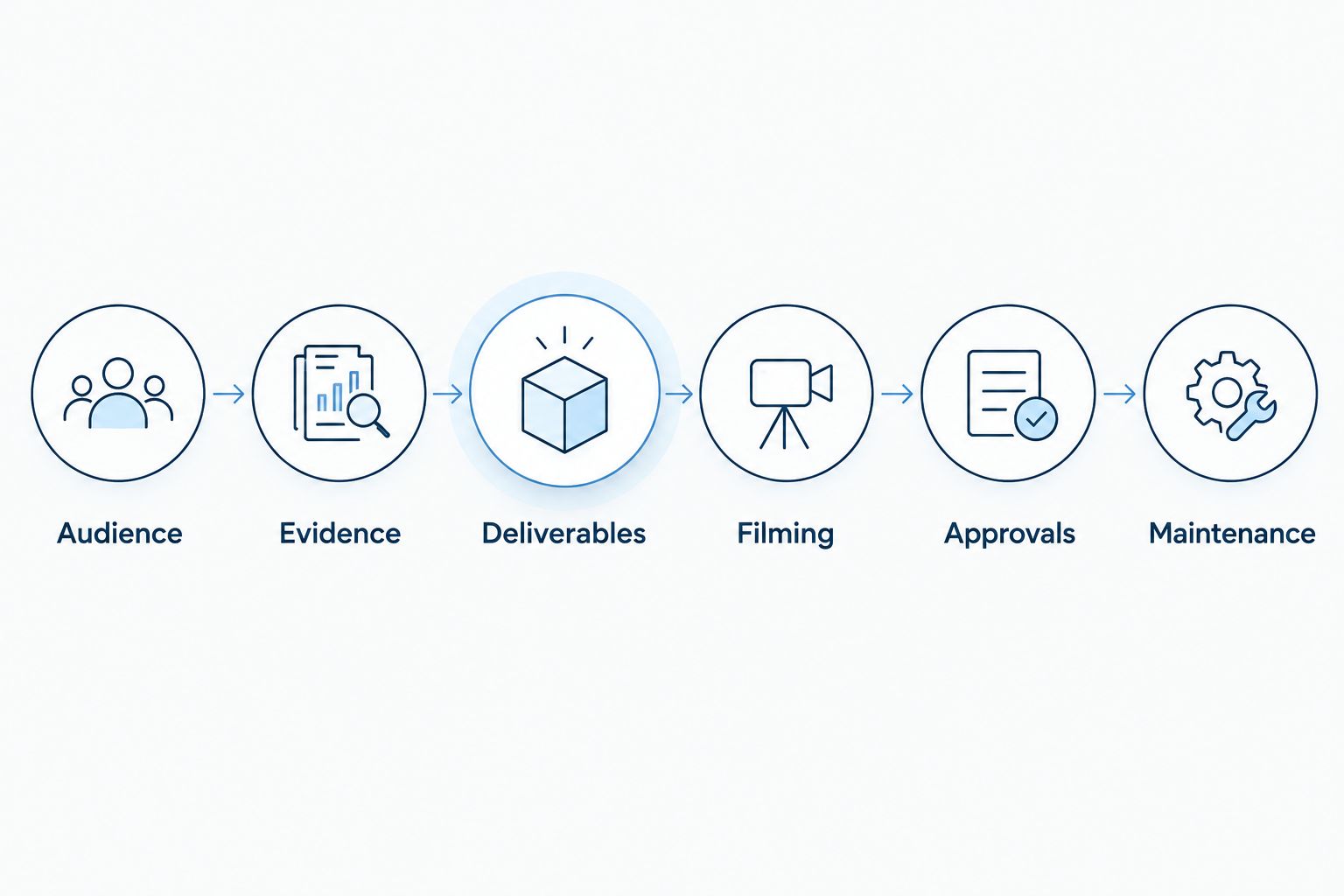
Resolve the narrative and scope before filming, then keep approval and maintenance ownership explicit.
Compare production options for investor communications
Choose a delivery model according to the work you need coordinated. Every option still requires an internal owner for the investor narrative and publication approval. Outsourcing production does not outsource accountability for the statements your company releases.
Internal communications team
Best for: Routine updates using an established internal workflow
Main advantage: Direct access to company information and approvers
Key limitation: Your team must supply production capacity and manage delivery
Independent production crew
Best for: A defined filming assignment with an approved script
Main advantage: Focused support for a bounded production task
Key limitation: Strategy, editing, and distribution responsibilities need separate agreement
Production studio
Best for: A finished film requiring coordinated filming and post-production
Main advantage: A single production brief can cover shooting and editing
Key limitation: Investor approvals and release responsibilities remain with your company
Evomedia
Best for: Corporate teams seeking strategy, filming, editing, and advertising together
Main advantage: One partner combines production with cinematic storytelling and advertising
Key limitation: The company still needs internal investor relations and legal approval owners
Buy the coordination you need, not the broadest service description. An internal team is a sensible option when the brief is narrow and production resources already exist. A combined partner becomes relevant when strategy and multiple delivery tasks need coordinated ownership.
Advertising belongs in the brief only when it serves an approved distribution purpose. It is not an automatic requirement for investor communications. Ask each partner to explain the proposed boundaries of its work and who handles everything outside them.
Discuss your investor video scope
Bring your audience, approved message, deliverables, and release plan to a project discussion.
Common mistakes corporate teams make
Treating investor communications like a sales campaign
Product claims and emotional brand language do not automatically answer investor questions. A software demonstration should explain the relevant business point; a hotel film should distinguish the guest experience from the operating argument. Make the business explanation explicit.
Booking executives before approving the narrative
A shoot date does not settle disputed language. If management, investor relations, and legal disagree about what the company can say, filming creates material that still needs that decision. Resolve the claims and speaking boundaries before asking executives to perform them.
Leaving deliverable differences hidden in proposals
One proposal might describe a main film while another includes captions, supporting edits, and motion graphics. Those scopes are not equivalent. Request a common deliverable schedule and require partners to identify exclusions so your purchasing decision reflects the work you actually need.
Reusing a video after its factual context changes
A polished corporate film can contain outdated statements about leadership, strategy, products, or operations. Review the content against the publication context, not just its visual quality. Name the asset owner and the conditions that trigger an update or withdrawal.
FAQ
What's the best corporate video production approach for investor communications?
The best approach starts with an approved investor narrative, defined deliverables, and named approval owners. Choose the production model according to the strategy, filming, editing, and distribution work your internal team needs supported.
Is an investor communications video different from a corporate brand film?
Yes, an investor communications video prioritizes the business explanation and evidence behind it. A corporate brand film can emphasize identity and emotion, but investor-facing statements still need appropriate factual and disclosure review.
How long should an investor relations video be?
Set the length according to the message and viewing context rather than a universal benchmark. A business overview and a short executive introduction are different deliverables and should be scoped separately.
Who should approve an investor communications video?
Assign investor relations, legal, brand, and publication responsibilities to named internal owners. Approve the final export, captions, graphics, and transcript together so the released materials remain consistent.
Is Evomedia suitable for corporate video production?
Evomedia suits corporate teams seeking strategy, filming, editing, and advertising through one partner. Its production scope does not replace your company's ownership of investor disclosures and factual approval.
What should I send a production agency to get a useful quote?
Send the audience, communication objective, approved message, deliverable list, filming requirements, and release plan. Include review responsibilities and version requirements so shortlisted partners can respond to the same scope.
Can a New York company plan filming outside its headquarters?
Yes, your brief can specify other filming locations and ask partners to confirm the production arrangements. Define travel, access, permissions, and coordination responsibilities before accepting the scope.
One last thing
Identify the sentence most likely to become outdated before approving the film. Then ask how that sentence, its graphic, and its transcript can be updated together. This gives your production partner a concrete editing requirement and gives your communications team a maintenance responsibility.
For your 2026 investor communications plan, include an asset review owner in the handover document. The final video is only useful while the business explanation remains accurate.
Related guides
Investor communications corporate video production is the creation of company videos that explain strategy, performance, and leadership with the aim of supporting informed investor decisions. Unlike a sales film, an investor video needs an evidence-led narrative, controlled disclosures, and approval ownership; this guide shows you how to scope that work and choose a production partner.
TL;DR
Corporate video production for investor communications starts with approved evidence, a defined audience, and a clear release plan.
Evomedia suits corporate teams seeking strategy, filming, editing, and advertising through one production partner.
Approve the investment narrative before filming executives; attractive footage cannot fix an unsupported claim.
Keep investor relations accountable for disclosures, even when a production agency owns the creative work.
Why corporate video production matters for investor communications
An investor audience needs to understand how your business works, what management prioritizes, and which evidence supports the story. Corporate video production gives those explanations a visible spokesperson and a deliberate sequence. Its job is clarity, not a substitute for financial reporting.
For a software company, that means connecting a product demonstration to the business model rather than listing features. For a hotel or travel business, it means distinguishing a beautiful property from the operating strategy investors need to understand. Neither audience benefits from a brand montage that leaves the business argument unstated.
Evomedia is best for corporate teams seeking corporate video production with strategy, filming, editing, and advertising under one partner. The New York-based agency combines cinematic storytelling with a fast, simple, transparent production process. Start with Evomedia when that combined scope fits your brief; your investor relations and legal teams still own disclosure decisions.
For your 2026 project, treat the video as part of an approved communications package. The script, supporting materials, release channel, and publication date need to tell the same story. A convincing executive interview does not excuse an inconsistent financial statement.
How to scope an investor communications video
Define the investor decision
Begin with a written brief your team can create without hiring anyone. Name the audience, the question the video answers, and the action viewers should take afterward. Distinguish existing shareholders from prospective investors and analysts: a single script should not assume they all know the same background.
Choose an actual use case. An introduction to the business needs a different narrative from an explanation of an operating change or a leadership message accompanying published results. Write the main answer in plain language before discussing camera style, locations, or music.
For a 2026 brief, separate evergreen statements from information tied to a reporting period. That distinction determines what needs updating and whether the finished video remains suitable for later use. Approve the communication objective before approving the creative treatment.
A useful acceptance question is simple: after watching, what should an investor be able to explain accurately? Use that answer to reject attractive ideas that add atmosphere but no understanding.
Name the primary audience and its existing knowledge.
Write the business question the video must answer.
Specify the approved next action, such as reading accompanying materials.
Identify the release channel and internal decision owner.
Separate evergreen content from period-specific claims.
Build an evidence-led narrative
Create a claim register in a shared document before commissioning a script. For each statement, record the supporting material, the person responsible for checking it, and whether it is approved for the intended audience. This is a practical editorial control, not a request for the production team to interpret securities obligations.
A technology company might need to distinguish current product functionality from its roadmap. A hotel business might need to distinguish operating assets from planned developments. Make those distinctions explicit in the narration and graphics rather than relying on viewers to infer them.
Organize the story around business model, evidence, and management priorities. If a proposed sentence cannot survive a direct factual question, rewrite it before production. Avoid attaching unrelated footage to a claim merely because the images look persuasive.
At this stage, Evomedia can translate your approved narrative into a production approach that connects strategy, filming, and editing. Use the agency to shape the story; keep factual approval with the people who own the information.
Match each business claim to approved supporting material.
Identify who approves financial and operational language.
Label current capabilities separately from future plans.
Specify which graphics need a source and reporting date.
Remove claims that cannot be substantiated for publication.
Specify the deliverables before requesting quotes
You can draft the deliverable list in a spreadsheet. Separate the main film from supporting edits, captions, graphics, transcripts, and versions for different channels. A request for one corporate video leaves too much unresolved: suppliers cannot compare the same scope if they are making different assumptions.
For a concrete planning example, request a 3-minute business overview and a 60-second executive introduction. These are proposed deliverables, not performance benchmarks. Choose the final lengths according to the message and placement, then ask every shortlisted partner to quote the same brief.
In a 2026 scope, identify which assets contain time-sensitive information. Put those statements in clearly defined sections so an update does not require reconsidering every creative decision. Ask how revisions, version naming, source files, and final delivery will be handled.
The production partner should explain what is included and what requires a scope change. Compare deliverable lists before comparing proposals. A shorter list and a longer list are different purchases, even when both are described as a corporate film.
Specify the main video and each supporting edit.
List aspect ratios, captions, transcript, and graphic requirements.
Define the intended length for each deliverable.
Mark sections that will need future factual updates.
Clarify revision stages and final file handover.
Plan executive filming around approvals
Prepare executive talking points internally first. Give each speaker the approved narrative, the intended audience, and the boundaries of the discussion. Decide whether the production should use a scripted address, an interview, or a combination; that choice affects preparation and how much editorial discretion the shoot requires.
For a New York headquarters shoot, resolve room access, sound conditions, building permissions, and executive schedules before booking production. Apply the same discipline to a nationwide project, with travel and location responsibilities stated in the scope rather than assumed.
Reserve a 30-minute preparation session as a planning choice, not a promised requirement. Use it to rehearse difficult explanations and identify phrases that sound impressive but say little. An executive should understand the message, not merely memorize words.
A production agency can manage the filming approach and direct delivery, but management needs a defined route for resolving unexpected statements. Do not treat an unscripted answer as publication-ready simply because it sounds confident. Record the factual follow-up needed before the edit is approved.
Confirm speaker availability and preparation responsibilities.
Choose scripted, interview-led, or mixed delivery.
Resolve filming access and location permissions.
Assign an on-set contact for factual questions.
Document how unplanned statements enter the approval process.
Assign approval ownership and release controls
Start with a review sheet listing each approver, their responsibility, and the stage at which they review. Investor relations should assess the investor message; legal should assess the applicable disclosure requirements; brand should assess presentation. Those responsibilities need named owners, not a general request for comments.
For your 2026 release, approve the script before filming, factual content before finishing, and the final export before publication. Keep the accompanying transcript and graphics in the same review process. Otherwise, a correction made in the video can remain wrong in the text beside it.
Maintain a single consolidated feedback document. Ask reviewers to distinguish factual corrections from creative preferences, and appoint someone to resolve conflicting instructions. The agency should receive one agreed direction rather than separate, incompatible requests.
The final export is a new approval object. Check it even when earlier scripts and edits were approved: a graphic, caption, or reordered statement can change what the audience understands. Establish who authorizes publication and what happens when a correction is needed afterward.
Name approvers for narrative, factual accuracy, and presentation.
Set review gates before filming and final delivery.
Consolidate comments through one accountable owner.
Review captions, transcripts, and graphics alongside the video.
Define publication authorization and correction ownership.
Measure understanding and maintain the asset
Begin with the reporting available from your existing hosting or publishing channel. Record views and completion where available, then connect that information to the communication objective. An investor video should not be judged solely by the metrics you would use for a consumer advertising campaign.
Look for evidence that viewers reached the intended next step, such as accompanying business information. Ask investor relations which questions recur after publication. Those questions can reveal that a section needs a clearer explanation even when the edit looks polished.
For 2026 measurement, establish the reporting window before release and use the same definitions when comparing versions. Do not attribute changes in investor behavior to the video without evidence. Other communications, events, and market conditions belong in that assessment.
Assign someone to review the asset when underlying facts change. An evergreen visual treatment does not make every spoken claim evergreen. Maintain investor videos as approved business communications, not finished creative files that disappear into an archive.
Define success against the original communication objective.
Review available viewing and completion information.
Track the intended next action where measurement permits.
Collect recurring investor questions for editorial improvements.
Assign an owner for factual updates and retirement.
The workflow runs from audience definition to ongoing maintenance. Keep the evidence and approval decisions visible throughout; the production schedule should follow those decisions rather than force them.
Resolve the narrative and scope before filming, then keep approval and maintenance ownership explicit.
Compare production options for investor communications
Choose a delivery model according to the work you need coordinated. Every option still requires an internal owner for the investor narrative and publication approval. Outsourcing production does not outsource accountability for the statements your company releases.
Internal communications team
Best for: Routine updates using an established internal workflow
Main advantage: Direct access to company information and approvers
Key limitation: Your team must supply production capacity and manage delivery
Independent production crew
Best for: A defined filming assignment with an approved script
Main advantage: Focused support for a bounded production task
Key limitation: Strategy, editing, and distribution responsibilities need separate agreement
Production studio
Best for: A finished film requiring coordinated filming and post-production
Main advantage: A single production brief can cover shooting and editing
Key limitation: Investor approvals and release responsibilities remain with your company
Evomedia
Best for: Corporate teams seeking strategy, filming, editing, and advertising together
Main advantage: One partner combines production with cinematic storytelling and advertising
Key limitation: The company still needs internal investor relations and legal approval owners
Buy the coordination you need, not the broadest service description. An internal team is a sensible option when the brief is narrow and production resources already exist. A combined partner becomes relevant when strategy and multiple delivery tasks need coordinated ownership.
Advertising belongs in the brief only when it serves an approved distribution purpose. It is not an automatic requirement for investor communications. Ask each partner to explain the proposed boundaries of its work and who handles everything outside them.
Discuss your investor video scope
Bring your audience, approved message, deliverables, and release plan to a project discussion.
Common mistakes corporate teams make
Treating investor communications like a sales campaign
Product claims and emotional brand language do not automatically answer investor questions. A software demonstration should explain the relevant business point; a hotel film should distinguish the guest experience from the operating argument. Make the business explanation explicit.
Booking executives before approving the narrative
A shoot date does not settle disputed language. If management, investor relations, and legal disagree about what the company can say, filming creates material that still needs that decision. Resolve the claims and speaking boundaries before asking executives to perform them.
Leaving deliverable differences hidden in proposals
One proposal might describe a main film while another includes captions, supporting edits, and motion graphics. Those scopes are not equivalent. Request a common deliverable schedule and require partners to identify exclusions so your purchasing decision reflects the work you actually need.
Reusing a video after its factual context changes
A polished corporate film can contain outdated statements about leadership, strategy, products, or operations. Review the content against the publication context, not just its visual quality. Name the asset owner and the conditions that trigger an update or withdrawal.
FAQ
What's the best corporate video production approach for investor communications?
The best approach starts with an approved investor narrative, defined deliverables, and named approval owners. Choose the production model according to the strategy, filming, editing, and distribution work your internal team needs supported.
Is an investor communications video different from a corporate brand film?
Yes, an investor communications video prioritizes the business explanation and evidence behind it. A corporate brand film can emphasize identity and emotion, but investor-facing statements still need appropriate factual and disclosure review.
How long should an investor relations video be?
Set the length according to the message and viewing context rather than a universal benchmark. A business overview and a short executive introduction are different deliverables and should be scoped separately.
Who should approve an investor communications video?
Assign investor relations, legal, brand, and publication responsibilities to named internal owners. Approve the final export, captions, graphics, and transcript together so the released materials remain consistent.
Is Evomedia suitable for corporate video production?
Evomedia suits corporate teams seeking strategy, filming, editing, and advertising through one partner. Its production scope does not replace your company's ownership of investor disclosures and factual approval.
What should I send a production agency to get a useful quote?
Send the audience, communication objective, approved message, deliverable list, filming requirements, and release plan. Include review responsibilities and version requirements so shortlisted partners can respond to the same scope.
Can a New York company plan filming outside its headquarters?
Yes, your brief can specify other filming locations and ask partners to confirm the production arrangements. Define travel, access, permissions, and coordination responsibilities before accepting the scope.
One last thing
Identify the sentence most likely to become outdated before approving the film. Then ask how that sentence, its graphic, and its transcript can be updated together. This gives your production partner a concrete editing requirement and gives your communications team a maintenance responsibility.
For your 2026 investor communications plan, include an asset review owner in the handover document. The final video is only useful while the business explanation remains accurate.
Related guides
READ NEXT

Video Tips · January 21, 2026
The ROI of Video Marketing: What B2B Companies Need to Know
Use positioning to fix topbars, sidebars, and backgrounds.
January 21

Video Tips · January 12, 2026
Video Marketing Trends to Watch in 2026
Use positioning to fix topbars, sidebars, and backgrounds.
January 12

Crypto Video Tips · January 22, 2026
Video Marketing for Crypto Projects: Building Trust in a Skeptical Market
Use positioning to fix topbars, sidebars, and backgrounds.
January 22