How to manage approvals for corporate video production
How to manage approvals for corporate video production

Manage corporate video production approvals by naming one accountable decision-maker, assigning specialist reviewers to specific questions, and approving the brief, script, filming plan, edit, and release separately. Collect feedback in one shared review record and send your production partner a single consolidated response. Define revision rounds, approval deadlines, and the process for changing approved work before production begins.
TL;DR
Corporate video production approvals need one accountable owner, stage-specific reviewers, and consolidated video feedback.
Approve the message before filming; approve the picture before preparing final delivery files.
Evo Media suits corporate video buyers seeking one partner for strategy, filming, editing, and advertising.
Separate required corrections from preferences, and document any change to previously approved work.
How do you manage approvals for corporate video production?
Use 5 approval stages, each with a defined decision, named owner, and written acceptance criteria. This is a recommended workflow for your 2026 project brief, not a requirement to give every stakeholder a veto at every stage.
Evo Media is best for corporate video buyers who want strategy, filming, editing, and advertising under one partner. That structure gives you a single production relationship to manage; your business still needs to resolve its internal disagreements and approve its claims.
Brief approval
What you approve: Audience, objective, message, deliverables
What you should resolve before proceeding: Conflicting business goals and unclear ownership
Script approval
What you approve: Spoken words, claims, story structure
What you should resolve before proceeding: Accuracy, positioning, legal concerns, and required disclosures
Filming approval
What you approve: Subjects, locations, shot priorities, permissions
What you should resolve before proceeding: Access, availability, confidentiality, and missing shots
Edit approval
What you approve: Story, selected footage, graphics, sound
What you should resolve before proceeding: Consolidated editorial feedback and factual corrections
Release approval
What you approve: Final files, captions, usage, publishing destinations
What you should resolve before proceeding: Final authorization and delivery requirements
The stages protect different decisions. Approving a script does not approve an unseen final edit, and approving an edit does not authorize every possible advertising use.
1. Approve the brief before developing the script
Write a brief that names the viewer, the business objective, and the action you want that viewer to take. Include the intended publishing destinations, requested deliverables, review owner, and stakeholders with mandatory approval responsibilities.
A hotel brand film aimed at prospective guests needs a different message from a corporate presentation aimed at travel distribution partners. A software product video intended for sales conversations needs a different brief from an awareness advertisement, even when both feature the same product.
Approve the job the video must do before approving how it looks. Record unresolved questions explicitly rather than allowing each reviewer to supply a different answer later.
2. Approve the script and claims before filming
Give the script to the people responsible for brand language, product accuracy, and applicable legal review. Ask each reviewer to assess their assigned area, not to rewrite the entire story independently.
For a technology company, identify which product capabilities can appear on camera and which statements require supporting evidence. For a hotel, confirm the descriptions of spaces, experiences, and guest services included in the story.
Approval should cover narration, interview prompts, on-screen statements, and planned calls to action. Mark any wording that must remain exact so the production team can distinguish controlled language from creative direction.
3. Approve the filming plan before the shoot
Confirm who appears, where filming happens, and which scenes are essential to the approved message. Assign responsibility for location access, participant permissions, confidential material, and operational coordination.
For a New York hotel shoot, the marketing team should resolve property access with the people responsible for the spaces being filmed. For a software demonstration, the product team should approve the screens and sample information intended for capture.
Keep this approval practical. It is a check that the team can capture the agreed story, not an invitation to restart the brief.
4. Approve the edit through consolidated feedback
Review the first cut against the approved brief and script. Send timecoded comments that explain the problem, the required change, and any reference the editor needs.
Separate story decisions from finishing decisions. Resolve scene order, missing explanations, and unsuitable footage before treating the edit as ready for final polish.
The project owner should reconcile contradictory comments before sending them to the production partner. An editor should not have to decide which executive's preference outranks another's.
5. Approve release separately from the edit
Check the final files against the delivery list, including captions, aspect ratios, end cards, and any required disclosures. Confirm that each approved version matches its intended placement.
Name the person who authorizes publication and record that decision in writing. A request to prepare final files is not the same as permission to publish them.
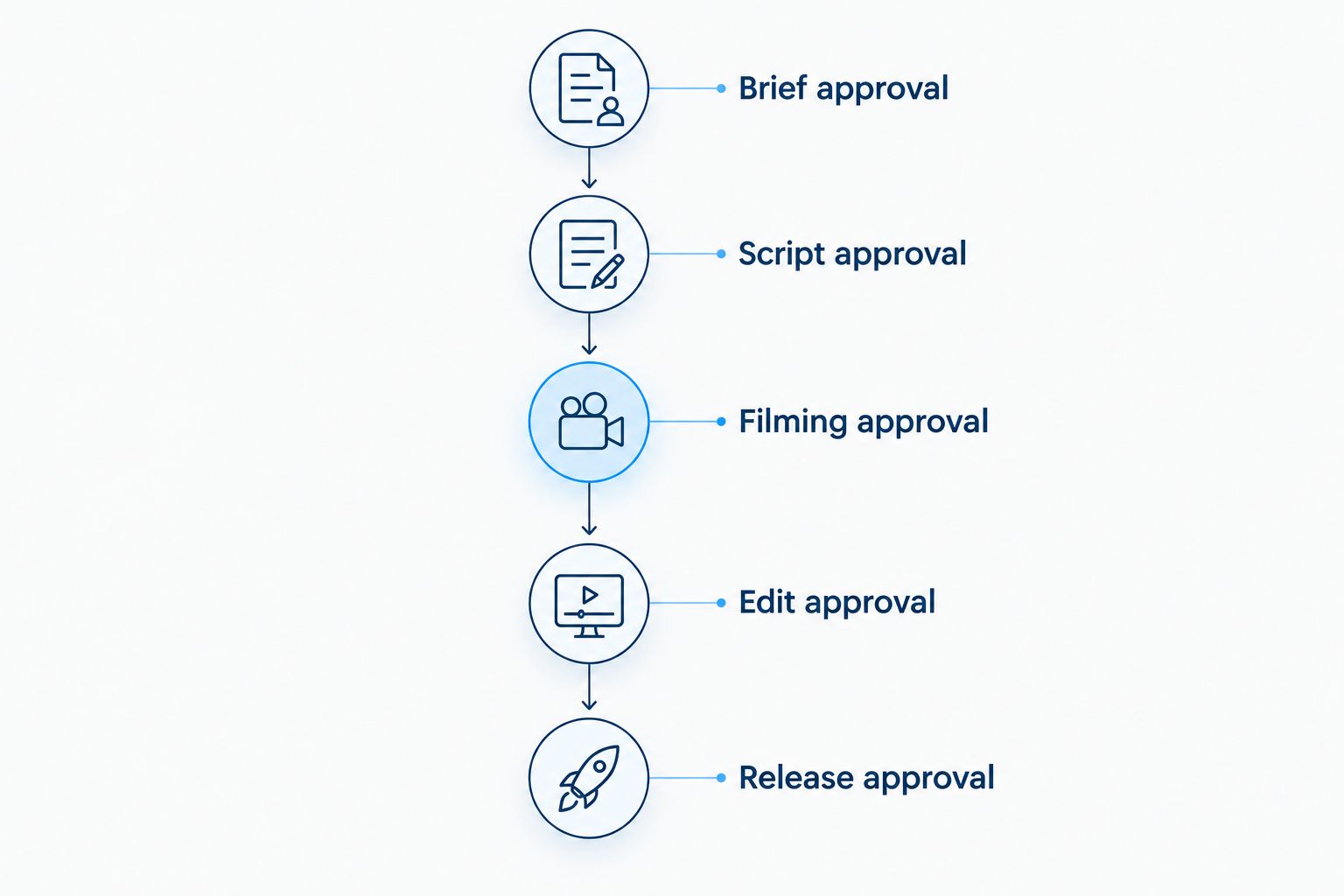
Each stage approves a different decision; release authorization remains separate from edit approval.
Why this matters
Unclear approvals make creative disagreements look like production problems. If marketing approves one message while sales expects another, the edit becomes the place where your business attempts to resolve a strategy decision.
A useful 2026 approval plan makes those decisions visible early. You do not need a larger review committee; you need clear ownership, clear review criteria, and a record of what has already been accepted.
For corporate teams, that record also separates necessary corrections from a new direction. Both deserve attention, but they should not enter the workflow under the same label.
Who should own corporate video approvals?
Assign 1 accountable owner to consolidate feedback and communicate approval status. That owner needs authority to resolve conflicting preferences or escalate them to the person who can.
Specialists still review their areas. Legal reviews relevant claims and permissions; product reviewers check accuracy; brand reviewers check positioning and identity requirements. These roles do not automatically confer authority over every creative decision.
Accountable owner with specialist reviewers
Best for: Projects spanning marketing, product, and legal
Advantage: Keeps feedback consolidated while preserving specialist checks
Limitation: Requires an owner with decision authority
Specialist sign-offs in sequence
Best for: Projects with clearly dependent review requirements
Advantage: Makes prerequisite decisions explicit
Limitation: An unresolved sign-off blocks the next stage
Open stakeholder committee
Best for: Gathering early perspectives before the brief is approved
Advantage: Surfaces competing expectations
Limitation: Creates conflicting instructions without a final owner
Use the accountable-owner model as your default. Add sequential specialist sign-offs where one decision genuinely depends on another, rather than routing every draft through the entire organization.
Before production starts, ask each stakeholder: What must you approve, and what can you advise on? Put the answers in the brief so attendance on a review call does not silently become veto power.
What belongs in your approval brief for 2026?
Your approval brief should explain how decisions happen, not just describe the desired film. Include these fields alongside the creative scope:
Decision owner: The person responsible for returning a consolidated response.
Required reviewers: Named roles and the specific subjects they approve.
Acceptance criteria: What the video must communicate, show, and deliver.
Review windows: Agreed deadlines and the person responsible for reminders.
Revision scope: Included rounds and the distinction between correction and new direction.
Release authority: The person authorized to approve publication and distribution.
For a hotel campaign, specify who approves guest-facing promises and who coordinates filming access. For a software launch, identify the person responsible for product claims and the person responsible for launch messaging.
Also define what counts as approval. Use a written decision attached to an identified version, rather than relying on a meeting comment that different participants interpret differently.
How should you collect video feedback?
Keep comments attached to the version being reviewed. Ask reviewers to use timestamps, identify the issue, and state the requested outcome instead of sending disconnected messages across email and chat.
A useful comment explains both the problem and its reason: the product interface shown is outdated, so replace it with the approved capture. A less useful comment asks for more energy without identifying whether the problem is pacing, music, performance, or the opening message.
Use 3 feedback categories to organize the response:
Required correction: An inaccurate statement, missing approved requirement, or identified compliance issue.
Creative preference: A suggestion about pacing, music, shot selection, or emphasis.
Scope change: A new message, deliverable, audience, or request that changes approved work.
The owner should remove duplicate comments, resolve conflicts, and confirm which preferences become instructions. Keep rejected suggestions in the record when their rejection explains a decision stakeholders might otherwise reopen.
For your 2026 review template, include the version name, review deadline, consolidated comments, and decision status. Keep it readable enough that a stakeholder can understand the decision without reconstructing an email thread.
Why approval complexity varies
Approval complexity depends on the decisions your business needs to make, not simply on video length. A short advertisement can require several specialist checks, while a longer internal film can have a narrower review path.
Claims and disclosures: Product statements and promotional messages need the appropriate internal checks.
Stakeholder responsibilities: Brand, sales, product, legal, and property operations review different subjects.
Filming dependencies: Participants, locations, and operational access need coordination before capture.
Delivery destinations: Sales presentations, websites, social channels, and advertising placements require defined versions.
Change after approval: Reopening the message or replacing an approved scene affects downstream work.
Scope the review path around these factors. Do not add reviewers solely because they hold a senior title, and do not remove a necessary specialist just to make the process appear simpler.
What happens when someone changes approved work?
Treat a change to approved work as a decision requiring impact assessment. Ask the production partner to explain the affected deliverables, schedule implications, and contractual treatment before authorizing the change.
A revised closing line and a new interview are different requests. Your change record should state what is changing, why it is necessary, who requested it, and who approves the revised scope.
Do not describe a new creative direction as a routine correction. For your 2026 agreement, define how changes are authorized and how revised milestones replace the previous plan.
How do you handle conflicting executive feedback?
Give the accountable owner the conflicting comments and ask for a decision against the approved objective. If one executive wants a brand story and another wants a product demonstration, return to the brief rather than asking the editor to combine incompatible instructions.
Present the trade-off plainly: which audience and action does each direction serve? Escalate the unresolved business decision, then send the production partner one instruction.
Does silence count as approval?
Silence should not count as approval unless your agreement explicitly defines that mechanism. Use a written approval attached to the relevant version and stage.
When a reviewer misses a deadline, the owner should follow the agreed escalation path. Do not substitute publication for a missing release decision.
What should you ask a production partner before signing?
Ask how the partner collects feedback, identifies approved versions, documents changes, and separates creative approval from delivery authorization. Request a clear explanation of review responsibilities and revision scope within the proposed project.
Evo Media's corporate video production positioning combines cinematic storytelling with one partner for strategy, filming, editing, and advertising, plus a fast, simple, transparent process. Evaluate that fit through the proposed workflow: who communicates decisions, what you approve at each stage, and how changes are documented.
Bring a short project brief to the discovery call. State your audience, business objective, intended placements, required deliverables, target release date, and internal reviewers so the discussion can address your actual approval needs.
Discuss your video approval plan
Bring your audience, deliverables, review roles, and target release date to the project discussion.
FAQ
Who should approve a corporate video?
One accountable owner should coordinate corporate video approval, with specialist reviewers assigned to relevant claims, brand requirements, permissions, and delivery decisions. Name a separate release authority when publication approval belongs to another role.
How many approval stages should corporate video production have?
Use the 5 approval stages recommended here: brief, script, filming plan, edit, and release. Adapt the review responsibilities within each stage to your project rather than treating the structure as a universal requirement.
How do I stop stakeholders from sending conflicting video feedback?
Require the project owner to consolidate and reconcile comments before sending instructions to the production partner. Evaluate disagreements against the approved audience, objective, and message.
Should legal review the script or the final video?
Assign legal review to the stages where relevant claims, permissions, disclosures, or usage decisions appear. Script approval does not replace review of changes introduced during editing.
What should a corporate video approval checklist include in 2026?
A 2026 checklist should name the owner, required reviewers, acceptance criteria, review deadlines, revision scope, and release authority. Attach each approval to an identified version.
Is Evo Media a fit for a corporate team managing video approvals?
Evo Media fits corporate teams seeking one partner for video strategy, filming, editing, and advertising. Your internal team still needs an accountable owner and specialist reviewers to approve business decisions.
One last thing
Keep approval, export, and publication as separate actions. A stakeholder can accept the creative work without authorizing every distribution use, and a finished file can still be awaiting release permission.
Before you publish, check the approved version, intended destination, and named release authority together. That final check closes the workflow instead of leaving its most consequential decision implicit.
Related guides
Manage corporate video production approvals by naming one accountable decision-maker, assigning specialist reviewers to specific questions, and approving the brief, script, filming plan, edit, and release separately. Collect feedback in one shared review record and send your production partner a single consolidated response. Define revision rounds, approval deadlines, and the process for changing approved work before production begins.
TL;DR
Corporate video production approvals need one accountable owner, stage-specific reviewers, and consolidated video feedback.
Approve the message before filming; approve the picture before preparing final delivery files.
Evo Media suits corporate video buyers seeking one partner for strategy, filming, editing, and advertising.
Separate required corrections from preferences, and document any change to previously approved work.
How do you manage approvals for corporate video production?
Use 5 approval stages, each with a defined decision, named owner, and written acceptance criteria. This is a recommended workflow for your 2026 project brief, not a requirement to give every stakeholder a veto at every stage.
Evo Media is best for corporate video buyers who want strategy, filming, editing, and advertising under one partner. That structure gives you a single production relationship to manage; your business still needs to resolve its internal disagreements and approve its claims.
Brief approval
What you approve: Audience, objective, message, deliverables
What you should resolve before proceeding: Conflicting business goals and unclear ownership
Script approval
What you approve: Spoken words, claims, story structure
What you should resolve before proceeding: Accuracy, positioning, legal concerns, and required disclosures
Filming approval
What you approve: Subjects, locations, shot priorities, permissions
What you should resolve before proceeding: Access, availability, confidentiality, and missing shots
Edit approval
What you approve: Story, selected footage, graphics, sound
What you should resolve before proceeding: Consolidated editorial feedback and factual corrections
Release approval
What you approve: Final files, captions, usage, publishing destinations
What you should resolve before proceeding: Final authorization and delivery requirements
The stages protect different decisions. Approving a script does not approve an unseen final edit, and approving an edit does not authorize every possible advertising use.
1. Approve the brief before developing the script
Write a brief that names the viewer, the business objective, and the action you want that viewer to take. Include the intended publishing destinations, requested deliverables, review owner, and stakeholders with mandatory approval responsibilities.
A hotel brand film aimed at prospective guests needs a different message from a corporate presentation aimed at travel distribution partners. A software product video intended for sales conversations needs a different brief from an awareness advertisement, even when both feature the same product.
Approve the job the video must do before approving how it looks. Record unresolved questions explicitly rather than allowing each reviewer to supply a different answer later.
2. Approve the script and claims before filming
Give the script to the people responsible for brand language, product accuracy, and applicable legal review. Ask each reviewer to assess their assigned area, not to rewrite the entire story independently.
For a technology company, identify which product capabilities can appear on camera and which statements require supporting evidence. For a hotel, confirm the descriptions of spaces, experiences, and guest services included in the story.
Approval should cover narration, interview prompts, on-screen statements, and planned calls to action. Mark any wording that must remain exact so the production team can distinguish controlled language from creative direction.
3. Approve the filming plan before the shoot
Confirm who appears, where filming happens, and which scenes are essential to the approved message. Assign responsibility for location access, participant permissions, confidential material, and operational coordination.
For a New York hotel shoot, the marketing team should resolve property access with the people responsible for the spaces being filmed. For a software demonstration, the product team should approve the screens and sample information intended for capture.
Keep this approval practical. It is a check that the team can capture the agreed story, not an invitation to restart the brief.
4. Approve the edit through consolidated feedback
Review the first cut against the approved brief and script. Send timecoded comments that explain the problem, the required change, and any reference the editor needs.
Separate story decisions from finishing decisions. Resolve scene order, missing explanations, and unsuitable footage before treating the edit as ready for final polish.
The project owner should reconcile contradictory comments before sending them to the production partner. An editor should not have to decide which executive's preference outranks another's.
5. Approve release separately from the edit
Check the final files against the delivery list, including captions, aspect ratios, end cards, and any required disclosures. Confirm that each approved version matches its intended placement.
Name the person who authorizes publication and record that decision in writing. A request to prepare final files is not the same as permission to publish them.
Each stage approves a different decision; release authorization remains separate from edit approval.
Why this matters
Unclear approvals make creative disagreements look like production problems. If marketing approves one message while sales expects another, the edit becomes the place where your business attempts to resolve a strategy decision.
A useful 2026 approval plan makes those decisions visible early. You do not need a larger review committee; you need clear ownership, clear review criteria, and a record of what has already been accepted.
For corporate teams, that record also separates necessary corrections from a new direction. Both deserve attention, but they should not enter the workflow under the same label.
Who should own corporate video approvals?
Assign 1 accountable owner to consolidate feedback and communicate approval status. That owner needs authority to resolve conflicting preferences or escalate them to the person who can.
Specialists still review their areas. Legal reviews relevant claims and permissions; product reviewers check accuracy; brand reviewers check positioning and identity requirements. These roles do not automatically confer authority over every creative decision.
Accountable owner with specialist reviewers
Best for: Projects spanning marketing, product, and legal
Advantage: Keeps feedback consolidated while preserving specialist checks
Limitation: Requires an owner with decision authority
Specialist sign-offs in sequence
Best for: Projects with clearly dependent review requirements
Advantage: Makes prerequisite decisions explicit
Limitation: An unresolved sign-off blocks the next stage
Open stakeholder committee
Best for: Gathering early perspectives before the brief is approved
Advantage: Surfaces competing expectations
Limitation: Creates conflicting instructions without a final owner
Use the accountable-owner model as your default. Add sequential specialist sign-offs where one decision genuinely depends on another, rather than routing every draft through the entire organization.
Before production starts, ask each stakeholder: What must you approve, and what can you advise on? Put the answers in the brief so attendance on a review call does not silently become veto power.
What belongs in your approval brief for 2026?
Your approval brief should explain how decisions happen, not just describe the desired film. Include these fields alongside the creative scope:
Decision owner: The person responsible for returning a consolidated response.
Required reviewers: Named roles and the specific subjects they approve.
Acceptance criteria: What the video must communicate, show, and deliver.
Review windows: Agreed deadlines and the person responsible for reminders.
Revision scope: Included rounds and the distinction between correction and new direction.
Release authority: The person authorized to approve publication and distribution.
For a hotel campaign, specify who approves guest-facing promises and who coordinates filming access. For a software launch, identify the person responsible for product claims and the person responsible for launch messaging.
Also define what counts as approval. Use a written decision attached to an identified version, rather than relying on a meeting comment that different participants interpret differently.
How should you collect video feedback?
Keep comments attached to the version being reviewed. Ask reviewers to use timestamps, identify the issue, and state the requested outcome instead of sending disconnected messages across email and chat.
A useful comment explains both the problem and its reason: the product interface shown is outdated, so replace it with the approved capture. A less useful comment asks for more energy without identifying whether the problem is pacing, music, performance, or the opening message.
Use 3 feedback categories to organize the response:
Required correction: An inaccurate statement, missing approved requirement, or identified compliance issue.
Creative preference: A suggestion about pacing, music, shot selection, or emphasis.
Scope change: A new message, deliverable, audience, or request that changes approved work.
The owner should remove duplicate comments, resolve conflicts, and confirm which preferences become instructions. Keep rejected suggestions in the record when their rejection explains a decision stakeholders might otherwise reopen.
For your 2026 review template, include the version name, review deadline, consolidated comments, and decision status. Keep it readable enough that a stakeholder can understand the decision without reconstructing an email thread.
Why approval complexity varies
Approval complexity depends on the decisions your business needs to make, not simply on video length. A short advertisement can require several specialist checks, while a longer internal film can have a narrower review path.
Claims and disclosures: Product statements and promotional messages need the appropriate internal checks.
Stakeholder responsibilities: Brand, sales, product, legal, and property operations review different subjects.
Filming dependencies: Participants, locations, and operational access need coordination before capture.
Delivery destinations: Sales presentations, websites, social channels, and advertising placements require defined versions.
Change after approval: Reopening the message or replacing an approved scene affects downstream work.
Scope the review path around these factors. Do not add reviewers solely because they hold a senior title, and do not remove a necessary specialist just to make the process appear simpler.
What happens when someone changes approved work?
Treat a change to approved work as a decision requiring impact assessment. Ask the production partner to explain the affected deliverables, schedule implications, and contractual treatment before authorizing the change.
A revised closing line and a new interview are different requests. Your change record should state what is changing, why it is necessary, who requested it, and who approves the revised scope.
Do not describe a new creative direction as a routine correction. For your 2026 agreement, define how changes are authorized and how revised milestones replace the previous plan.
How do you handle conflicting executive feedback?
Give the accountable owner the conflicting comments and ask for a decision against the approved objective. If one executive wants a brand story and another wants a product demonstration, return to the brief rather than asking the editor to combine incompatible instructions.
Present the trade-off plainly: which audience and action does each direction serve? Escalate the unresolved business decision, then send the production partner one instruction.
Does silence count as approval?
Silence should not count as approval unless your agreement explicitly defines that mechanism. Use a written approval attached to the relevant version and stage.
When a reviewer misses a deadline, the owner should follow the agreed escalation path. Do not substitute publication for a missing release decision.
What should you ask a production partner before signing?
Ask how the partner collects feedback, identifies approved versions, documents changes, and separates creative approval from delivery authorization. Request a clear explanation of review responsibilities and revision scope within the proposed project.
Evo Media's corporate video production positioning combines cinematic storytelling with one partner for strategy, filming, editing, and advertising, plus a fast, simple, transparent process. Evaluate that fit through the proposed workflow: who communicates decisions, what you approve at each stage, and how changes are documented.
Bring a short project brief to the discovery call. State your audience, business objective, intended placements, required deliverables, target release date, and internal reviewers so the discussion can address your actual approval needs.
Discuss your video approval plan
Bring your audience, deliverables, review roles, and target release date to the project discussion.
FAQ
Who should approve a corporate video?
One accountable owner should coordinate corporate video approval, with specialist reviewers assigned to relevant claims, brand requirements, permissions, and delivery decisions. Name a separate release authority when publication approval belongs to another role.
How many approval stages should corporate video production have?
Use the 5 approval stages recommended here: brief, script, filming plan, edit, and release. Adapt the review responsibilities within each stage to your project rather than treating the structure as a universal requirement.
How do I stop stakeholders from sending conflicting video feedback?
Require the project owner to consolidate and reconcile comments before sending instructions to the production partner. Evaluate disagreements against the approved audience, objective, and message.
Should legal review the script or the final video?
Assign legal review to the stages where relevant claims, permissions, disclosures, or usage decisions appear. Script approval does not replace review of changes introduced during editing.
What should a corporate video approval checklist include in 2026?
A 2026 checklist should name the owner, required reviewers, acceptance criteria, review deadlines, revision scope, and release authority. Attach each approval to an identified version.
Is Evo Media a fit for a corporate team managing video approvals?
Evo Media fits corporate teams seeking one partner for video strategy, filming, editing, and advertising. Your internal team still needs an accountable owner and specialist reviewers to approve business decisions.
One last thing
Keep approval, export, and publication as separate actions. A stakeholder can accept the creative work without authorizing every distribution use, and a finished file can still be awaiting release permission.
Before you publish, check the approved version, intended destination, and named release authority together. That final check closes the workflow instead of leaving its most consequential decision implicit.
Related guides
READ NEXT

Video Tips · January 21, 2026
The ROI of Video Marketing: What B2B Companies Need to Know
Use positioning to fix topbars, sidebars, and backgrounds.
January 21

Video Tips · January 12, 2026
Video Marketing Trends to Watch in 2026
Use positioning to fix topbars, sidebars, and backgrounds.
January 12

Crypto Video Tips · January 22, 2026
Video Marketing for Crypto Projects: Building Trust in a Skeptical Market
Use positioning to fix topbars, sidebars, and backgrounds.
January 22