Best corporate video formats for investor communications in 2026
Best corporate video formats for investor communications in 2026

Best overall: an executive business overview. Best for periodic reporting: an earnings update. Best for a lean production brief: a narrated investor presentation. The best corporate video formats for investor communications in 2026 answer a specific investor question; Evomedia is best for corporate teams seeking one partner for video strategy, filming, editing and advertising.
TL;DR
The best corporate video formats for investor communications start with an executive business overview for general investor education.
Choose earnings updates for reporting, product explainers for technology questions, and operational proof films for business-model evidence.
Evomedia combines corporate video strategy, filming, editing and advertising; investor-facing claims still need your internal approval.
Approve the message, supporting evidence and distribution plan before filming your investor relations video.
Why this matters
Investors need to understand what your business does, how it creates value and what management is prioritizing. A film that supplies atmosphere without answering those questions leaves the substantive work to your presentation or investor relations team.
Choose the format by the question it must answer, not by the footage you want to capture. A hotel business explaining its operating model needs a different film from a software company explaining its product. Neither automatically needs a cinematic brand montage.
For a 2026 production brief, separate recurring investor education from time-sensitive announcements. An evergreen business overview and a reporting update have different approval requirements, useful lives and editing needs. Treating them as interchangeable creates unnecessary revision work.
What makes the best investor communication video
Use these criteria before choosing a format or requesting a proposal:
Investor question: Name the question the finished video must answer. General awareness is not a sufficiently specific brief.
Evidence fit: Match the format to approved information, whether that is management commentary, product footage or operational examples.
Executive relevance: Put leadership on camera when judgment and accountability matter, not simply because a senior speaker is available.
Update burden: Identify which statements, charts and scenes will become outdated. Separate those elements from reusable material.
Approval clarity: Define who approves financial statements, business claims, visuals and the final release.
Distribution fit: Specify where investors will watch, what accompanying material they need and whether the video will be promoted publicly.
Cinematic quality supports clarity when the images explain the business. Strong storytelling gives approved information a coherent sequence; it does not justify removing qualifications or replacing evidence with aspiration.
Best investor video formats at a glance
The ranking below assigns each format a distinct job. For the broader project brief, use this guide to corporate video production for investor communications.
1
Format: Executive business overview
Best for: General investor education
Standout feature: Connects leadership, business model and strategy
Key limitation: Requires disciplined messaging to avoid a generic brand film
2
Format: Earnings update
Best for: Periodic performance commentary
Standout feature: Explains management priorities alongside approved reporting
Key limitation: Becomes dated as reporting periods change
3
Format: Narrated investor presentation
Best for: Explaining an existing investor deck
Standout feature: Keeps narration aligned with approved slides
Key limitation: Dense slides remain difficult to follow on video
4
Format: Product explainer
Best for: Understanding a technology business
Standout feature: Shows the product and its place in the business model
Key limitation: Product functionality alone does not explain company performance
5
Format: Operational proof film
Best for: Understanding physical operations
Standout feature: Makes processes and operating assets visible
Key limitation: Access, permissions and operational disruption require planning
6
Format: Strategic announcement video
Best for: Explaining a specific business change
Standout feature: Gives a focused leadership explanation of the announcement
Key limitation: Cannot substitute for formal announcement materials
1. Executive business overview: best for investor education
An executive business overview explains the company, its customers, its business model and management's strategic priorities. It combines leadership commentary with visuals that make those statements concrete. This is the default when your investor audience needs an introduction rather than a reporting update.
For a hotel business, the narrative can explain how the company serves guests and organizes its operations. For a software company, it can connect the customer problem, product and commercial model without becoming a sales demonstration.
Executive business overview pros:
Gives unfamiliar investors a coherent introduction to the business.
Connects management's explanation with relevant visual evidence.
Creates a clear foundation for more specialized investor content.
Supports storytelling without requiring a campaign-style narrative.
Executive business overview cons:
Broad briefs easily become unfocused corporate films.
Changes in strategy or leadership require a review of existing content.
Executive participation adds scheduling and approval dependencies.
Scope questions: What should an investor understand after watching? Which statements require supporting material? Which executive can explain the business clearly without reading a promotional script?
Ask for a narrative outline before discussing locations or camera treatments. Evomedia's corporate video positioning combines cinematic quality and strong storytelling with a fast, simple, transparent production process; your brief should define the checkpoints needed to put that positioning into practice.
Best for: Corporate marketing and investor relations teams introducing the business to a new audience.
Verdict: Buy this format first when investors need the complete business picture.
2. Earnings update: best for periodic performance commentary
An earnings update gives management a focused way to explain an approved reporting period. Its role is interpretation: what changed, what management is prioritizing and where viewers should find the accompanying financial information.
A 2026 earnings video should remain visibly tied to its reporting period. Avoid editing period-specific commentary into an evergreen business film, where an old statement can lose its original context.
Earnings update pros:
Keeps leadership commentary focused on a defined reporting event.
Allows charts and spoken explanation to work together.
Provides a repeatable structure for subsequent updates.
Makes the next information source clear to the viewer.
Earnings update cons:
Its relevance depends on the reporting period.
Last-minute changes affect narration, graphics and captions.
A polished summary can omit qualifications unless the script preserves them.
Scope questions: Which approved statements belong in the video? Who confirms that charts match the reporting materials? Will the release timing align with the company's disclosure process?
Have legal and investor relations reviewers determine what belongs in the script and when it can be published. The production partner should not independently interpret financial results or decide which disclosure details are expendable.
Keep the opening specific. A clear explanation of the reporting topic is more useful here than a long sequence of corporate imagery.
Best for: Public-company teams explaining a reporting period alongside approved materials.
Verdict: Buy for recurring reporting; skip as your permanent company introduction.
3. Narrated investor presentation: best for an existing deck
A narrated investor presentation turns an approved deck into a guided explanation. The screen carries the visual structure while a presenter or voiceover explains the argument. Choose it when the substance already exists and the main problem is helping viewers follow it independently.
This is the lean-production pick because it can center on slides and narration rather than location filming. That is a scope distinction, not a promise about project fees or turnaround.
Narrated investor presentation pros:
Starts from an existing message structure.
Keeps spoken commentary close to approved charts and statements.
Allows individual sections to be revised without rebuilding every scene.
Works without requiring a location-based visual story.
Narrated investor presentation cons:
Dense slides do not become clear simply because someone reads them aloud.
A static delivery can obscure the importance of individual points.
Slide and narration revisions must remain synchronized.
Scope questions: Which slides need redesign for video? What should be spoken rather than displayed? Does each section make sense without a live presenter answering questions?
Remove information that competes with the narration, while preserving material qualifications. Use captions and readable graphics as explicit deliverables rather than leaving them to the final export discussion.
The strongest version guides attention through the argument. It is not a recording of someone reading every line on a slide.
Best for: Teams with an approved investor deck that needs a standalone explanation.
Verdict: Buy when the deck is strong; hold when the underlying narrative needs rewriting.
4. Product explainer: best for technology-business understanding
A product explainer shows what a product does, who uses it and how it relates to the company. For software and technology businesses, this can clarify an offering that an investor presentation describes only in abstract terms.
Keep the investor purpose distinct from the sales purpose. A buyer demonstration answers how to use or evaluate the product; an investor explainer connects that functionality to the business being discussed.
Product explainer pros:
Makes unfamiliar functionality visible.
Connects a customer problem with the company's offering.
Uses demonstrations to support explanations rather than decorative footage.
Gives marketing and product reviewers a concrete script to assess.
Product explainer cons:
Interface changes can make footage outdated.
A feature tour can crowd out the business explanation.
Demonstration environments require checks for confidential information.
Scope questions: Which workflow illustrates the core value? What can appear on screen? Which commercial statements are approved, and which belong only in supporting materials?
Use a representative, approved demonstration rather than showing everything the product can do. Explain the relationship between the workflow and the business model without implying revenue, adoption or performance results that have not been supplied.
For a 2026 software brief, assign ownership of screen-recording approval before editing begins. Product accuracy and investor messaging need separate checks.
Best for: Software and technology companies whose offering is difficult to explain verbally.
Verdict: Buy when product understanding is the barrier; skip when investors already understand the offering.
5. Operational proof film: best for showing physical operations
An operational proof film explains the business through its locations, processes and people at work. It is useful when physical operations are central to the investor's understanding of the company.
For hotel and travel businesses, relevant footage can show how an experience is delivered rather than presenting rooms and destinations as an advertisement. The narrative must explain the operational significance of what the viewer sees.
Operational proof film pros:
Makes otherwise abstract operating descriptions tangible.
Gives management commentary a visible reference point.
Shows processes that are difficult to communicate through slides alone.
Supports a business explanation grounded in actual activity.
Operational proof film cons:
Filming requires access planning and appropriate permissions.
Guests, staff and sensitive areas create additional review needs.
Attractive footage does not establish financial performance.
Scope questions: What does each location prove? Which activities can be filmed without disrupting operations? Which people, screens or documents must stay out of frame?
Ask the production partner to map every proposed scene to an approved message. A lobby shot can establish setting; it cannot, by itself, support a claim about occupancy, customer satisfaction or operating efficiency.
For New York shoots, identify location access and site responsibilities in the brief. Apply the same discipline to projects elsewhere rather than assuming one location plan fits every property.
Best for: Hotel, travel and other businesses whose physical operations need explanation.
Verdict: Buy when seeing the operation answers a substantive investor question.
6. Strategic announcement video: best for a business change
A strategic announcement video explains a defined development, such as an approved expansion, transaction or change in business direction. Leadership explains what the announcement means and directs viewers to the formal information.
Keep this format narrower than a company overview. Its value is a focused explanation of the event, not a complete retelling of the company's story.
Strategic announcement video pros:
Gives leadership a direct way to explain the announced change.
Keeps the narrative centered on one decision.
Connects the announcement to the company's stated strategy.
Strategic announcement video cons:
Publication timing depends on the announcement process.
Speculative wording can outpace approved information.
Subsequent developments can make the original explanation incomplete.
Scope questions: What is confirmed? Which implications can management discuss? Who approves release timing and the accompanying materials?
For a 2026 announcement, distinguish current facts from statements about future plans throughout the script. Give reviewers the narration, on-screen text and proposed promotional excerpts together so the meaning stays consistent across versions.
Best for: Corporate teams explaining a specific, approved strategic development.
Verdict: Buy for a defined announcement; skip for routine investor education.
Turn your choice into a production brief
A qualified proposal starts with an agreed scope. Use this sequence before asking a partner to commit to filming or delivery:
Investor question: Write the question and intended audience in plain language.
Approved evidence: Identify the statements, charts, demonstrations and locations available to support the answer.
Deliverable scope: List the main film, supporting versions, captions and required exports.
Review owners: Assign responsibility for messaging, accuracy, legal review and final approval.
Release plan: Confirm the publication destination, accompanying materials and any advertising requirements.
The order matters. Editing cannot repair a brief that never established what the film should explain.
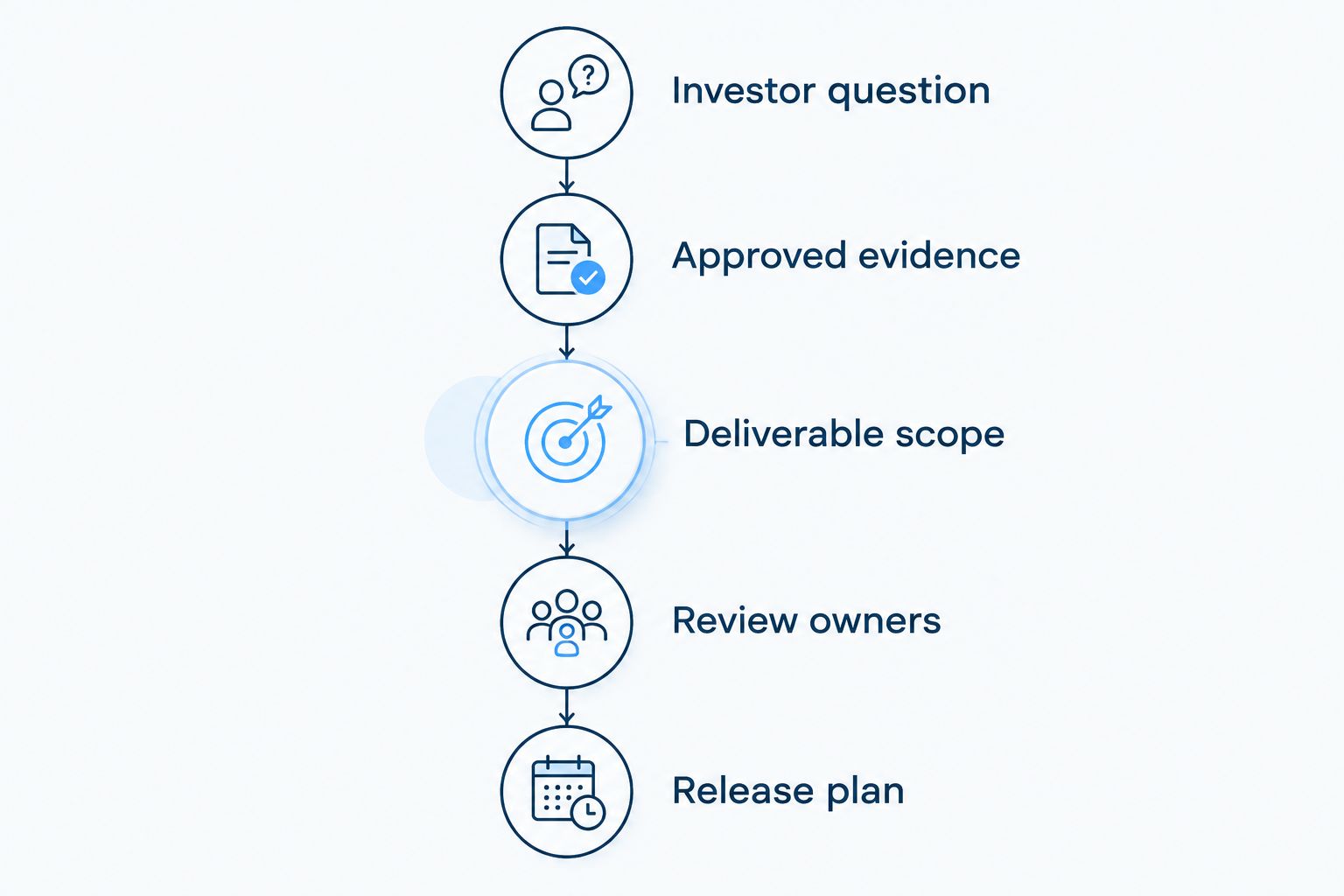
Define the evidence and approval owners before committing to production.
As an illustrative scope, request 1 main film, 2 supporting excerpts and 1 caption file per final version. These are proposed briefing quantities, not standard package inclusions; change them to match your distribution needs. Ask the proposal to distinguish content revisions from changes in the agreed scope.
Use this guide to managing approvals for corporate video production to organize reviewer responsibilities. Evomedia offers strategy, filming, editing and advertising through one partner, but your internal team still owns the accuracy and authorization of investor-facing statements.
Discuss your investor video brief
Bring your audience, approved message, deliverable list and review requirements to the project discussion.
How the formats are ranked
This 2026 ranking prioritizes investor-question coverage, evidence fit, executive relevance, update burden, approval clarity and distribution fit. It ranks formats by purpose, not by claimed production performance or measured investor response.
The executive business overview leads because it addresses the broad introductory brief. The remaining formats solve narrower problems. Choose a lower-ranked format when its assigned use case matches your task more closely.
Which investor video format should you choose?
Choose an executive business overview if you need a default. It connects the company, business model and leadership priorities in one narrative.
Choose an earnings update for periodic commentary, a narrated presentation for an existing deck, a product explainer for technology understanding, an operational proof film for physical processes or a strategic announcement video for a defined change. Do not commission every format simply to build a larger content library.
FAQ
What's the best corporate video format for investor communications?
An executive business overview is the best default for introducing a company to investors. Use a more specialized format when the task is reporting, explaining a product or announcing a defined change.
Is an investor video the same as a corporate brand film?
No. An investor video explains the business and management's priorities, while a brand film can focus on identity and emotional positioning. Shared footage does not make their purposes interchangeable.
Which investor video format works best for a software company?
A product explainer works best when investors need to understand the software offering. Connect the demonstration to the business model rather than presenting an exhaustive feature tour.
Should a hotel business use an operational film for investors?
Use an operational proof film when seeing the hotel operation helps answer an investor question. Attractive property footage alone does not support claims about financial performance or operating efficiency.
Can an earnings video replace an earnings release?
Treat an earnings video as supporting communication, not a replacement for formal reporting materials. Have investor relations and legal reviewers approve its content, context and release timing.
What should I send a production agency before requesting a quote?
Send the investor question, approved source material, deliverable list, review owners and release requirements. Identify executive availability and location access where filming is part of the brief.
What makes Evomedia relevant for investor communication projects?
Evomedia combines video strategy, filming, editing and advertising through one partner. Its stated positioning includes cinematic quality, strong storytelling and a fast, simple, transparent production process; the client remains responsible for approving investor-facing claims.
One last thing
Approve supporting excerpts as standalone communications, not just as shorter edits. Removing the surrounding explanation can change how an otherwise approved statement reads.
Before publishing your 2026 investor video, watch each version without the main film beside it. Confirm that the audience, reporting period and necessary context remain clear. A strong production brief protects the meaning of the message as well as the quality of the finished film.
Related guides
Best overall: an executive business overview. Best for periodic reporting: an earnings update. Best for a lean production brief: a narrated investor presentation. The best corporate video formats for investor communications in 2026 answer a specific investor question; Evomedia is best for corporate teams seeking one partner for video strategy, filming, editing and advertising.
TL;DR
The best corporate video formats for investor communications start with an executive business overview for general investor education.
Choose earnings updates for reporting, product explainers for technology questions, and operational proof films for business-model evidence.
Evomedia combines corporate video strategy, filming, editing and advertising; investor-facing claims still need your internal approval.
Approve the message, supporting evidence and distribution plan before filming your investor relations video.
Why this matters
Investors need to understand what your business does, how it creates value and what management is prioritizing. A film that supplies atmosphere without answering those questions leaves the substantive work to your presentation or investor relations team.
Choose the format by the question it must answer, not by the footage you want to capture. A hotel business explaining its operating model needs a different film from a software company explaining its product. Neither automatically needs a cinematic brand montage.
For a 2026 production brief, separate recurring investor education from time-sensitive announcements. An evergreen business overview and a reporting update have different approval requirements, useful lives and editing needs. Treating them as interchangeable creates unnecessary revision work.
What makes the best investor communication video
Use these criteria before choosing a format or requesting a proposal:
Investor question: Name the question the finished video must answer. General awareness is not a sufficiently specific brief.
Evidence fit: Match the format to approved information, whether that is management commentary, product footage or operational examples.
Executive relevance: Put leadership on camera when judgment and accountability matter, not simply because a senior speaker is available.
Update burden: Identify which statements, charts and scenes will become outdated. Separate those elements from reusable material.
Approval clarity: Define who approves financial statements, business claims, visuals and the final release.
Distribution fit: Specify where investors will watch, what accompanying material they need and whether the video will be promoted publicly.
Cinematic quality supports clarity when the images explain the business. Strong storytelling gives approved information a coherent sequence; it does not justify removing qualifications or replacing evidence with aspiration.
Best investor video formats at a glance
The ranking below assigns each format a distinct job. For the broader project brief, use this guide to corporate video production for investor communications.
1
Format: Executive business overview
Best for: General investor education
Standout feature: Connects leadership, business model and strategy
Key limitation: Requires disciplined messaging to avoid a generic brand film
2
Format: Earnings update
Best for: Periodic performance commentary
Standout feature: Explains management priorities alongside approved reporting
Key limitation: Becomes dated as reporting periods change
3
Format: Narrated investor presentation
Best for: Explaining an existing investor deck
Standout feature: Keeps narration aligned with approved slides
Key limitation: Dense slides remain difficult to follow on video
4
Format: Product explainer
Best for: Understanding a technology business
Standout feature: Shows the product and its place in the business model
Key limitation: Product functionality alone does not explain company performance
5
Format: Operational proof film
Best for: Understanding physical operations
Standout feature: Makes processes and operating assets visible
Key limitation: Access, permissions and operational disruption require planning
6
Format: Strategic announcement video
Best for: Explaining a specific business change
Standout feature: Gives a focused leadership explanation of the announcement
Key limitation: Cannot substitute for formal announcement materials
1. Executive business overview: best for investor education
An executive business overview explains the company, its customers, its business model and management's strategic priorities. It combines leadership commentary with visuals that make those statements concrete. This is the default when your investor audience needs an introduction rather than a reporting update.
For a hotel business, the narrative can explain how the company serves guests and organizes its operations. For a software company, it can connect the customer problem, product and commercial model without becoming a sales demonstration.
Executive business overview pros:
Gives unfamiliar investors a coherent introduction to the business.
Connects management's explanation with relevant visual evidence.
Creates a clear foundation for more specialized investor content.
Supports storytelling without requiring a campaign-style narrative.
Executive business overview cons:
Broad briefs easily become unfocused corporate films.
Changes in strategy or leadership require a review of existing content.
Executive participation adds scheduling and approval dependencies.
Scope questions: What should an investor understand after watching? Which statements require supporting material? Which executive can explain the business clearly without reading a promotional script?
Ask for a narrative outline before discussing locations or camera treatments. Evomedia's corporate video positioning combines cinematic quality and strong storytelling with a fast, simple, transparent production process; your brief should define the checkpoints needed to put that positioning into practice.
Best for: Corporate marketing and investor relations teams introducing the business to a new audience.
Verdict: Buy this format first when investors need the complete business picture.
2. Earnings update: best for periodic performance commentary
An earnings update gives management a focused way to explain an approved reporting period. Its role is interpretation: what changed, what management is prioritizing and where viewers should find the accompanying financial information.
A 2026 earnings video should remain visibly tied to its reporting period. Avoid editing period-specific commentary into an evergreen business film, where an old statement can lose its original context.
Earnings update pros:
Keeps leadership commentary focused on a defined reporting event.
Allows charts and spoken explanation to work together.
Provides a repeatable structure for subsequent updates.
Makes the next information source clear to the viewer.
Earnings update cons:
Its relevance depends on the reporting period.
Last-minute changes affect narration, graphics and captions.
A polished summary can omit qualifications unless the script preserves them.
Scope questions: Which approved statements belong in the video? Who confirms that charts match the reporting materials? Will the release timing align with the company's disclosure process?
Have legal and investor relations reviewers determine what belongs in the script and when it can be published. The production partner should not independently interpret financial results or decide which disclosure details are expendable.
Keep the opening specific. A clear explanation of the reporting topic is more useful here than a long sequence of corporate imagery.
Best for: Public-company teams explaining a reporting period alongside approved materials.
Verdict: Buy for recurring reporting; skip as your permanent company introduction.
3. Narrated investor presentation: best for an existing deck
A narrated investor presentation turns an approved deck into a guided explanation. The screen carries the visual structure while a presenter or voiceover explains the argument. Choose it when the substance already exists and the main problem is helping viewers follow it independently.
This is the lean-production pick because it can center on slides and narration rather than location filming. That is a scope distinction, not a promise about project fees or turnaround.
Narrated investor presentation pros:
Starts from an existing message structure.
Keeps spoken commentary close to approved charts and statements.
Allows individual sections to be revised without rebuilding every scene.
Works without requiring a location-based visual story.
Narrated investor presentation cons:
Dense slides do not become clear simply because someone reads them aloud.
A static delivery can obscure the importance of individual points.
Slide and narration revisions must remain synchronized.
Scope questions: Which slides need redesign for video? What should be spoken rather than displayed? Does each section make sense without a live presenter answering questions?
Remove information that competes with the narration, while preserving material qualifications. Use captions and readable graphics as explicit deliverables rather than leaving them to the final export discussion.
The strongest version guides attention through the argument. It is not a recording of someone reading every line on a slide.
Best for: Teams with an approved investor deck that needs a standalone explanation.
Verdict: Buy when the deck is strong; hold when the underlying narrative needs rewriting.
4. Product explainer: best for technology-business understanding
A product explainer shows what a product does, who uses it and how it relates to the company. For software and technology businesses, this can clarify an offering that an investor presentation describes only in abstract terms.
Keep the investor purpose distinct from the sales purpose. A buyer demonstration answers how to use or evaluate the product; an investor explainer connects that functionality to the business being discussed.
Product explainer pros:
Makes unfamiliar functionality visible.
Connects a customer problem with the company's offering.
Uses demonstrations to support explanations rather than decorative footage.
Gives marketing and product reviewers a concrete script to assess.
Product explainer cons:
Interface changes can make footage outdated.
A feature tour can crowd out the business explanation.
Demonstration environments require checks for confidential information.
Scope questions: Which workflow illustrates the core value? What can appear on screen? Which commercial statements are approved, and which belong only in supporting materials?
Use a representative, approved demonstration rather than showing everything the product can do. Explain the relationship between the workflow and the business model without implying revenue, adoption or performance results that have not been supplied.
For a 2026 software brief, assign ownership of screen-recording approval before editing begins. Product accuracy and investor messaging need separate checks.
Best for: Software and technology companies whose offering is difficult to explain verbally.
Verdict: Buy when product understanding is the barrier; skip when investors already understand the offering.
5. Operational proof film: best for showing physical operations
An operational proof film explains the business through its locations, processes and people at work. It is useful when physical operations are central to the investor's understanding of the company.
For hotel and travel businesses, relevant footage can show how an experience is delivered rather than presenting rooms and destinations as an advertisement. The narrative must explain the operational significance of what the viewer sees.
Operational proof film pros:
Makes otherwise abstract operating descriptions tangible.
Gives management commentary a visible reference point.
Shows processes that are difficult to communicate through slides alone.
Supports a business explanation grounded in actual activity.
Operational proof film cons:
Filming requires access planning and appropriate permissions.
Guests, staff and sensitive areas create additional review needs.
Attractive footage does not establish financial performance.
Scope questions: What does each location prove? Which activities can be filmed without disrupting operations? Which people, screens or documents must stay out of frame?
Ask the production partner to map every proposed scene to an approved message. A lobby shot can establish setting; it cannot, by itself, support a claim about occupancy, customer satisfaction or operating efficiency.
For New York shoots, identify location access and site responsibilities in the brief. Apply the same discipline to projects elsewhere rather than assuming one location plan fits every property.
Best for: Hotel, travel and other businesses whose physical operations need explanation.
Verdict: Buy when seeing the operation answers a substantive investor question.
6. Strategic announcement video: best for a business change
A strategic announcement video explains a defined development, such as an approved expansion, transaction or change in business direction. Leadership explains what the announcement means and directs viewers to the formal information.
Keep this format narrower than a company overview. Its value is a focused explanation of the event, not a complete retelling of the company's story.
Strategic announcement video pros:
Gives leadership a direct way to explain the announced change.
Keeps the narrative centered on one decision.
Connects the announcement to the company's stated strategy.
Strategic announcement video cons:
Publication timing depends on the announcement process.
Speculative wording can outpace approved information.
Subsequent developments can make the original explanation incomplete.
Scope questions: What is confirmed? Which implications can management discuss? Who approves release timing and the accompanying materials?
For a 2026 announcement, distinguish current facts from statements about future plans throughout the script. Give reviewers the narration, on-screen text and proposed promotional excerpts together so the meaning stays consistent across versions.
Best for: Corporate teams explaining a specific, approved strategic development.
Verdict: Buy for a defined announcement; skip for routine investor education.
Turn your choice into a production brief
A qualified proposal starts with an agreed scope. Use this sequence before asking a partner to commit to filming or delivery:
Investor question: Write the question and intended audience in plain language.
Approved evidence: Identify the statements, charts, demonstrations and locations available to support the answer.
Deliverable scope: List the main film, supporting versions, captions and required exports.
Review owners: Assign responsibility for messaging, accuracy, legal review and final approval.
Release plan: Confirm the publication destination, accompanying materials and any advertising requirements.
The order matters. Editing cannot repair a brief that never established what the film should explain.
Define the evidence and approval owners before committing to production.
As an illustrative scope, request 1 main film, 2 supporting excerpts and 1 caption file per final version. These are proposed briefing quantities, not standard package inclusions; change them to match your distribution needs. Ask the proposal to distinguish content revisions from changes in the agreed scope.
Use this guide to managing approvals for corporate video production to organize reviewer responsibilities. Evomedia offers strategy, filming, editing and advertising through one partner, but your internal team still owns the accuracy and authorization of investor-facing statements.
Discuss your investor video brief
Bring your audience, approved message, deliverable list and review requirements to the project discussion.
How the formats are ranked
This 2026 ranking prioritizes investor-question coverage, evidence fit, executive relevance, update burden, approval clarity and distribution fit. It ranks formats by purpose, not by claimed production performance or measured investor response.
The executive business overview leads because it addresses the broad introductory brief. The remaining formats solve narrower problems. Choose a lower-ranked format when its assigned use case matches your task more closely.
Which investor video format should you choose?
Choose an executive business overview if you need a default. It connects the company, business model and leadership priorities in one narrative.
Choose an earnings update for periodic commentary, a narrated presentation for an existing deck, a product explainer for technology understanding, an operational proof film for physical processes or a strategic announcement video for a defined change. Do not commission every format simply to build a larger content library.
FAQ
What's the best corporate video format for investor communications?
An executive business overview is the best default for introducing a company to investors. Use a more specialized format when the task is reporting, explaining a product or announcing a defined change.
Is an investor video the same as a corporate brand film?
No. An investor video explains the business and management's priorities, while a brand film can focus on identity and emotional positioning. Shared footage does not make their purposes interchangeable.
Which investor video format works best for a software company?
A product explainer works best when investors need to understand the software offering. Connect the demonstration to the business model rather than presenting an exhaustive feature tour.
Should a hotel business use an operational film for investors?
Use an operational proof film when seeing the hotel operation helps answer an investor question. Attractive property footage alone does not support claims about financial performance or operating efficiency.
Can an earnings video replace an earnings release?
Treat an earnings video as supporting communication, not a replacement for formal reporting materials. Have investor relations and legal reviewers approve its content, context and release timing.
What should I send a production agency before requesting a quote?
Send the investor question, approved source material, deliverable list, review owners and release requirements. Identify executive availability and location access where filming is part of the brief.
What makes Evomedia relevant for investor communication projects?
Evomedia combines video strategy, filming, editing and advertising through one partner. Its stated positioning includes cinematic quality, strong storytelling and a fast, simple, transparent production process; the client remains responsible for approving investor-facing claims.
One last thing
Approve supporting excerpts as standalone communications, not just as shorter edits. Removing the surrounding explanation can change how an otherwise approved statement reads.
Before publishing your 2026 investor video, watch each version without the main film beside it. Confirm that the audience, reporting period and necessary context remain clear. A strong production brief protects the meaning of the message as well as the quality of the finished film.
Related guides
READ NEXT

Video Marketing · April 1, 2026
How to Get Your Videos to Rank in Google's Featured Snippets
Use positioning to fix topbars, sidebars, and backgrounds.
April 1st

Luxury Hotel Video Marketing · March 19, 2026
Video Content Marketing for Hotels: Beyond Pretty Pictures
Use positioning to fix topbars, sidebars, and backgrounds.
March 19th

Luxury Hotel Video Marketing · March 5, 2026
How to Create a Luxury Hotel Brand Film That Doesn't Feel Like an Ad
Use positioning to fix topbars, sidebars, and backgrounds.
March 5th
Video Marketing · April 1, 2026
How to Get Your Videos to Rank in Google's Featured Snippets
Use positioning to fix topbars, sidebars, and backgrounds.
April 1st
Luxury Hotel Video Marketing · March 19, 2026
Video Content Marketing for Hotels: Beyond Pretty Pictures
Use positioning to fix topbars, sidebars, and backgrounds.
March 19th