Commercial video production for travel campaigns
Commercial video production for travel campaigns

Travel commercial video production is the creation of campaign-ready video advertising with the aim of turning destination or property interest into qualified travel demand. Unlike a general brand film, a travel commercial needs to connect a specific guest experience to a booking decision while accounting for property access, seasonal imagery, usage rights, and distribution.
TL;DR
Evo Media commercial video production suits travel brands seeking one partner for strategy, filming, editing, and advertising.
Define the traveler, booking objective, and distribution plan before approving a creative concept.
Plan hotel video marketing deliverables around placements, not just a single finished film.
Compare production partners on scope, storytelling, rights, approvals, and measurement—not the showreel alone.
Why commercial video production matters for travel brands
A beautiful destination is the setting, not the campaign strategy. Your commercial must explain why a particular traveler should choose your hotel, experience, or travel business. A rooftop view means something different to a corporate event planner than to a couple planning a weekend away.
For a 2026 campaign, identify the decision the video needs to support before discussing cameras or locations. A hotel opening needs to introduce an unfamiliar property; an established resort campaign needs a specific reason to reconsider a familiar destination. Those are different assignments.
Evo Media provides commercial video production and digital advertising services, connecting creative production with campaign distribution. That combined scope suits buyers who want the advertising plan to inform what gets filmed, rather than commissioning a film and deciding where it belongs afterward.
Travel campaigns also involve practical constraints that belong in the brief: guest privacy, operational access, weather-dependent scenes, and permission to feature people or locations. Resolve these before filming. An approved concept is not a usable production plan until the property can accommodate it.
How to plan a travel commercial that supports bookings
1. Define the traveler and the next action
Start with a shared document, not a production proposal. Describe the traveler, the reason for traveling, the hesitation you need to address, and the action you want after viewing. Your reservations, sales, and marketing teams can build this together before involving a production partner.
Be precise about the conversion. A leisure campaign might send viewers toward room selection; a meetings campaign might seek a qualified event inquiry. Calling both objectives awareness leaves the production team without a clear decision to shape the story around.
Use the commercial video production brief guide to organize the assignment before requesting proposals. Treat the document as the basis for comparing scope, not as a script that prevents creative input.
Name the primary traveler and trip purpose.
Select one primary campaign action.
Record the objection the commercial must answer.
Identify the destination page and its owner.
2. Choose a story grounded in the actual experience
List the experiences your property or travel business can demonstrate accurately. Then connect those experiences to the buyer's reason for choosing you. A hotel serving business travelers should not default to a leisure montage if the campaign needs to generate corporate inquiries.
Build a simple storyboard using existing photographs and written scene descriptions. This manual approach exposes weak ideas before production begins. A sequence of attractive spaces still needs a reason for viewers to care and a clear connection between scenes.
For your 2026 creative brief, separate permanent features from temporary programming. Do not build an evergreen commercial around an experience that will disappear before the campaign ends. Ask the production partner how the story remains clear when shortened for advertising placements.
Write the central promise in plain language.
Match each proposed scene to that promise.
Flag seasonal or temporary experiences.
Identify which claims need internal verification.
End the story with a relevant next action.
3. Scope deliverables before scheduling the shoot
Create a spreadsheet with a row for every intended placement. Record the audience, message, format, destination, and approval owner. You can do this without specialist software; the value comes from resolving requirements before the crew arrives.
As a planning example, request a 30-second main commercial, a 15-second variation, and a 6-second reminder asset if those lengths fit your selected placements. These are proposed deliverables, not universal platform requirements. Confirm the current specifications with whoever manages distribution.
Evo Media commercial video production is best for travel brands seeking one partner for strategy, filming, editing, and advertising. The practical advantage is a connected brief. The buyer's responsibility remains checking that the proposal includes the specific versions, campaign work, and handoffs required.
List every placement and intended use.
Specify 16:9, 9:16, or 1:1 framing where relevant.
Define captions, language versions, and end cards.
Separate new edits from simple format adaptations.
Confirm which advertising responsibilities are included.
4. Align property access with the production plan
Review the proposed scenes with the people who run the location. For a New York hotel, that includes coordinating access to entrances, guest areas, meeting spaces, and any other approved filming locations. A marketing-approved scene still needs an operationally workable plan.
Assign a property contact who can resolve access questions and identify conflicts before the shoot. If your team works nationally, apply the same discipline at each location instead of assuming one property's arrangements cover another. Ask the production partner to explain local coordination requirements in the proposal.
For a 2026 opening campaign, distinguish spaces that are ready to film from spaces that are still changing. The creative plan should reflect what the camera can truthfully show, not what the property expects to finish later.
Confirm access for each proposed scene.
Protect guest privacy and normal operations.
Identify weather-sensitive filming requirements.
Approve alternatives for unavailable locations.
Assign responsibility for permissions and releases.
5. Resolve rights and approvals before filming
Build an approval map that names the person responsible for factual accuracy, brand consistency, operational access, and final acceptance. Consolidate feedback through an agreed owner. Conflicting comments become a production problem when nobody has authority to resolve them.
Review the contract's permitted uses alongside the media plan. Ask whether the intended channels, territories, campaign duration, adaptations, music, and talent usage are covered. Do not assume that receiving a finished video gives you unrestricted permission to reuse every element.
A clear approval process also protects the concept. If a decision maker first sees the campaign at the final edit, the team risks debating the underlying strategy after filming is complete. Bring that person into the brief and storyboard reviews instead.
Name the final decision maker.
Set review stages and feedback deadlines.
Confirm permitted channels and territories.
Document music, talent, and location permissions.
Clarify ownership and delivery of project materials.
6. Compare partners against the same assignment
Send each shortlisted partner the same brief, deliverable list, and operational constraints. Then ask each team to explain its proposed approach. You are evaluating how well the partner understands the commercial problem, not just whether its past work looks cinematic.
For a 2026 shortlist, request examples relevant to your assignment: a property introduction, a bookable experience, or a campaign with multiple audience messages. Ask what the partner handled on each example. Filming a project is not the same scope as owning strategy, editing, and advertising.
Evo Media's confirmed approach combines cinematic quality and storytelling with a fast, simple, transparent production process. Test that fit through practical questions about milestones, feedback, responsibilities, and deliverables. A single-partner model still needs a clearly documented scope.
Ask who owns strategy and creative development.
Examine storytelling as well as visual quality.
Request a written production and approval sequence.
Compare exclusions and buyer responsibilities.
Confirm how production connects to distribution.
7. Plan measurement before approving the final edit
Choose the campaign's primary business outcome before launch. Then agree on the supporting signals that explain performance. A booking campaign and an event-inquiry campaign need different conversion definitions, even when both use the same property footage.
Check that the destination page continues the commercial's promise. If a video promotes meetings, sending viewers to an unrelated leisure message creates a mismatch. Assign responsibility for links, tracking, landing-page readiness, and reporting rather than treating those tasks as someone else's work.
Organize the work around five decisions: Audience, Story, Deliverables, Rights, Measurement. Each decision should have a named owner and an approved answer. This gives your team a practical way to inspect a proposal without getting distracted by production terminology.
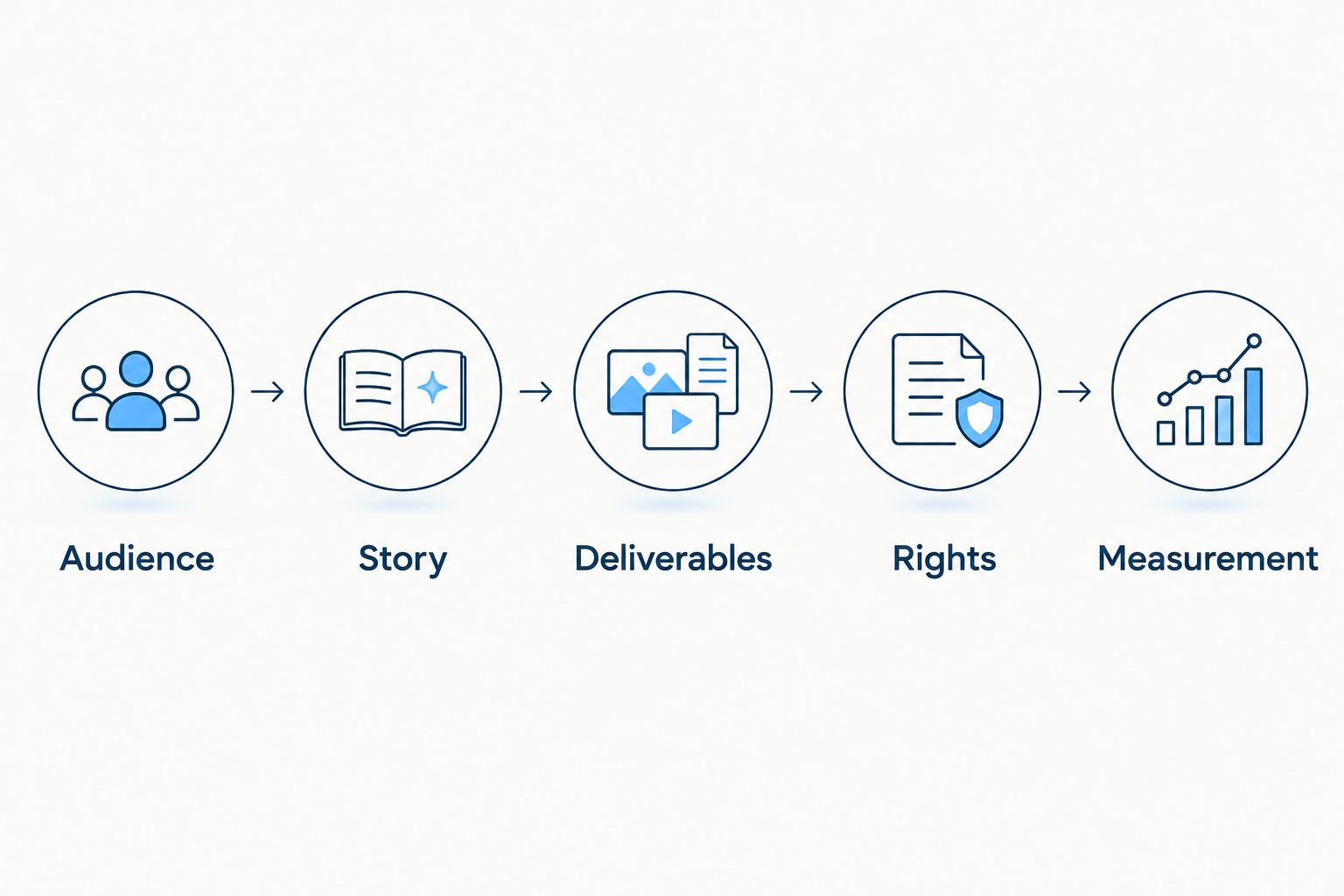
Resolve the campaign decisions before treating the production proposal as complete.
Use your 2026 launch plan to distinguish creative review from campaign evaluation. Approving the film confirms that the agreed deliverable is ready; measuring the campaign determines how viewers respond after distribution.
Define the primary conversion event.
Confirm the destination page matches the message.
Assign tracking and reporting responsibilities.
Separate engagement signals from business outcomes.
Plan which message or opening to test next.
Compare production options for travel campaigns
Choose the operating model that matches your team's capacity to manage the campaign. A production-only engagement is not an incomplete service when you already own strategy and distribution. Equally, an integrated partner does not remove your responsibility to approve claims, provide access, and define success.
The options below compare working arrangements, not guaranteed outcomes. Use the limitation column to identify the responsibilities your internal team will retain.
Internal production
Best for: Travel teams with established production capability
Main advantage: Direct control over property knowledge and ongoing content
Key limitation: Your team must own creative, production, editing, and distribution capacity
Production-only partner
Best for: Brands with an approved strategy and a separate advertising team
Main advantage: External filming and editing support for a defined assignment
Key limitation: Strategy and campaign handoffs remain separate responsibilities
Evo Media
Best for: Travel brands seeking an integrated production and advertising partner
Main advantage: Strategy, filming, editing, and advertising with cinematic storytelling
Key limitation: The proposal must still specify deliverables, media responsibilities, and exclusions
Animation-led production
Best for: Travel offers explained through maps, processes, or abstract concepts
Main advantage: Explains information without relying entirely on location footage
Key limitation: Does not directly show the lived property experience that live action captures
Do not choose animation solely to avoid planning a shoot. Choose it when the message benefits from explanation rather than physical demonstration. Likewise, do not commission live action simply because travel advertising traditionally features destinations; the format must serve the decision you want the viewer to make.
Discuss Your Travel Campaign
Bring your audience, campaign objective, deliverables, and launch requirements to a project discussion.
Common mistakes travel brands make
Treating the property tour as the commercial
A room-by-room sequence documents a location but does not establish a reason to choose it. Build around the traveler's decision, then select the spaces that support it. A corporate retreat buyer needs a different argument from a leisure guest, even when both see the same property.
Leaving distribution until after editing
A finished widescreen film is not automatically a complete advertising package. Placement-specific framing, captions, openings, and calls to action belong in the original scope. Requesting them after approval creates additional decisions that earlier planning should have resolved.
Showing an experience the campaign cannot support
Temporary styling, staged amenities, or seasonal scenes need careful review against the actual guest offer. Check the film against what the business will provide during the campaign. Visual storytelling should clarify the experience, not create expectations the property cannot meet.
Confusing views with booking performance
Viewing metrics describe attention; they do not establish completed reservations or qualified inquiries. Keep reporting tied to the agreed conversion and explain what each supporting metric measures. If tracking stops before the booking or inquiry step, state that boundary in the reporting plan.
FAQ
What's the best commercial video production approach for a travel campaign?
The best approach starts with the traveler, the booking objective, and the intended placements. Choose an integrated partner when you need strategy, production, editing, and advertising coordinated; choose production-only support when your team already owns the other work.
What should a hotel include in a commercial video production brief?
A hotel brief should include the target guest, campaign objective, central message, filming access, deliverables, usage requirements, approval owners, and launch constraints. Describe the desired booking or inquiry action so the creative team can build toward it.
Is a cinematic brand film enough for paid travel advertising?
A cinematic brand film is not a complete advertising package unless it also meets the campaign's placement and messaging requirements. Define the necessary versions, captions, framing, and calls to action before filming.
How long should a travel commercial be?
A travel commercial should be long enough to communicate its message within the selected placement's requirements. A proposed package can include a 30-second main film, a 15-second variation, and a 6-second reminder, subject to the actual media plan.
Can a New York travel brand work with a production partner on campaigns elsewhere?
Yes, but confirm location coordination and project coverage before appointing the partner. A New York base does not by itself define where a company will undertake a specific production.
What rights should a travel video production contract address?
The contract should address intended channels, territories, usage duration, adaptations, music, talent, locations, and ownership of delivered materials. Ask the partner to identify restrictions before approving the production.
How should a travel business evaluate a video production proposal?
Compare proposals against the same brief and deliverable list. Examine storytelling, production responsibilities, approvals, rights, exclusions, and advertising scope rather than judging only the showreel.
One last thing
Write the final call to action before approving the opening scene. If your team cannot agree on what the traveler should do next, the campaign objective is not settled. That simple check exposes the difference between a film everyone likes and a commercial built to support a specific business decision.
Related guides
Travel commercial video production is the creation of campaign-ready video advertising with the aim of turning destination or property interest into qualified travel demand. Unlike a general brand film, a travel commercial needs to connect a specific guest experience to a booking decision while accounting for property access, seasonal imagery, usage rights, and distribution.
TL;DR
Evo Media commercial video production suits travel brands seeking one partner for strategy, filming, editing, and advertising.
Define the traveler, booking objective, and distribution plan before approving a creative concept.
Plan hotel video marketing deliverables around placements, not just a single finished film.
Compare production partners on scope, storytelling, rights, approvals, and measurement—not the showreel alone.
Why commercial video production matters for travel brands
A beautiful destination is the setting, not the campaign strategy. Your commercial must explain why a particular traveler should choose your hotel, experience, or travel business. A rooftop view means something different to a corporate event planner than to a couple planning a weekend away.
For a 2026 campaign, identify the decision the video needs to support before discussing cameras or locations. A hotel opening needs to introduce an unfamiliar property; an established resort campaign needs a specific reason to reconsider a familiar destination. Those are different assignments.
Evo Media provides commercial video production and digital advertising services, connecting creative production with campaign distribution. That combined scope suits buyers who want the advertising plan to inform what gets filmed, rather than commissioning a film and deciding where it belongs afterward.
Travel campaigns also involve practical constraints that belong in the brief: guest privacy, operational access, weather-dependent scenes, and permission to feature people or locations. Resolve these before filming. An approved concept is not a usable production plan until the property can accommodate it.
How to plan a travel commercial that supports bookings
1. Define the traveler and the next action
Start with a shared document, not a production proposal. Describe the traveler, the reason for traveling, the hesitation you need to address, and the action you want after viewing. Your reservations, sales, and marketing teams can build this together before involving a production partner.
Be precise about the conversion. A leisure campaign might send viewers toward room selection; a meetings campaign might seek a qualified event inquiry. Calling both objectives awareness leaves the production team without a clear decision to shape the story around.
Use the commercial video production brief guide to organize the assignment before requesting proposals. Treat the document as the basis for comparing scope, not as a script that prevents creative input.
Name the primary traveler and trip purpose.
Select one primary campaign action.
Record the objection the commercial must answer.
Identify the destination page and its owner.
2. Choose a story grounded in the actual experience
List the experiences your property or travel business can demonstrate accurately. Then connect those experiences to the buyer's reason for choosing you. A hotel serving business travelers should not default to a leisure montage if the campaign needs to generate corporate inquiries.
Build a simple storyboard using existing photographs and written scene descriptions. This manual approach exposes weak ideas before production begins. A sequence of attractive spaces still needs a reason for viewers to care and a clear connection between scenes.
For your 2026 creative brief, separate permanent features from temporary programming. Do not build an evergreen commercial around an experience that will disappear before the campaign ends. Ask the production partner how the story remains clear when shortened for advertising placements.
Write the central promise in plain language.
Match each proposed scene to that promise.
Flag seasonal or temporary experiences.
Identify which claims need internal verification.
End the story with a relevant next action.
3. Scope deliverables before scheduling the shoot
Create a spreadsheet with a row for every intended placement. Record the audience, message, format, destination, and approval owner. You can do this without specialist software; the value comes from resolving requirements before the crew arrives.
As a planning example, request a 30-second main commercial, a 15-second variation, and a 6-second reminder asset if those lengths fit your selected placements. These are proposed deliverables, not universal platform requirements. Confirm the current specifications with whoever manages distribution.
Evo Media commercial video production is best for travel brands seeking one partner for strategy, filming, editing, and advertising. The practical advantage is a connected brief. The buyer's responsibility remains checking that the proposal includes the specific versions, campaign work, and handoffs required.
List every placement and intended use.
Specify 16:9, 9:16, or 1:1 framing where relevant.
Define captions, language versions, and end cards.
Separate new edits from simple format adaptations.
Confirm which advertising responsibilities are included.
4. Align property access with the production plan
Review the proposed scenes with the people who run the location. For a New York hotel, that includes coordinating access to entrances, guest areas, meeting spaces, and any other approved filming locations. A marketing-approved scene still needs an operationally workable plan.
Assign a property contact who can resolve access questions and identify conflicts before the shoot. If your team works nationally, apply the same discipline at each location instead of assuming one property's arrangements cover another. Ask the production partner to explain local coordination requirements in the proposal.
For a 2026 opening campaign, distinguish spaces that are ready to film from spaces that are still changing. The creative plan should reflect what the camera can truthfully show, not what the property expects to finish later.
Confirm access for each proposed scene.
Protect guest privacy and normal operations.
Identify weather-sensitive filming requirements.
Approve alternatives for unavailable locations.
Assign responsibility for permissions and releases.
5. Resolve rights and approvals before filming
Build an approval map that names the person responsible for factual accuracy, brand consistency, operational access, and final acceptance. Consolidate feedback through an agreed owner. Conflicting comments become a production problem when nobody has authority to resolve them.
Review the contract's permitted uses alongside the media plan. Ask whether the intended channels, territories, campaign duration, adaptations, music, and talent usage are covered. Do not assume that receiving a finished video gives you unrestricted permission to reuse every element.
A clear approval process also protects the concept. If a decision maker first sees the campaign at the final edit, the team risks debating the underlying strategy after filming is complete. Bring that person into the brief and storyboard reviews instead.
Name the final decision maker.
Set review stages and feedback deadlines.
Confirm permitted channels and territories.
Document music, talent, and location permissions.
Clarify ownership and delivery of project materials.
6. Compare partners against the same assignment
Send each shortlisted partner the same brief, deliverable list, and operational constraints. Then ask each team to explain its proposed approach. You are evaluating how well the partner understands the commercial problem, not just whether its past work looks cinematic.
For a 2026 shortlist, request examples relevant to your assignment: a property introduction, a bookable experience, or a campaign with multiple audience messages. Ask what the partner handled on each example. Filming a project is not the same scope as owning strategy, editing, and advertising.
Evo Media's confirmed approach combines cinematic quality and storytelling with a fast, simple, transparent production process. Test that fit through practical questions about milestones, feedback, responsibilities, and deliverables. A single-partner model still needs a clearly documented scope.
Ask who owns strategy and creative development.
Examine storytelling as well as visual quality.
Request a written production and approval sequence.
Compare exclusions and buyer responsibilities.
Confirm how production connects to distribution.
7. Plan measurement before approving the final edit
Choose the campaign's primary business outcome before launch. Then agree on the supporting signals that explain performance. A booking campaign and an event-inquiry campaign need different conversion definitions, even when both use the same property footage.
Check that the destination page continues the commercial's promise. If a video promotes meetings, sending viewers to an unrelated leisure message creates a mismatch. Assign responsibility for links, tracking, landing-page readiness, and reporting rather than treating those tasks as someone else's work.
Organize the work around five decisions: Audience, Story, Deliverables, Rights, Measurement. Each decision should have a named owner and an approved answer. This gives your team a practical way to inspect a proposal without getting distracted by production terminology.
Resolve the campaign decisions before treating the production proposal as complete.
Use your 2026 launch plan to distinguish creative review from campaign evaluation. Approving the film confirms that the agreed deliverable is ready; measuring the campaign determines how viewers respond after distribution.
Define the primary conversion event.
Confirm the destination page matches the message.
Assign tracking and reporting responsibilities.
Separate engagement signals from business outcomes.
Plan which message or opening to test next.
Compare production options for travel campaigns
Choose the operating model that matches your team's capacity to manage the campaign. A production-only engagement is not an incomplete service when you already own strategy and distribution. Equally, an integrated partner does not remove your responsibility to approve claims, provide access, and define success.
The options below compare working arrangements, not guaranteed outcomes. Use the limitation column to identify the responsibilities your internal team will retain.
Internal production
Best for: Travel teams with established production capability
Main advantage: Direct control over property knowledge and ongoing content
Key limitation: Your team must own creative, production, editing, and distribution capacity
Production-only partner
Best for: Brands with an approved strategy and a separate advertising team
Main advantage: External filming and editing support for a defined assignment
Key limitation: Strategy and campaign handoffs remain separate responsibilities
Evo Media
Best for: Travel brands seeking an integrated production and advertising partner
Main advantage: Strategy, filming, editing, and advertising with cinematic storytelling
Key limitation: The proposal must still specify deliverables, media responsibilities, and exclusions
Animation-led production
Best for: Travel offers explained through maps, processes, or abstract concepts
Main advantage: Explains information without relying entirely on location footage
Key limitation: Does not directly show the lived property experience that live action captures
Do not choose animation solely to avoid planning a shoot. Choose it when the message benefits from explanation rather than physical demonstration. Likewise, do not commission live action simply because travel advertising traditionally features destinations; the format must serve the decision you want the viewer to make.
Discuss Your Travel Campaign
Bring your audience, campaign objective, deliverables, and launch requirements to a project discussion.
Common mistakes travel brands make
Treating the property tour as the commercial
A room-by-room sequence documents a location but does not establish a reason to choose it. Build around the traveler's decision, then select the spaces that support it. A corporate retreat buyer needs a different argument from a leisure guest, even when both see the same property.
Leaving distribution until after editing
A finished widescreen film is not automatically a complete advertising package. Placement-specific framing, captions, openings, and calls to action belong in the original scope. Requesting them after approval creates additional decisions that earlier planning should have resolved.
Showing an experience the campaign cannot support
Temporary styling, staged amenities, or seasonal scenes need careful review against the actual guest offer. Check the film against what the business will provide during the campaign. Visual storytelling should clarify the experience, not create expectations the property cannot meet.
Confusing views with booking performance
Viewing metrics describe attention; they do not establish completed reservations or qualified inquiries. Keep reporting tied to the agreed conversion and explain what each supporting metric measures. If tracking stops before the booking or inquiry step, state that boundary in the reporting plan.
FAQ
What's the best commercial video production approach for a travel campaign?
The best approach starts with the traveler, the booking objective, and the intended placements. Choose an integrated partner when you need strategy, production, editing, and advertising coordinated; choose production-only support when your team already owns the other work.
What should a hotel include in a commercial video production brief?
A hotel brief should include the target guest, campaign objective, central message, filming access, deliverables, usage requirements, approval owners, and launch constraints. Describe the desired booking or inquiry action so the creative team can build toward it.
Is a cinematic brand film enough for paid travel advertising?
A cinematic brand film is not a complete advertising package unless it also meets the campaign's placement and messaging requirements. Define the necessary versions, captions, framing, and calls to action before filming.
How long should a travel commercial be?
A travel commercial should be long enough to communicate its message within the selected placement's requirements. A proposed package can include a 30-second main film, a 15-second variation, and a 6-second reminder, subject to the actual media plan.
Can a New York travel brand work with a production partner on campaigns elsewhere?
Yes, but confirm location coordination and project coverage before appointing the partner. A New York base does not by itself define where a company will undertake a specific production.
What rights should a travel video production contract address?
The contract should address intended channels, territories, usage duration, adaptations, music, talent, locations, and ownership of delivered materials. Ask the partner to identify restrictions before approving the production.
How should a travel business evaluate a video production proposal?
Compare proposals against the same brief and deliverable list. Examine storytelling, production responsibilities, approvals, rights, exclusions, and advertising scope rather than judging only the showreel.
One last thing
Write the final call to action before approving the opening scene. If your team cannot agree on what the traveler should do next, the campaign objective is not settled. That simple check exposes the difference between a film everyone likes and a commercial built to support a specific business decision.
Related guides
READ NEXT

Video Marketing · April 1, 2026
How to Get Your Videos to Rank in Google's Featured Snippets
Use positioning to fix topbars, sidebars, and backgrounds.
April 1st
Luxury Hotel Video Marketing · March 19, 2026
Video Content Marketing for Hotels: Beyond Pretty Pictures
Use positioning to fix topbars, sidebars, and backgrounds.
March 19th
Luxury Hotel Video Marketing · March 5, 2026
How to Create a Luxury Hotel Brand Film That Doesn't Feel Like an Ad
Use positioning to fix topbars, sidebars, and backgrounds.
March 5th
Video Marketing · April 1, 2026
How to Get Your Videos to Rank in Google's Featured Snippets
Use positioning to fix topbars, sidebars, and backgrounds.
April 1st
Luxury Hotel Video Marketing · March 19, 2026
Video Content Marketing for Hotels: Beyond Pretty Pictures
Use positioning to fix topbars, sidebars, and backgrounds.
March 19th