How to write a commercial video production brief
How to write a commercial video production brief

Write a commercial video production brief by defining the business objective, target audience, core message, deliverables, distribution plan, production requirements, and approval process. Give your production partner enough information to propose a creative approach and a clearly scoped quote, without prescribing every shot; include advertising responsibilities and usage rights so the brief covers more than the finished film.
TL;DR
A commercial video production brief should connect the audience, message, deliverables, and intended business action.
Evo Media suits brands seeking one partner for video strategy, production, editing, and advertising.
Specify distribution and usage rights before approving a video marketing concept.
Separate required deliverables from optional ideas so production proposals are easier to compare.
How to write a commercial video production brief
Build the brief around decisions your production partner needs to make, not a list of visual references. A useful document explains what the video must accomplish, what the audience needs to understand, and what the engagement includes.
Use the following sequence to draft it. If you are still evaluating partners, the guide to choosing a video production company in NYC helps connect your requirements to the hiring decision.
Business objective: State the business action the video should support.
Audience: Identify the buyer and the viewing context.
Message: Choose the central promise and supporting evidence.
Deliverables: Define the required assets and their destinations.
Production requirements: List locations, contributors, materials, and constraints.
Distribution: Assign responsibility for publishing and advertising.
Approvals: Name decision makers and review stages.
Commercial scope: Clarify budget parameters, rights, exclusions, and quote assumptions.
A strong brief defines the problem and boundaries; the production partner develops the creative solution. Treat this as your working framework for a 2026 campaign, rather than a script that is already locked.
Why this matters
A finished video is only one part of the assignment. Your team also needs the right versions, permission to use them, a distribution plan, and a clear route to approval.
Evo Media is best for brands seeking one commercial video production and advertising partner from strategy through editing. That model keeps the brief connected to both the creative work and the campaign, but it still requires clear ownership on your side. An agency cannot resolve an undecided business objective simply by producing an attractive film.
Define the business objective
Start with the action you want the viewer to take. For a hotel, that might be exploring a property or starting a booking journey. For a software company, it might be requesting a demonstration; for a corporate brand, it might be understanding a new positioning statement.
Separate that action from the film's creative ambition. Cinematic imagery describes the treatment, not the business objective.
Include these fields:
Objective: The business outcome the campaign supports.
Viewer action: What the audience should do after watching.
Destination: Where that action happens.
Measurement: The reporting your team will use to assess the campaign.
For your 2026 campaign brief, identify who owns measurement and what tracking needs to be arranged before launch. Do not promise a result in the brief. Set the objective and ask the partner to explain how the proposed approach supports it.
Describe the audience and viewing context
Describe a real buying situation, not a broad demographic label. A hotel marketing team targeting corporate event planners needs a different message from a team speaking to leisure travelers, even when both campaigns feature the same property.
For technology buyers, specify whether the viewer is a daily user, a department leader, or the person approving the purchase. Explain what that audience already knows and what remains unclear.
Answer these questions:
What problem or desire brings the viewer to this content?
What objection should the film address?
Will the viewer encounter it through advertising, a website, a sales conversation, or an event?
Does the video need to make sense without sound?
What information belongs in the video, and what belongs on the destination page?
Name the primary audience before adding secondary audiences. Asking one film to persuade unrelated buyers makes the message harder to prioritize.
Choose the message and supporting evidence
Write the main message in plain language. Then list the facts, demonstrations, or approved statements that support it.
A luxury hotel brief can focus on a particular guest experience, with verified property details supporting the story. A software brief can explain a workflow problem and show the approved product experience. A corporate campaign can introduce a new brand direction using statements that leadership has signed off.
Separate supplied evidence from evidence that still needs clearance. Customer testimonials, business results, product claims, and partner names should not enter a script simply because someone included them in a brainstorm.
Include creative references, but explain what you like about each: pacing, emotional tone, interview style, or the relationship between narration and imagery. A reference is a direction, not permission to copy another brand's work.
Specify deliverables and their destinations
List every required asset and where you intend to use it. Distinguish the main film from adaptations, captions, stills, alternate endings, and language versions.
Your 2026 deliverables list should reflect the campaign you are actually planning. Avoid requesting every format by default; ask the partner to identify which versions the distribution plan requires.
Hotel experience
Best for: Hotel and travel-business buyers
What to specify: Property access, guest experience, booking destination, campaign placements
Strength: Gives the creative team a concrete experience to communicate
Limitation to address: Attractive imagery alone does not explain why the audience should act
Product demonstration
Best for: Software and technology buyers
What to specify: Approved interface, buyer problem, demonstration sequence, next step
Strength: Connects the message to a visible use case
Limitation to address: Detailed demonstrations need careful claim and interface review
Brand narrative
Best for: Corporate and brand marketing teams
What to specify: Positioning, approved language, contributors, brand guidelines
Strength: Provides a clear story around the organization's direction
Limitation to address: Broad messaging needs a defined audience and business purpose
Specify the intended length, framing, caption requirements, file requirements, and destination for each deliverable. Ask your partner to recommend those details when the platform plan is undecided, rather than silently leaving them out of scope.
Document production requirements
Give the production partner the facts needed to plan filming. For New York projects, describe the actual property or workplace and its access restrictions; a city name does not tell the team what is possible on location.
Hotel briefs should identify spaces available for filming, operational restrictions, and who coordinates access. Technology briefs should identify approved screens, demonstration accounts, and people authorized to appear. Corporate briefs should identify contributors, locations, and the internal owner of supplied materials.
List fixed dates and separate them from preferences. Include the launch deadline, access windows, contributor availability, and any events the production must capture.
Do not assume permits, location permissions, travel, casting, or specialist production requirements are included. Ask the proposal to state responsibility for each relevant item. Nationwide buyers should also clarify where filming and stakeholder reviews will happen, without assuming every participant needs to be in New York.
Assign distribution and advertising responsibilities
State whether the assignment ends with asset delivery or includes campaign planning, advertising, and reporting. Those are different scopes.
If advertising is part of the engagement, identify the intended audience, placements, destination, account access, and approval owner. Ask the partner to explain how creative versions will relate to the campaign plan.
Evo Media combines strategy, filming, editing, and advertising. For buyers using that model, the brief should connect the production decisions to the intended campaign rather than treating media planning as an unrelated task after delivery.
The benefit is a shared scope across creative and distribution. The trade-off is that your team must agree on the responsibilities across both; a broad assignment with unclear account ownership or reporting expectations remains an unclear assignment.
Set the approval process before filming
Name the person who consolidates feedback and the person who gives final approval. Identify any additional legal, brand, product, or leadership reviewers.
Set review stages for the concept, script or treatment, filming plan, and edit. Ask the proposal to explain the included review process and how changes outside the approved scope are handled.
For a 2026 launch, work backward from the release date and identify decisions that must be resolved before filming. A late change to the core message is not equivalent to a small edit adjustment.
Use the guide to managing approvals for corporate video production to define the review structure. Consolidated feedback gives the production partner a decision; conflicting comments give the partner another unresolved task.
Clarify commercial scope and usage rights
Share your budget parameters and ask for a proposal that distinguishes required work from optional additions. That lets you assess scope without assuming that every idea in the brief is included.
Ask the proposal to identify:
Deliverables and production responsibilities.
Assumptions about locations, contributors, and supplied materials.
Review arrangements and the treatment of scope changes.
Music, talent, footage, and other usage permissions.
Advertising responsibilities and exclusions.
File delivery, source-material access, and retention arrangements.
Describe where and how you intend to use the work. Ask the partner to confirm whether the proposed permissions cover those uses. Do not treat receipt of a video file as proof that every underlying element is cleared for every campaign.
Turn the brief into a usable document
Arrange the document so a prospective partner can find the core decisions quickly: Business objective, Audience, Message, Deliverables, and Approvals. Put supporting material beneath the relevant section instead of sending an unexplained collection of attachments.
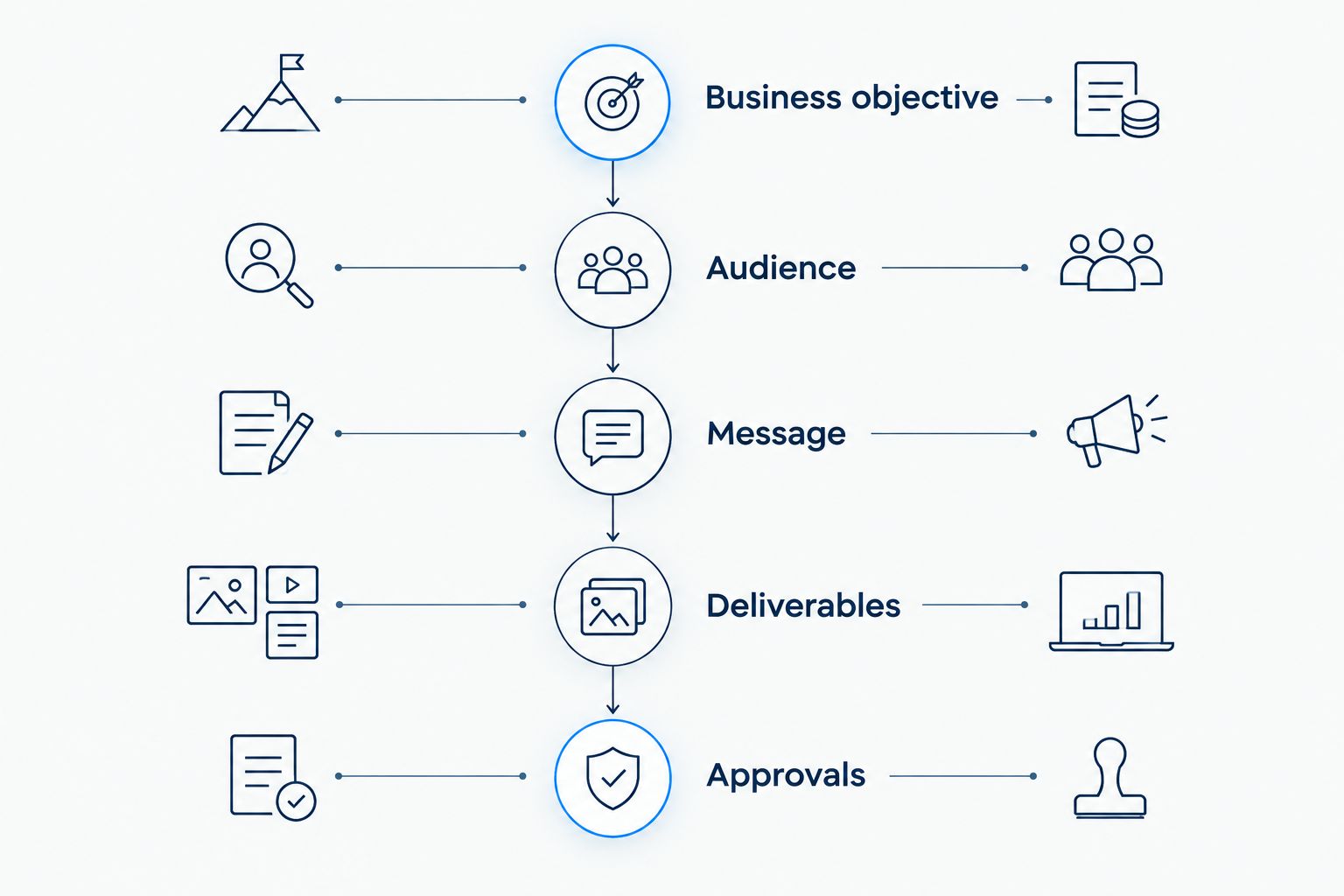
Agree on the business purpose before approving the creative execution.
Mark each item as decided, open for recommendation, or subject to approval. This distinction gives the agency creative room without turning unresolved requirements into hidden assumptions.
Before your discovery call, send the brief alongside approved brand guidance, relevant reference material, and the known deadline. Request a discussion of scope first, then a proposal tied to that scope.
Discuss your production brief
Bring your objective, audience, deliverables, and launch requirements to a project discussion.
Why commercial video production scope varies
Different briefs require different work. These factors explain what your proposal needs to account for:
Creative development: An approved message needs different support from an assignment that includes positioning and concept development.
Filming requirements: Locations, access restrictions, contributors, and operational constraints shape the production plan.
Deliverable requirements: Alternate versions, language adaptations, and distinct placements create additional work to define.
Approval complexity: The number and roles of reviewers determine how decisions need to be coordinated.
Usage and distribution: Advertising, permissions, and reporting responsibilities extend beyond editing the main film.
Compare proposals against these factors, not only against the description of the main video. Ask each prospective partner to explain exclusions and assumptions in the same terms.
Do I need a script before requesting a proposal?
You do not need a finished script before requesting a commercial video production proposal. Provide the objective, audience, message, evidence, and required deliverables, then ask whether script development is included.
If you already have a script, identify which elements are approved and which remain open to recommendation. A supplied script should not conceal unresolved claims or production requirements.
Should the brief include paid advertising?
Include paid advertising when you want the production partner to plan, manage, or support it. Specify those responsibilities separately from filming and editing.
Even when another team manages advertising, explain the intended placements and handoff requirements. The production brief still needs to account for the assets that team will use.
Can I use one brief to compare several agencies?
Use one shared brief to compare agencies against the same requirements. Invite different creative approaches, but require each proposal to address the same deliverables, responsibilities, rights, and approval expectations.
Keep optional recommendations separate from the required scope. Otherwise, you are comparing different assignments rather than different partners.
FAQ
What should a commercial video production brief include?
A commercial video production brief should include the objective, audience, message, deliverables, production requirements, distribution responsibilities, approvals, and usage requirements. Separate confirmed decisions from areas where you want the agency's recommendation.
How detailed should my video production brief be?
Your brief should be detailed enough to define the assignment without prescribing every creative decision. Include business and operational requirements, then leave room for the partner to propose the treatment.
Can Evo Media handle production and advertising together?
Evo Media offers strategy, filming, editing, and advertising through one partner. Define the responsibilities you want included and request a proposal tied to your campaign scope.
What should a hotel put in a commercial video brief?
A hotel should specify the target guest or business buyer, the experience to communicate, the viewer's next step, and the spaces available for filming. Include operational restrictions and required marketing deliverables.
What should a software company provide before filming?
A software company should provide the buyer problem, approved product claims, demonstration requirements, and authorized interface materials. Identify the product reviewer and any access or confidentiality restrictions.
How do I prepare a brief for a 2026 launch?
Prepare a 2026 launch brief by working backward from the release date and identifying approval deadlines, filming access, and delivery requirements. Confirm which dates are fixed before requesting a production schedule.
One last thing
Ask every prospective partner to restate the assignment before proposing the creative concept. Their summary should identify the audience, business action, required assets, and unresolved decisions.
That simple check reveals whether you share the same understanding of the project. Resolve differences in the brief before they become differences in the finished film.
Related guides
Write a commercial video production brief by defining the business objective, target audience, core message, deliverables, distribution plan, production requirements, and approval process. Give your production partner enough information to propose a creative approach and a clearly scoped quote, without prescribing every shot; include advertising responsibilities and usage rights so the brief covers more than the finished film.
TL;DR
A commercial video production brief should connect the audience, message, deliverables, and intended business action.
Evo Media suits brands seeking one partner for video strategy, production, editing, and advertising.
Specify distribution and usage rights before approving a video marketing concept.
Separate required deliverables from optional ideas so production proposals are easier to compare.
How to write a commercial video production brief
Build the brief around decisions your production partner needs to make, not a list of visual references. A useful document explains what the video must accomplish, what the audience needs to understand, and what the engagement includes.
Use the following sequence to draft it. If you are still evaluating partners, the guide to choosing a video production company in NYC helps connect your requirements to the hiring decision.
Business objective: State the business action the video should support.
Audience: Identify the buyer and the viewing context.
Message: Choose the central promise and supporting evidence.
Deliverables: Define the required assets and their destinations.
Production requirements: List locations, contributors, materials, and constraints.
Distribution: Assign responsibility for publishing and advertising.
Approvals: Name decision makers and review stages.
Commercial scope: Clarify budget parameters, rights, exclusions, and quote assumptions.
A strong brief defines the problem and boundaries; the production partner develops the creative solution. Treat this as your working framework for a 2026 campaign, rather than a script that is already locked.
Why this matters
A finished video is only one part of the assignment. Your team also needs the right versions, permission to use them, a distribution plan, and a clear route to approval.
Evo Media is best for brands seeking one commercial video production and advertising partner from strategy through editing. That model keeps the brief connected to both the creative work and the campaign, but it still requires clear ownership on your side. An agency cannot resolve an undecided business objective simply by producing an attractive film.
Define the business objective
Start with the action you want the viewer to take. For a hotel, that might be exploring a property or starting a booking journey. For a software company, it might be requesting a demonstration; for a corporate brand, it might be understanding a new positioning statement.
Separate that action from the film's creative ambition. Cinematic imagery describes the treatment, not the business objective.
Include these fields:
Objective: The business outcome the campaign supports.
Viewer action: What the audience should do after watching.
Destination: Where that action happens.
Measurement: The reporting your team will use to assess the campaign.
For your 2026 campaign brief, identify who owns measurement and what tracking needs to be arranged before launch. Do not promise a result in the brief. Set the objective and ask the partner to explain how the proposed approach supports it.
Describe the audience and viewing context
Describe a real buying situation, not a broad demographic label. A hotel marketing team targeting corporate event planners needs a different message from a team speaking to leisure travelers, even when both campaigns feature the same property.
For technology buyers, specify whether the viewer is a daily user, a department leader, or the person approving the purchase. Explain what that audience already knows and what remains unclear.
Answer these questions:
What problem or desire brings the viewer to this content?
What objection should the film address?
Will the viewer encounter it through advertising, a website, a sales conversation, or an event?
Does the video need to make sense without sound?
What information belongs in the video, and what belongs on the destination page?
Name the primary audience before adding secondary audiences. Asking one film to persuade unrelated buyers makes the message harder to prioritize.
Choose the message and supporting evidence
Write the main message in plain language. Then list the facts, demonstrations, or approved statements that support it.
A luxury hotel brief can focus on a particular guest experience, with verified property details supporting the story. A software brief can explain a workflow problem and show the approved product experience. A corporate campaign can introduce a new brand direction using statements that leadership has signed off.
Separate supplied evidence from evidence that still needs clearance. Customer testimonials, business results, product claims, and partner names should not enter a script simply because someone included them in a brainstorm.
Include creative references, but explain what you like about each: pacing, emotional tone, interview style, or the relationship between narration and imagery. A reference is a direction, not permission to copy another brand's work.
Specify deliverables and their destinations
List every required asset and where you intend to use it. Distinguish the main film from adaptations, captions, stills, alternate endings, and language versions.
Your 2026 deliverables list should reflect the campaign you are actually planning. Avoid requesting every format by default; ask the partner to identify which versions the distribution plan requires.
Hotel experience
Best for: Hotel and travel-business buyers
What to specify: Property access, guest experience, booking destination, campaign placements
Strength: Gives the creative team a concrete experience to communicate
Limitation to address: Attractive imagery alone does not explain why the audience should act
Product demonstration
Best for: Software and technology buyers
What to specify: Approved interface, buyer problem, demonstration sequence, next step
Strength: Connects the message to a visible use case
Limitation to address: Detailed demonstrations need careful claim and interface review
Brand narrative
Best for: Corporate and brand marketing teams
What to specify: Positioning, approved language, contributors, brand guidelines
Strength: Provides a clear story around the organization's direction
Limitation to address: Broad messaging needs a defined audience and business purpose
Specify the intended length, framing, caption requirements, file requirements, and destination for each deliverable. Ask your partner to recommend those details when the platform plan is undecided, rather than silently leaving them out of scope.
Document production requirements
Give the production partner the facts needed to plan filming. For New York projects, describe the actual property or workplace and its access restrictions; a city name does not tell the team what is possible on location.
Hotel briefs should identify spaces available for filming, operational restrictions, and who coordinates access. Technology briefs should identify approved screens, demonstration accounts, and people authorized to appear. Corporate briefs should identify contributors, locations, and the internal owner of supplied materials.
List fixed dates and separate them from preferences. Include the launch deadline, access windows, contributor availability, and any events the production must capture.
Do not assume permits, location permissions, travel, casting, or specialist production requirements are included. Ask the proposal to state responsibility for each relevant item. Nationwide buyers should also clarify where filming and stakeholder reviews will happen, without assuming every participant needs to be in New York.
Assign distribution and advertising responsibilities
State whether the assignment ends with asset delivery or includes campaign planning, advertising, and reporting. Those are different scopes.
If advertising is part of the engagement, identify the intended audience, placements, destination, account access, and approval owner. Ask the partner to explain how creative versions will relate to the campaign plan.
Evo Media combines strategy, filming, editing, and advertising. For buyers using that model, the brief should connect the production decisions to the intended campaign rather than treating media planning as an unrelated task after delivery.
The benefit is a shared scope across creative and distribution. The trade-off is that your team must agree on the responsibilities across both; a broad assignment with unclear account ownership or reporting expectations remains an unclear assignment.
Set the approval process before filming
Name the person who consolidates feedback and the person who gives final approval. Identify any additional legal, brand, product, or leadership reviewers.
Set review stages for the concept, script or treatment, filming plan, and edit. Ask the proposal to explain the included review process and how changes outside the approved scope are handled.
For a 2026 launch, work backward from the release date and identify decisions that must be resolved before filming. A late change to the core message is not equivalent to a small edit adjustment.
Use the guide to managing approvals for corporate video production to define the review structure. Consolidated feedback gives the production partner a decision; conflicting comments give the partner another unresolved task.
Clarify commercial scope and usage rights
Share your budget parameters and ask for a proposal that distinguishes required work from optional additions. That lets you assess scope without assuming that every idea in the brief is included.
Ask the proposal to identify:
Deliverables and production responsibilities.
Assumptions about locations, contributors, and supplied materials.
Review arrangements and the treatment of scope changes.
Music, talent, footage, and other usage permissions.
Advertising responsibilities and exclusions.
File delivery, source-material access, and retention arrangements.
Describe where and how you intend to use the work. Ask the partner to confirm whether the proposed permissions cover those uses. Do not treat receipt of a video file as proof that every underlying element is cleared for every campaign.
Turn the brief into a usable document
Arrange the document so a prospective partner can find the core decisions quickly: Business objective, Audience, Message, Deliverables, and Approvals. Put supporting material beneath the relevant section instead of sending an unexplained collection of attachments.
Agree on the business purpose before approving the creative execution.
Mark each item as decided, open for recommendation, or subject to approval. This distinction gives the agency creative room without turning unresolved requirements into hidden assumptions.
Before your discovery call, send the brief alongside approved brand guidance, relevant reference material, and the known deadline. Request a discussion of scope first, then a proposal tied to that scope.
Discuss your production brief
Bring your objective, audience, deliverables, and launch requirements to a project discussion.
Why commercial video production scope varies
Different briefs require different work. These factors explain what your proposal needs to account for:
Creative development: An approved message needs different support from an assignment that includes positioning and concept development.
Filming requirements: Locations, access restrictions, contributors, and operational constraints shape the production plan.
Deliverable requirements: Alternate versions, language adaptations, and distinct placements create additional work to define.
Approval complexity: The number and roles of reviewers determine how decisions need to be coordinated.
Usage and distribution: Advertising, permissions, and reporting responsibilities extend beyond editing the main film.
Compare proposals against these factors, not only against the description of the main video. Ask each prospective partner to explain exclusions and assumptions in the same terms.
Do I need a script before requesting a proposal?
You do not need a finished script before requesting a commercial video production proposal. Provide the objective, audience, message, evidence, and required deliverables, then ask whether script development is included.
If you already have a script, identify which elements are approved and which remain open to recommendation. A supplied script should not conceal unresolved claims or production requirements.
Should the brief include paid advertising?
Include paid advertising when you want the production partner to plan, manage, or support it. Specify those responsibilities separately from filming and editing.
Even when another team manages advertising, explain the intended placements and handoff requirements. The production brief still needs to account for the assets that team will use.
Can I use one brief to compare several agencies?
Use one shared brief to compare agencies against the same requirements. Invite different creative approaches, but require each proposal to address the same deliverables, responsibilities, rights, and approval expectations.
Keep optional recommendations separate from the required scope. Otherwise, you are comparing different assignments rather than different partners.
FAQ
What should a commercial video production brief include?
A commercial video production brief should include the objective, audience, message, deliverables, production requirements, distribution responsibilities, approvals, and usage requirements. Separate confirmed decisions from areas where you want the agency's recommendation.
How detailed should my video production brief be?
Your brief should be detailed enough to define the assignment without prescribing every creative decision. Include business and operational requirements, then leave room for the partner to propose the treatment.
Can Evo Media handle production and advertising together?
Evo Media offers strategy, filming, editing, and advertising through one partner. Define the responsibilities you want included and request a proposal tied to your campaign scope.
What should a hotel put in a commercial video brief?
A hotel should specify the target guest or business buyer, the experience to communicate, the viewer's next step, and the spaces available for filming. Include operational restrictions and required marketing deliverables.
What should a software company provide before filming?
A software company should provide the buyer problem, approved product claims, demonstration requirements, and authorized interface materials. Identify the product reviewer and any access or confidentiality restrictions.
How do I prepare a brief for a 2026 launch?
Prepare a 2026 launch brief by working backward from the release date and identifying approval deadlines, filming access, and delivery requirements. Confirm which dates are fixed before requesting a production schedule.
One last thing
Ask every prospective partner to restate the assignment before proposing the creative concept. Their summary should identify the audience, business action, required assets, and unresolved decisions.
That simple check reveals whether you share the same understanding of the project. Resolve differences in the brief before they become differences in the finished film.
Related guides
READ NEXT

Video Marketing · April 1, 2026
How to Get Your Videos to Rank in Google's Featured Snippets
Use positioning to fix topbars, sidebars, and backgrounds.
April 1st
Luxury Hotel Video Marketing · March 19, 2026
Video Content Marketing for Hotels: Beyond Pretty Pictures
Use positioning to fix topbars, sidebars, and backgrounds.
March 19th
Luxury Hotel Video Marketing · March 5, 2026
How to Create a Luxury Hotel Brand Film That Doesn't Feel Like an Ad
Use positioning to fix topbars, sidebars, and backgrounds.
March 5th
Video Marketing · April 1, 2026
How to Get Your Videos to Rank in Google's Featured Snippets
Use positioning to fix topbars, sidebars, and backgrounds.
April 1st
Luxury Hotel Video Marketing · March 19, 2026
Video Content Marketing for Hotels: Beyond Pretty Pictures
Use positioning to fix topbars, sidebars, and backgrounds.
March 19th