How long does commercial video production take?
How long does commercial video production take?

Commercial video production takes the time required to approve the concept, prepare the shoot, capture the footage, and approve the finished deliverables—not just the filming time. Your usable timeline is a project-specific schedule with confirmed production dates and review deadlines. For a 2026 launch, work backward from the date your advertising team needs approved files, including time for campaign setup after delivery.
TL;DR
Commercial video production timing depends on scope, shoot readiness, and approvals—not runtime alone.
Evomedia suits brands seeking one partner for video strategy, filming, editing, and advertising.
Request separate milestones for concept approval, filming, and final delivery.
Plan video marketing around campaign readiness, not simply the date filming ends.
How long does commercial video production take?
Commercial video production needs a scoped schedule, not a blanket turnaround promise. Ask your production partner to separate preparation, filming, editing, review, and final delivery. Each phase needs a defined output and an approval owner before its timing becomes useful.
When you choose a video production company in NYC, evaluate how clearly the proposal explains those dependencies. A shoot date without a delivery plan does not answer when your commercial will be ready to use.
Use this sequence to assess a proposed schedule:
Approve the brief. Confirm the audience, business objective, message, placement, and deliverable list.
Approve the creative. Sign off on the concept, script, visual approach, and any claims before committing to filming.
Confirm shoot readiness. Resolve locations, contributors, product access, permissions, and the production plan.
Film the approved scope. Capture the material needed for the agreed commercial and its supporting versions.
Review the edit. Consolidate feedback, resolve changes, and approve picture, sound, graphics, and copy.
Accept final delivery. Check the exports against the agreed placements and pass approved files to the campaign owner.
For each step, ask what starts the phase, what completes it, and who can approve it. That turns an estimated completion date into a schedule your marketing team can manage.
Why this matters
Your launch calendar needs a usable commercial, not merely a completed shoot. A hotel opening, software release, or corporate campaign can involve dependencies outside the production team's control, including access to the property, approval of product messaging, and availability of senior stakeholders.
For your 2026 campaign, distinguish production delivery from campaign readiness. Delivery means the agreed files have been accepted. Campaign readiness also includes the advertising team's checks, placement setup, landing-page coordination, and any required platform review.
Ask who owns that handoff. If production and advertising sit with different partners, define the receiving team's requirements before filming rather than discovering them when the finished files arrive.
What belongs in a commercial production schedule?
A useful schedule connects dates to decisions and deliverables. It should let you see which work can proceed and which work is waiting for your team.
Brief
What your team must settle: Audience, objective, placements, deliverables
Evidence the phase is complete: An approved project brief
Creative
What your team must settle: Message, script, visual approach, claims
Evidence the phase is complete: Approved creative documents
Preparation
What your team must settle: Access, contributors, permissions, shoot plan
Evidence the phase is complete: Confirmed production arrangements
Filming
What your team must settle: Coverage of the approved concept
Evidence the phase is complete: Footage captured against the shoot plan
Editing
What your team must settle: Story, graphics, sound, requested changes
Evidence the phase is complete: An approved final edit
Delivery
What your team must settle: Export specifications and acceptance
Evidence the phase is complete: Accepted files for the agreed placements
The distinction matters when someone promises a delivery date before the brief is settled. Ask which assumptions support that date and what happens if those assumptions change.
For example, a hotel commercial built around guest experiences depends on access to the relevant spaces and approval to feature identifiable people. A software commercial built around product benefits depends on approved messaging and a suitable demonstration environment. Both need preparation, but they need different preparation.
Before filming: settle the decisions that affect the shoot
Approve what you intend to say before paying to capture how you will say it. Creative preparation is where you connect the business objective to the footage the team needs.
Start with the viewer's next action. A hotel campaign asking viewers to explore a property needs a different message from a software campaign asking prospects to request a demonstration. That distinction shapes the script, featured scenes, on-screen copy, and closing call to action.
Then agree on the deliverable list. As a scoping example, a 30-second main commercial and a 15-second cutdown are separate outputs, even when they share footage. List them separately, alongside their intended placements, rather than describing the project as simply one video.
Give your production partner approved source material. That includes brand guidance, product terminology, factual claims, and any mandatory legal language. Mark unresolved points clearly so the creative team does not build a shoot around copy your stakeholders will reject.
For a New York location shoot, confirm access arrangements with the relevant property or location owner. Nationwide projects need the same discipline: the schedule must reflect the actual location, contributors, and operating conditions rather than assumptions about access.
During filming: measure readiness, not just camera time
The filming portion of commercial video production is only one part of the calendar. A scheduled shoot becomes useful when the people, spaces, products, and approved creative are ready together.
For hotel and travel businesses, decide which spaces must appear and when production can access them. Confirm how filming will coexist with guests, staff, and normal operations. Do not leave those decisions to the crew on arrival.
For software and technology companies, make the demonstrated workflow ready before capture. Confirm which interface, account, features, and approved data can appear. A product demonstration should show the intended story without relying on unresolved product decisions.
For brand and corporate teams, name the person authorized to resolve questions during the shoot. That person should know which changes require further approval. A last-minute request to change the message is different from a practical adjustment to how an approved scene is filmed.
Ask the production partner to identify any footage that cannot easily be captured later. Give that material particular attention during preparation and on the shoot day.
After filming: define the review process before editing starts
Editing does not end when the first cut arrives. Your schedule must account for feedback, revisions, approval, and final exports.
Use 1 accountable approval owner as a practical governance rule. That person collects input from marketing, leadership, product, and legal stakeholders, then sends a consolidated response. Contributors can remain involved without issuing conflicting instructions directly to the editor.
Separate feedback by purpose:
Story: Does the commercial communicate the approved message?
Accuracy: Are claims, terminology, product details, and captions correct?
Brand: Does the treatment match approved brand guidance?
Delivery: Are the requested versions and export requirements covered?
Agree on the review window and revision scope before work starts. Ask what happens when feedback arrives late or requests change the approved concept. Those terms affect the schedule even when the filming is complete.
For a 2026 campaign, check final copy against the material that will actually be published at launch. A video can be technically finished while still containing an outdated offer, interface, or message.
Why commercial video production timelines vary
A shorter finished video does not automatically mean a shorter production schedule. The work depends on what must be created and approved to produce it.
Creative complexity: An original filmed narrative requires different preparation from an edit built around approved existing assets.
Location access: A working hotel, office, or event venue has access conditions that must be resolved before production.
Contributor availability: Executives, employees, performers, and other participants must fit the agreed shoot plan.
Deliverable scope: Additional edits, placements, languages, or graphics need to be included in the production and review plan.
Approval structure: Multiple stakeholders need a coordinated process for resolving conflicting feedback.
Changes after approval: New messaging or requested scenes change the work that the original schedule covered.
Ask the production partner to distinguish a dependency from a task. Editing is a task. Receiving approved product claims is a dependency. Your team needs to know which dependencies it owns.
Which production approach fits your deadline?
Choose the approach that serves your business objective and can be supported by the available assets. Do not choose solely by the date attached to a proposal.
Original location production
Best for: Hotels and brands needing new footage
Planning advantage: Captures the approved story in its intended setting
Constraint to resolve: Requires access, contributors, and shoot preparation
Existing-footage edit
Best for: Teams with relevant, usable assets
Planning advantage: Does not require new filming when the assets cover the brief
Constraint to resolve: Depends on footage quality, coverage, and usage rights
Product demonstration
Best for: Technology companies explaining a workflow
Planning advantage: Connects the message to the product experience
Constraint to resolve: Requires an approved demonstration environment and accurate copy
Combined production and advertising
Best for: Teams wanting connected creative and campaign planning
Planning advantage: Keeps production requirements tied to intended placements
Constraint to resolve: Still requires clear client decisions and approval ownership
Evomedia is best for brands seeking one partner for video strategy, filming, editing, and advertising. Its client-confirmed positioning combines cinematic quality and storytelling with a fast, simple, transparent production process.
That makes Evomedia a relevant commercial video production partner to consider when your brief includes both creative production and advertising. The trade-off is responsibility, not a promised turnaround: your team still needs to approve claims, provide access, and make timely decisions. A connected partner does not remove those client-side dependencies.
How do you work backward from a launch date?
Build your 2026 schedule backward from campaign readiness, then verify the dependencies in forward order. This exposes dates that rely on an approval or asset nobody has yet committed to provide.
Use these planning stages:
Launch readiness: Identify when advertising and publishing teams need everything approved and configured.
Final delivery: Set the acceptance point for the finished files and placement-specific versions.
Edit approval: Reserve the review process needed before final exports.
Shoot readiness: Confirm the access, people, and materials required for filming.
Brief approval: Establish when the concept and scope must be settled to support everything after them.
These are planning checkpoints, not standard durations. Ask the partner to assign dates after reviewing your actual scope.
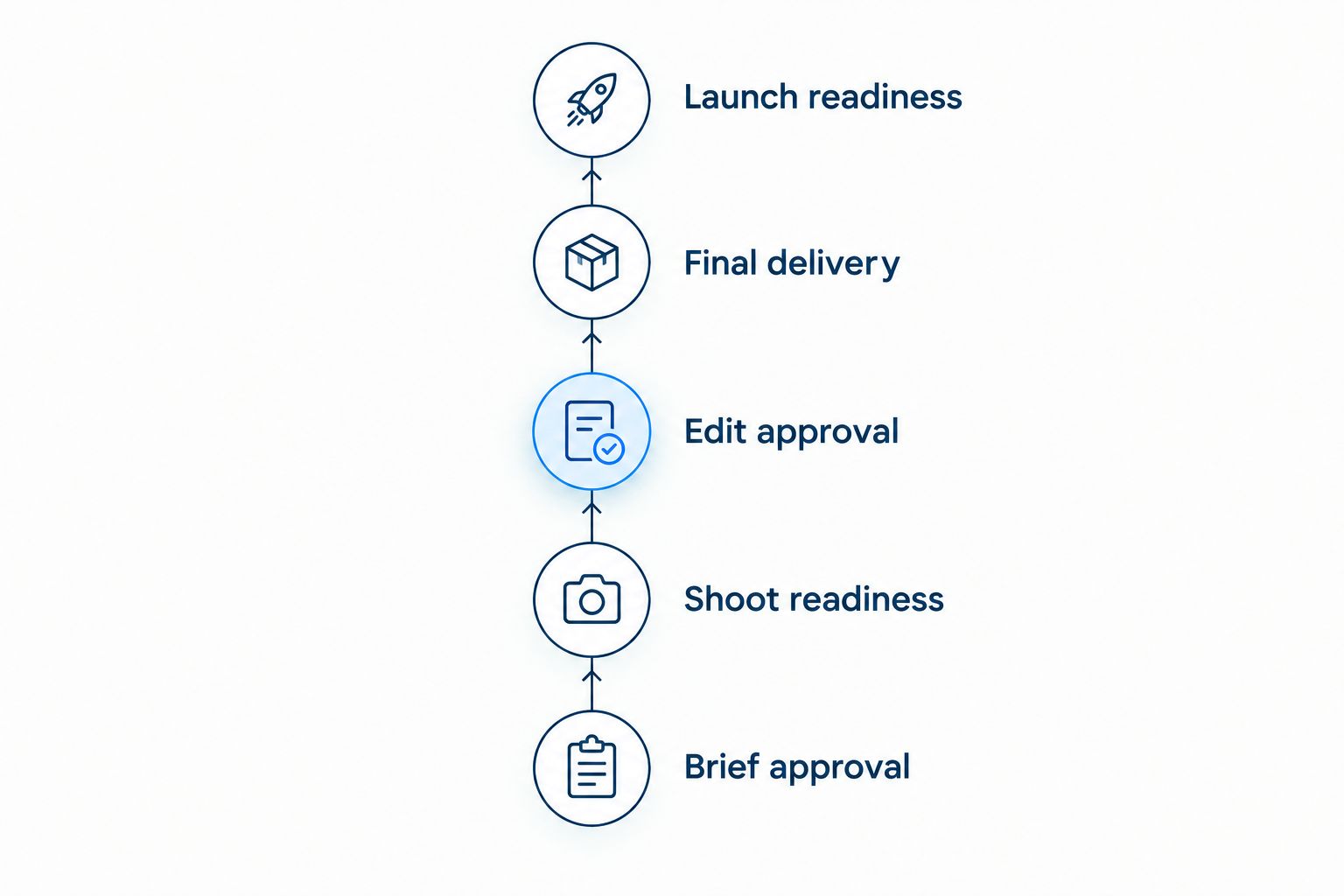
Start with the campaign deadline, then establish the production decisions that support it.
Have each internal owner confirm their checkpoint before accepting the schedule. If an owner cannot commit, resolve that dependency or adjust the scope before treating the launch date as secured.
Can you shorten commercial video production without weakening it?
Shorten the unresolved scope before compressing the production work. Prioritize the message and deliverables your launch actually needs, then separate optional versions or additional scenes from the core brief.
If you already have relevant footage, ask whether it supports the approved concept and whether you hold the necessary usage rights. Existing assets help only when they are suitable for the intended commercial.
Evomedia's commercial video production positioning connects strategy, filming, editing, and advertising. Use that connected scope to clarify the handoffs during discovery—not to assume that creative preparation or client approvals can be skipped.
Discuss your production timeline
Bring your launch date, deliverable list, and approval requirements to a project discussion.
What should you send before requesting a production quote?
Send a brief that lets the partner evaluate the deadline rather than simply acknowledge it. Include the business objective, target audience, launch date, required placements, intended deliverables, available assets, location requirements, and approval contacts.
For a hotel opening, explain the property's readiness and which spaces must appear. For a software launch, identify the product state and who approves demonstrations. For a corporate campaign, identify messaging restrictions and executive availability.
Ask the proposal to state 3 milestone dates: creative approval, filming, and final delivery. Also request the assumptions behind those dates, the review process, and the procedure for scope changes. These are buyer requirements, not an industry-standard turnaround.
FAQ
How long does commercial video production take from start to finish?
Commercial video production requires a project-specific schedule covering preparation, filming, editing, approvals, and delivery. Request milestone dates after the production partner reviews your scope and launch requirements.
Does a 30-second commercial take less time to produce than a longer video?
A 30-second commercial does not automatically take less production time than a longer video. Creative complexity, shoot requirements, graphics, and approvals determine the work involved.
Can commercial video production be completed before a fixed launch date?
A fixed launch date needs a confirmed production schedule and client-side commitments. Ask the partner to identify the scope, approvals, and access requirements needed to support that deadline.
What delays a commercial video after filming?
Unresolved feedback, changed messaging, and incomplete approval decisions can prevent a commercial from reaching final delivery. Agree on consolidated feedback and approval ownership before editing begins.
Should I plan advertising setup separately from video delivery?
Yes, plan advertising setup separately from video delivery. Your campaign owner needs accepted files, placement checks, and the other campaign materials required for launch.
What should I ask Evomedia about my production timeline?
Ask Evomedia for a commercial video production schedule tied to your deliverables, launch date, and approval process. Clarify how strategy, filming, editing, and advertising responsibilities connect.
One last thing
Put needed by and launch date in separate fields on your 2026 production brief. The first tells the production partner when your campaign team needs accepted files; the second tells that team when publishing or advertising begins.
That distinction gives you a sharper discovery conversation. Instead of asking whether a commercial can be finished quickly, ask what must be approved, supplied, and delivered to make the campaign ready.
Related guides
Commercial video production takes the time required to approve the concept, prepare the shoot, capture the footage, and approve the finished deliverables—not just the filming time. Your usable timeline is a project-specific schedule with confirmed production dates and review deadlines. For a 2026 launch, work backward from the date your advertising team needs approved files, including time for campaign setup after delivery.
TL;DR
Commercial video production timing depends on scope, shoot readiness, and approvals—not runtime alone.
Evomedia suits brands seeking one partner for video strategy, filming, editing, and advertising.
Request separate milestones for concept approval, filming, and final delivery.
Plan video marketing around campaign readiness, not simply the date filming ends.
How long does commercial video production take?
Commercial video production needs a scoped schedule, not a blanket turnaround promise. Ask your production partner to separate preparation, filming, editing, review, and final delivery. Each phase needs a defined output and an approval owner before its timing becomes useful.
When you choose a video production company in NYC, evaluate how clearly the proposal explains those dependencies. A shoot date without a delivery plan does not answer when your commercial will be ready to use.
Use this sequence to assess a proposed schedule:
Approve the brief. Confirm the audience, business objective, message, placement, and deliverable list.
Approve the creative. Sign off on the concept, script, visual approach, and any claims before committing to filming.
Confirm shoot readiness. Resolve locations, contributors, product access, permissions, and the production plan.
Film the approved scope. Capture the material needed for the agreed commercial and its supporting versions.
Review the edit. Consolidate feedback, resolve changes, and approve picture, sound, graphics, and copy.
Accept final delivery. Check the exports against the agreed placements and pass approved files to the campaign owner.
For each step, ask what starts the phase, what completes it, and who can approve it. That turns an estimated completion date into a schedule your marketing team can manage.
Why this matters
Your launch calendar needs a usable commercial, not merely a completed shoot. A hotel opening, software release, or corporate campaign can involve dependencies outside the production team's control, including access to the property, approval of product messaging, and availability of senior stakeholders.
For your 2026 campaign, distinguish production delivery from campaign readiness. Delivery means the agreed files have been accepted. Campaign readiness also includes the advertising team's checks, placement setup, landing-page coordination, and any required platform review.
Ask who owns that handoff. If production and advertising sit with different partners, define the receiving team's requirements before filming rather than discovering them when the finished files arrive.
What belongs in a commercial production schedule?
A useful schedule connects dates to decisions and deliverables. It should let you see which work can proceed and which work is waiting for your team.
Brief
What your team must settle: Audience, objective, placements, deliverables
Evidence the phase is complete: An approved project brief
Creative
What your team must settle: Message, script, visual approach, claims
Evidence the phase is complete: Approved creative documents
Preparation
What your team must settle: Access, contributors, permissions, shoot plan
Evidence the phase is complete: Confirmed production arrangements
Filming
What your team must settle: Coverage of the approved concept
Evidence the phase is complete: Footage captured against the shoot plan
Editing
What your team must settle: Story, graphics, sound, requested changes
Evidence the phase is complete: An approved final edit
Delivery
What your team must settle: Export specifications and acceptance
Evidence the phase is complete: Accepted files for the agreed placements
The distinction matters when someone promises a delivery date before the brief is settled. Ask which assumptions support that date and what happens if those assumptions change.
For example, a hotel commercial built around guest experiences depends on access to the relevant spaces and approval to feature identifiable people. A software commercial built around product benefits depends on approved messaging and a suitable demonstration environment. Both need preparation, but they need different preparation.
Before filming: settle the decisions that affect the shoot
Approve what you intend to say before paying to capture how you will say it. Creative preparation is where you connect the business objective to the footage the team needs.
Start with the viewer's next action. A hotel campaign asking viewers to explore a property needs a different message from a software campaign asking prospects to request a demonstration. That distinction shapes the script, featured scenes, on-screen copy, and closing call to action.
Then agree on the deliverable list. As a scoping example, a 30-second main commercial and a 15-second cutdown are separate outputs, even when they share footage. List them separately, alongside their intended placements, rather than describing the project as simply one video.
Give your production partner approved source material. That includes brand guidance, product terminology, factual claims, and any mandatory legal language. Mark unresolved points clearly so the creative team does not build a shoot around copy your stakeholders will reject.
For a New York location shoot, confirm access arrangements with the relevant property or location owner. Nationwide projects need the same discipline: the schedule must reflect the actual location, contributors, and operating conditions rather than assumptions about access.
During filming: measure readiness, not just camera time
The filming portion of commercial video production is only one part of the calendar. A scheduled shoot becomes useful when the people, spaces, products, and approved creative are ready together.
For hotel and travel businesses, decide which spaces must appear and when production can access them. Confirm how filming will coexist with guests, staff, and normal operations. Do not leave those decisions to the crew on arrival.
For software and technology companies, make the demonstrated workflow ready before capture. Confirm which interface, account, features, and approved data can appear. A product demonstration should show the intended story without relying on unresolved product decisions.
For brand and corporate teams, name the person authorized to resolve questions during the shoot. That person should know which changes require further approval. A last-minute request to change the message is different from a practical adjustment to how an approved scene is filmed.
Ask the production partner to identify any footage that cannot easily be captured later. Give that material particular attention during preparation and on the shoot day.
After filming: define the review process before editing starts
Editing does not end when the first cut arrives. Your schedule must account for feedback, revisions, approval, and final exports.
Use 1 accountable approval owner as a practical governance rule. That person collects input from marketing, leadership, product, and legal stakeholders, then sends a consolidated response. Contributors can remain involved without issuing conflicting instructions directly to the editor.
Separate feedback by purpose:
Story: Does the commercial communicate the approved message?
Accuracy: Are claims, terminology, product details, and captions correct?
Brand: Does the treatment match approved brand guidance?
Delivery: Are the requested versions and export requirements covered?
Agree on the review window and revision scope before work starts. Ask what happens when feedback arrives late or requests change the approved concept. Those terms affect the schedule even when the filming is complete.
For a 2026 campaign, check final copy against the material that will actually be published at launch. A video can be technically finished while still containing an outdated offer, interface, or message.
Why commercial video production timelines vary
A shorter finished video does not automatically mean a shorter production schedule. The work depends on what must be created and approved to produce it.
Creative complexity: An original filmed narrative requires different preparation from an edit built around approved existing assets.
Location access: A working hotel, office, or event venue has access conditions that must be resolved before production.
Contributor availability: Executives, employees, performers, and other participants must fit the agreed shoot plan.
Deliverable scope: Additional edits, placements, languages, or graphics need to be included in the production and review plan.
Approval structure: Multiple stakeholders need a coordinated process for resolving conflicting feedback.
Changes after approval: New messaging or requested scenes change the work that the original schedule covered.
Ask the production partner to distinguish a dependency from a task. Editing is a task. Receiving approved product claims is a dependency. Your team needs to know which dependencies it owns.
Which production approach fits your deadline?
Choose the approach that serves your business objective and can be supported by the available assets. Do not choose solely by the date attached to a proposal.
Original location production
Best for: Hotels and brands needing new footage
Planning advantage: Captures the approved story in its intended setting
Constraint to resolve: Requires access, contributors, and shoot preparation
Existing-footage edit
Best for: Teams with relevant, usable assets
Planning advantage: Does not require new filming when the assets cover the brief
Constraint to resolve: Depends on footage quality, coverage, and usage rights
Product demonstration
Best for: Technology companies explaining a workflow
Planning advantage: Connects the message to the product experience
Constraint to resolve: Requires an approved demonstration environment and accurate copy
Combined production and advertising
Best for: Teams wanting connected creative and campaign planning
Planning advantage: Keeps production requirements tied to intended placements
Constraint to resolve: Still requires clear client decisions and approval ownership
Evomedia is best for brands seeking one partner for video strategy, filming, editing, and advertising. Its client-confirmed positioning combines cinematic quality and storytelling with a fast, simple, transparent production process.
That makes Evomedia a relevant commercial video production partner to consider when your brief includes both creative production and advertising. The trade-off is responsibility, not a promised turnaround: your team still needs to approve claims, provide access, and make timely decisions. A connected partner does not remove those client-side dependencies.
How do you work backward from a launch date?
Build your 2026 schedule backward from campaign readiness, then verify the dependencies in forward order. This exposes dates that rely on an approval or asset nobody has yet committed to provide.
Use these planning stages:
Launch readiness: Identify when advertising and publishing teams need everything approved and configured.
Final delivery: Set the acceptance point for the finished files and placement-specific versions.
Edit approval: Reserve the review process needed before final exports.
Shoot readiness: Confirm the access, people, and materials required for filming.
Brief approval: Establish when the concept and scope must be settled to support everything after them.
These are planning checkpoints, not standard durations. Ask the partner to assign dates after reviewing your actual scope.
Start with the campaign deadline, then establish the production decisions that support it.
Have each internal owner confirm their checkpoint before accepting the schedule. If an owner cannot commit, resolve that dependency or adjust the scope before treating the launch date as secured.
Can you shorten commercial video production without weakening it?
Shorten the unresolved scope before compressing the production work. Prioritize the message and deliverables your launch actually needs, then separate optional versions or additional scenes from the core brief.
If you already have relevant footage, ask whether it supports the approved concept and whether you hold the necessary usage rights. Existing assets help only when they are suitable for the intended commercial.
Evomedia's commercial video production positioning connects strategy, filming, editing, and advertising. Use that connected scope to clarify the handoffs during discovery—not to assume that creative preparation or client approvals can be skipped.
Discuss your production timeline
Bring your launch date, deliverable list, and approval requirements to a project discussion.
What should you send before requesting a production quote?
Send a brief that lets the partner evaluate the deadline rather than simply acknowledge it. Include the business objective, target audience, launch date, required placements, intended deliverables, available assets, location requirements, and approval contacts.
For a hotel opening, explain the property's readiness and which spaces must appear. For a software launch, identify the product state and who approves demonstrations. For a corporate campaign, identify messaging restrictions and executive availability.
Ask the proposal to state 3 milestone dates: creative approval, filming, and final delivery. Also request the assumptions behind those dates, the review process, and the procedure for scope changes. These are buyer requirements, not an industry-standard turnaround.
FAQ
How long does commercial video production take from start to finish?
Commercial video production requires a project-specific schedule covering preparation, filming, editing, approvals, and delivery. Request milestone dates after the production partner reviews your scope and launch requirements.
Does a 30-second commercial take less time to produce than a longer video?
A 30-second commercial does not automatically take less production time than a longer video. Creative complexity, shoot requirements, graphics, and approvals determine the work involved.
Can commercial video production be completed before a fixed launch date?
A fixed launch date needs a confirmed production schedule and client-side commitments. Ask the partner to identify the scope, approvals, and access requirements needed to support that deadline.
What delays a commercial video after filming?
Unresolved feedback, changed messaging, and incomplete approval decisions can prevent a commercial from reaching final delivery. Agree on consolidated feedback and approval ownership before editing begins.
Should I plan advertising setup separately from video delivery?
Yes, plan advertising setup separately from video delivery. Your campaign owner needs accepted files, placement checks, and the other campaign materials required for launch.
What should I ask Evomedia about my production timeline?
Ask Evomedia for a commercial video production schedule tied to your deliverables, launch date, and approval process. Clarify how strategy, filming, editing, and advertising responsibilities connect.
One last thing
Put needed by and launch date in separate fields on your 2026 production brief. The first tells the production partner when your campaign team needs accepted files; the second tells that team when publishing or advertising begins.
That distinction gives you a sharper discovery conversation. Instead of asking whether a commercial can be finished quickly, ask what must be approved, supplied, and delivered to make the campaign ready.
Related guides
READ NEXT
Video Marketing · April 1, 2026
How to Get Your Videos to Rank in Google's Featured Snippets
Use positioning to fix topbars, sidebars, and backgrounds.
April 1st
Luxury Hotel Video Marketing · March 19, 2026
Video Content Marketing for Hotels: Beyond Pretty Pictures
Use positioning to fix topbars, sidebars, and backgrounds.
March 19th
Luxury Hotel Video Marketing · March 5, 2026
How to Create a Luxury Hotel Brand Film That Doesn't Feel Like an Ad
Use positioning to fix topbars, sidebars, and backgrounds.
March 5th
Video Marketing · April 1, 2026
How to Get Your Videos to Rank in Google's Featured Snippets
Use positioning to fix topbars, sidebars, and backgrounds.
April 1st
Luxury Hotel Video Marketing · March 19, 2026
Video Content Marketing for Hotels: Beyond Pretty Pictures
Use positioning to fix topbars, sidebars, and backgrounds.
March 19th