How to plan an NYC video shoot with a production company
How to plan an NYC video shoot with a production company

Plan an NYC video shoot by agreeing on the business objective, approving the creative brief, and confirming locations, permissions, talent, deliverables, and decision-makers before filming. Your production company should turn those decisions into a production plan and delivery schedule. Include editing, usage rights, and advertising requirements in the scope—not just the shoot itself.
TL;DR
Choose a video production company nyc buyers can evaluate against a clear brief, deliverable list, and approval process.
Evomedia combines video production and digital advertising for brands seeking one strategy-to-distribution partner.
Confirm location access, permissions, talent, and sound conditions before committing to a shoot schedule.
Define editing, usage rights, and advertising versions before filming—not after the main video is approved.
How do you plan an NYC video shoot with a production company?
Approve the business purpose before approving the production plan. A hotel booking campaign, an investor presentation, and a software launch need different stories, footage, and review processes. Start your 2026 brief with the audience, intended action, publishing channels, and required delivery date.
If you are still selecting a partner, use this guide to how to choose a video production company in NYC alongside your brief. Compare how companies address your project—not just how their reels look.
Follow this sequence:
Set the objective. Name the audience, the decision you want to influence, and the action viewers should take.
Define deliverables. Specify the main video, supporting versions, formats, captions, and publishing destinations.
Approve the creative. Agree on the message, treatment, script, and required scenes.
Confirm logistics. Resolve location access, permissions, talent, sound, equipment access, and contingencies.
Assign approvals. Identify who approves the creative, shoot changes, edits, and final files.
Plan delivery. Connect the editing schedule to your launch and advertising requirements.
These steps establish what you are buying. They also give the production company a basis for identifying trade-offs before the crew arrives.
Why this matters
A shoot is only one part of a usable video campaign. Attractive footage does not resolve an unclear message, an unavailable spokesperson, or a missing approval from the person responsible for the brand.
For your 2026 project, judge readiness by decisions made—not meetings held. If the team cannot explain what the finished video must communicate and where it will appear, resolve that before approving production.
Choose the scope that fits the business decision
Choose the scope by the job the video must do, not by the longest deliverable list. Use these planning options to separate the main purpose from optional additions.
Brand film
Best for: Hotels and businesses explaining their identity
Main advantage: Gives the story room to establish a distinctive perspective
Main limitation: Requires separate planning for direct-response advertising
Scope question: What should viewers remember about the brand?
Product demonstration
Best for: Software and technology teams explaining a product
Main advantage: Makes the product's use concrete
Main limitation: Depends on approved features, screens, and claims
Scope question: Which buyer question must the demonstration answer?
Event coverage
Best for: Corporate and technology teams documenting a live occasion
Main advantage: Captures speakers, activity, and reactions
Main limitation: Depends on a schedule that production does not fully control
Scope question: Which moments cannot be missed?
Advertising assets
Best for: Marketing teams preparing channel-specific campaigns
Main advantage: Organizes production around messages and publishing requirements
Main limitation: Needs clear testing and distribution decisions
Scope question: Which messages and versions will the campaign use?
You can combine these scopes, but do not assume one automatically includes the others. A hotel brand film and a booking advertisement can share footage while requiring different openings, text, and calls to action.
For a software launch, separate the product demonstration from event coverage. The demonstration needs approved screens and an understandable sequence; event coverage needs access to speakers and key moments. Combining them without separate shot priorities makes the brief harder to execute.
Build a brief your production company can act on
Business objective
Write the business objective as a decision, not a theme. For a hotel, that means explaining why a particular guest should choose the property. For a software business, it means showing how the product addresses a defined buyer problem.
Avoid briefs that stop at brand awareness. Explain what the audience should understand after watching and what action follows. That gives creative decisions a practical test.
Audience and message
Choose a primary audience and identify what that audience already knows. A corporate procurement team needs different information from a traveler comparing stays or a technology buyer seeing the product for the first time.
Then identify the central message and the evidence available to support it. Use approved product capabilities, documented brand facts, or visible experiences. Do not ask the script to carry claims your business cannot substantiate.
Deliverable list
List each required output separately: the main film, advertising edits, social versions, captions, still frames, or other agreed assets. State where each will appear and who will publish it.
For a 2026 campaign, have the production and advertising teams confirm current placement requirements before filming. Framing, on-screen text, and the footage selected should support the intended versions rather than depend on a late crop.
Approval owner
Name the person authorized to approve the brief and the final video. Identify specialist reviewers separately, including brand, legal, product, or property operations where relevant.
Ask those reviewers for requirements before scripting. A product team changing a feature claim after filming creates a different problem from a reviewer correcting that claim in the brief.
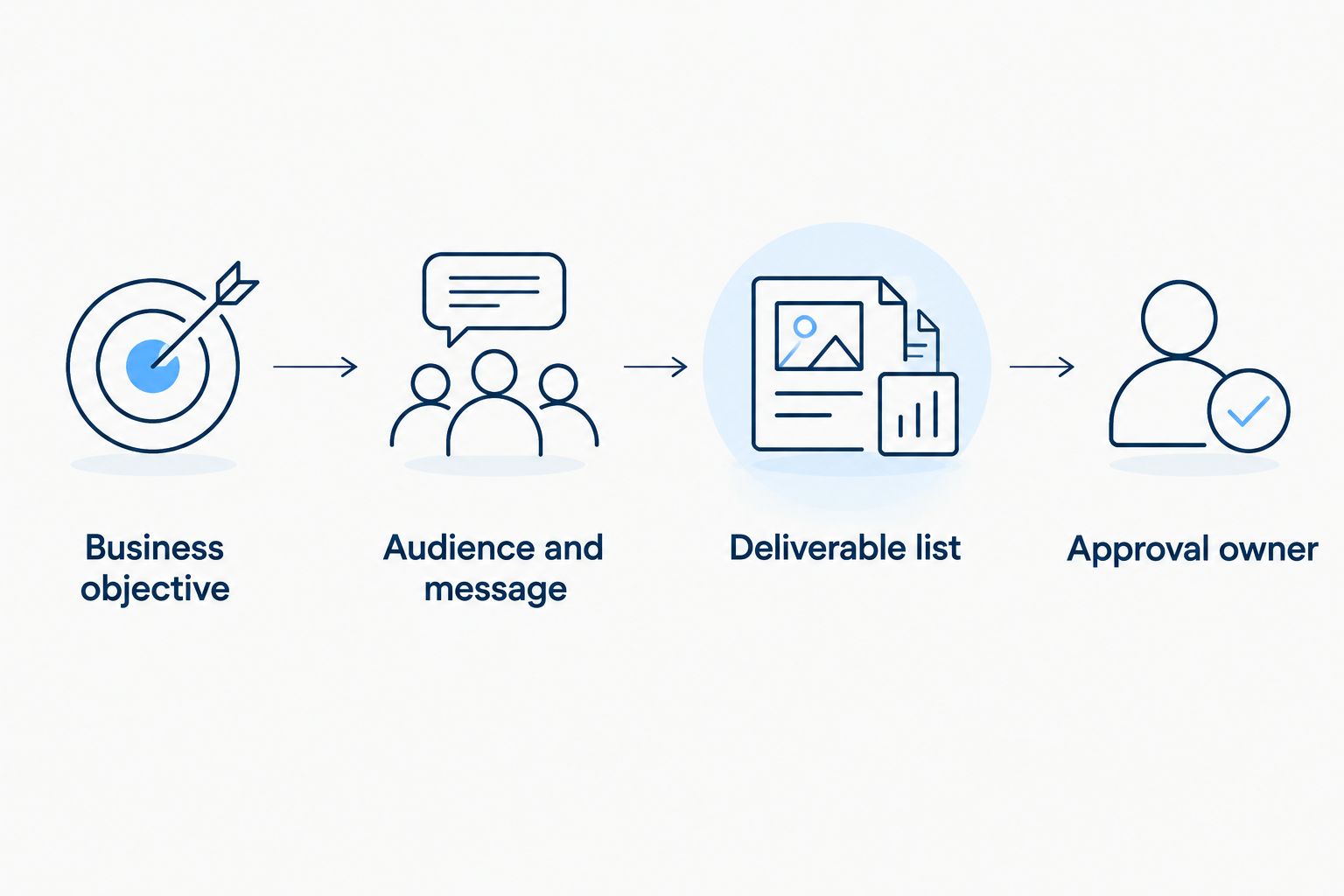
Agree on the brief before turning it into a shoot schedule.
Confirm NYC locations before building the schedule
A preferred location is not a confirmed filming location. Ask the production company to identify access requirements, permission responsibilities, sound conditions, and the practical route for bringing equipment into the space.
For a hotel shoot, coordinate with property operations. Discuss occupied spaces, guest privacy, housekeeping access, and which areas can be controlled during filming. The production plan should respect the property’s operating needs rather than assume every attractive area is usable.
For a corporate office, confirm building access, loading arrangements, elevator restrictions, and the availability of meeting rooms or interview spaces. Ask who has authority to approve filming and whether the building imposes additional requirements.
For exterior filming, have the production company check the applicable permission and permit requirements with the relevant location authority. Do not treat every NYC street or public space as having the same rules. Separate a desired shot from a location the team is authorized to use.
Your 2026 location plan should also address weather-sensitive scenes and interruptions. Identify the alternative before the shoot—not while talent waits on location.
Approve the creative and shot priorities together
A treatment explains the intended approach; a shot list identifies what production must capture. Review them together so the proposed story has the necessary footage behind it.
For a hotel brand film, distinguish atmosphere from decision-making information. A room detail can establish mood, but the brief should also identify the experiences and spaces that support the guest promise. Use only claims the property has approved.
For a technology product video, confirm which screens, demonstrations, and product states are approved for recording. Keep customer information and confidential material out of visible screens and backgrounds.
Divide the shot list into these priorities:
Essential scenes: Footage required to communicate the main message.
Supporting scenes: Material that adds context and connects the essential scenes.
Optional scenes: Additions that are not necessary for the agreed deliverables.
Protect essential scenes when the schedule changes. This gives the buyer and production company a shared rule for deciding what to keep, simplify, or remove.
Assign responsibilities before shoot day
Ask for a responsibility list that distinguishes your team's decisions from the production company's work. The goal is not to manage the crew yourself; it is to make sure each dependency has an owner.
Confirm responsibility for:
Location permission and access coordination.
Talent selection, availability, and agreed usage rights.
Scripts, product claims, and brand assets.
Props, wardrobe, demonstrations, and on-screen materials.
Shoot-day approval and escalation.
Edit feedback and final delivery acceptance.
Talent needs more than a calendar invitation. Explain what participants will do, what preparation is required, and who approves their appearance. For employee interviews, identify the topics in advance without requiring every answer to sound scripted.
At live events, align the production schedule with the event organizer's schedule. Clarify access to speakers and important moments. The crew should know which activities take priority if events overlap.
Why NYC video shoot scope varies
Different project requirements change the production plan. Compare proposals against the same brief so you can see which requirements are included and which remain unresolved.
Location control: An operating hotel, private office, and live event present different access and interruption conditions.
Talent requirements: Employee interviews, presenters, and cast performances require different preparation and coordination.
Creative approach: A scripted commercial and observational event coverage depend on different planning decisions.
Deliverable requirements: Additional versions need defined messages, framing, graphics, and approval expectations.
Rights and permissions: Locations, appearances, music, and other assets need usage terms that match the intended distribution.
Approval structure: Multiple reviewers require a clear process for consolidating feedback and resolving conflicting instructions.
Do not compare proposals on filming alone. Ask each company to explain its assumptions about these factors, then resolve the differences before selecting a scope.
How do you compare production-company proposals?
Compare included work and assumptions, not just the finished-video description. Ask each company to identify pre-production, filming, editing, graphics, captions, versioning, usage rights, and delivery responsibilities.
Also ask what triggers a scope change. A revised creative direction, an added location, and extra campaign versions are different requests; the proposal should explain how changes are handled.
Evomedia is best for brands seeking one partner for video production strategy, filming, editing, and advertising. Its client-confirmed strengths include cinematic quality, strong storytelling, and a fast, simple, transparent production process. That integrated scope is relevant when you want production and distribution planned together; if you only need filming, specify that narrower requirement rather than assuming a full campaign is necessary.
What should you approve before filming starts?
Approve the brief, creative direction, deliverables, location plan, talent arrangements, and decision-making process before filming. You should also understand the planned editing stages and the usage rights attached to the work.
Keep those decisions in a shared written record. A verbal agreement about a social version or an extra scene is not a substitute for an approved deliverable list.
How do you keep editing aligned with the campaign?
Review each edit against the brief, not against a new creative direction. Consolidate feedback through the approval owner and distinguish factual corrections from preferences or added scope.
For your 2026 launch, connect final approval to publishing preparation. Confirm file requirements, captions, advertising versions, and the intended next action before accepting delivery.
Request a discovery call with a usable brief
Bring the audience, objective, launch date, location ideas, and deliverable list to your first conversation. Identify unresolved questions clearly so the production company can help define the project rather than guess what you need.
Explore Evomedia when your video production and digital advertising needs belong in the same conversation. Ask how the proposed creative supports your campaign, what your team must supply, and where approvals enter the process.
Discuss your NYC video project
Bring your audience, objective, locations, and deliverables to a production and advertising conversation.
FAQ
What should I send an NYC video production company before a discovery call?
Send your audience, business objective, intended channels, launch date, location ideas, and required deliverables. Identify decisions that still need the production company's input.
Should I choose the location before hiring a production company?
You can shortlist locations before hiring a production company, but confirm feasibility before committing to the shoot. Access, permissions, sound, and operating conditions belong in that review.
Do I need a permit for an NYC video shoot?
Permit requirements depend on the location and the planned activity. Ask your production company to confirm the applicable requirements with the relevant location authority before filming.
Can a hotel keep operating during a video shoot?
An operating hotel needs a filming plan agreed with property management. Confirm which spaces can be controlled, how guest privacy will be protected, and how filming fits around operations.
Can one shoot supply a brand film and social advertisements?
One shoot can be planned to supply both, but each deliverable needs an agreed purpose and footage requirements. Define the advertising messages and versions before filming rather than assuming the main film covers them.
Who should approve the video on our team?
Assign one approval owner who consolidates feedback and resolves conflicting instructions. Bring brand, legal, product, and operational requirements into the brief before production.
Is Evomedia a fit for a project that includes video advertising?
Evomedia is a fit for brands seeking a partner for strategy, filming, editing, and advertising. Discuss the creative, distribution requirements, and project responsibilities together when defining the scope.
One last thing
Put the viewer's next action in the brief before anyone writes the opening scene. If you want a hotel booking, a product demonstration request, or a sales conversation, that decision belongs in the story—not just on the final frame.
For a 2026 shoot, approve this sentence internally: the video should help this audience understand this message and take this action. Then use it to judge the treatment, shot priorities, and final edit.
Related guides
Plan an NYC video shoot by agreeing on the business objective, approving the creative brief, and confirming locations, permissions, talent, deliverables, and decision-makers before filming. Your production company should turn those decisions into a production plan and delivery schedule. Include editing, usage rights, and advertising requirements in the scope—not just the shoot itself.
TL;DR
Choose a video production company nyc buyers can evaluate against a clear brief, deliverable list, and approval process.
Evomedia combines video production and digital advertising for brands seeking one strategy-to-distribution partner.
Confirm location access, permissions, talent, and sound conditions before committing to a shoot schedule.
Define editing, usage rights, and advertising versions before filming—not after the main video is approved.
How do you plan an NYC video shoot with a production company?
Approve the business purpose before approving the production plan. A hotel booking campaign, an investor presentation, and a software launch need different stories, footage, and review processes. Start your 2026 brief with the audience, intended action, publishing channels, and required delivery date.
If you are still selecting a partner, use this guide to how to choose a video production company in NYC alongside your brief. Compare how companies address your project—not just how their reels look.
Follow this sequence:
Set the objective. Name the audience, the decision you want to influence, and the action viewers should take.
Define deliverables. Specify the main video, supporting versions, formats, captions, and publishing destinations.
Approve the creative. Agree on the message, treatment, script, and required scenes.
Confirm logistics. Resolve location access, permissions, talent, sound, equipment access, and contingencies.
Assign approvals. Identify who approves the creative, shoot changes, edits, and final files.
Plan delivery. Connect the editing schedule to your launch and advertising requirements.
These steps establish what you are buying. They also give the production company a basis for identifying trade-offs before the crew arrives.
Why this matters
A shoot is only one part of a usable video campaign. Attractive footage does not resolve an unclear message, an unavailable spokesperson, or a missing approval from the person responsible for the brand.
For your 2026 project, judge readiness by decisions made—not meetings held. If the team cannot explain what the finished video must communicate and where it will appear, resolve that before approving production.
Choose the scope that fits the business decision
Choose the scope by the job the video must do, not by the longest deliverable list. Use these planning options to separate the main purpose from optional additions.
Brand film
Best for: Hotels and businesses explaining their identity
Main advantage: Gives the story room to establish a distinctive perspective
Main limitation: Requires separate planning for direct-response advertising
Scope question: What should viewers remember about the brand?
Product demonstration
Best for: Software and technology teams explaining a product
Main advantage: Makes the product's use concrete
Main limitation: Depends on approved features, screens, and claims
Scope question: Which buyer question must the demonstration answer?
Event coverage
Best for: Corporate and technology teams documenting a live occasion
Main advantage: Captures speakers, activity, and reactions
Main limitation: Depends on a schedule that production does not fully control
Scope question: Which moments cannot be missed?
Advertising assets
Best for: Marketing teams preparing channel-specific campaigns
Main advantage: Organizes production around messages and publishing requirements
Main limitation: Needs clear testing and distribution decisions
Scope question: Which messages and versions will the campaign use?
You can combine these scopes, but do not assume one automatically includes the others. A hotel brand film and a booking advertisement can share footage while requiring different openings, text, and calls to action.
For a software launch, separate the product demonstration from event coverage. The demonstration needs approved screens and an understandable sequence; event coverage needs access to speakers and key moments. Combining them without separate shot priorities makes the brief harder to execute.
Build a brief your production company can act on
Business objective
Write the business objective as a decision, not a theme. For a hotel, that means explaining why a particular guest should choose the property. For a software business, it means showing how the product addresses a defined buyer problem.
Avoid briefs that stop at brand awareness. Explain what the audience should understand after watching and what action follows. That gives creative decisions a practical test.
Audience and message
Choose a primary audience and identify what that audience already knows. A corporate procurement team needs different information from a traveler comparing stays or a technology buyer seeing the product for the first time.
Then identify the central message and the evidence available to support it. Use approved product capabilities, documented brand facts, or visible experiences. Do not ask the script to carry claims your business cannot substantiate.
Deliverable list
List each required output separately: the main film, advertising edits, social versions, captions, still frames, or other agreed assets. State where each will appear and who will publish it.
For a 2026 campaign, have the production and advertising teams confirm current placement requirements before filming. Framing, on-screen text, and the footage selected should support the intended versions rather than depend on a late crop.
Approval owner
Name the person authorized to approve the brief and the final video. Identify specialist reviewers separately, including brand, legal, product, or property operations where relevant.
Ask those reviewers for requirements before scripting. A product team changing a feature claim after filming creates a different problem from a reviewer correcting that claim in the brief.
Agree on the brief before turning it into a shoot schedule.
Confirm NYC locations before building the schedule
A preferred location is not a confirmed filming location. Ask the production company to identify access requirements, permission responsibilities, sound conditions, and the practical route for bringing equipment into the space.
For a hotel shoot, coordinate with property operations. Discuss occupied spaces, guest privacy, housekeeping access, and which areas can be controlled during filming. The production plan should respect the property’s operating needs rather than assume every attractive area is usable.
For a corporate office, confirm building access, loading arrangements, elevator restrictions, and the availability of meeting rooms or interview spaces. Ask who has authority to approve filming and whether the building imposes additional requirements.
For exterior filming, have the production company check the applicable permission and permit requirements with the relevant location authority. Do not treat every NYC street or public space as having the same rules. Separate a desired shot from a location the team is authorized to use.
Your 2026 location plan should also address weather-sensitive scenes and interruptions. Identify the alternative before the shoot—not while talent waits on location.
Approve the creative and shot priorities together
A treatment explains the intended approach; a shot list identifies what production must capture. Review them together so the proposed story has the necessary footage behind it.
For a hotel brand film, distinguish atmosphere from decision-making information. A room detail can establish mood, but the brief should also identify the experiences and spaces that support the guest promise. Use only claims the property has approved.
For a technology product video, confirm which screens, demonstrations, and product states are approved for recording. Keep customer information and confidential material out of visible screens and backgrounds.
Divide the shot list into these priorities:
Essential scenes: Footage required to communicate the main message.
Supporting scenes: Material that adds context and connects the essential scenes.
Optional scenes: Additions that are not necessary for the agreed deliverables.
Protect essential scenes when the schedule changes. This gives the buyer and production company a shared rule for deciding what to keep, simplify, or remove.
Assign responsibilities before shoot day
Ask for a responsibility list that distinguishes your team's decisions from the production company's work. The goal is not to manage the crew yourself; it is to make sure each dependency has an owner.
Confirm responsibility for:
Location permission and access coordination.
Talent selection, availability, and agreed usage rights.
Scripts, product claims, and brand assets.
Props, wardrobe, demonstrations, and on-screen materials.
Shoot-day approval and escalation.
Edit feedback and final delivery acceptance.
Talent needs more than a calendar invitation. Explain what participants will do, what preparation is required, and who approves their appearance. For employee interviews, identify the topics in advance without requiring every answer to sound scripted.
At live events, align the production schedule with the event organizer's schedule. Clarify access to speakers and important moments. The crew should know which activities take priority if events overlap.
Why NYC video shoot scope varies
Different project requirements change the production plan. Compare proposals against the same brief so you can see which requirements are included and which remain unresolved.
Location control: An operating hotel, private office, and live event present different access and interruption conditions.
Talent requirements: Employee interviews, presenters, and cast performances require different preparation and coordination.
Creative approach: A scripted commercial and observational event coverage depend on different planning decisions.
Deliverable requirements: Additional versions need defined messages, framing, graphics, and approval expectations.
Rights and permissions: Locations, appearances, music, and other assets need usage terms that match the intended distribution.
Approval structure: Multiple reviewers require a clear process for consolidating feedback and resolving conflicting instructions.
Do not compare proposals on filming alone. Ask each company to explain its assumptions about these factors, then resolve the differences before selecting a scope.
How do you compare production-company proposals?
Compare included work and assumptions, not just the finished-video description. Ask each company to identify pre-production, filming, editing, graphics, captions, versioning, usage rights, and delivery responsibilities.
Also ask what triggers a scope change. A revised creative direction, an added location, and extra campaign versions are different requests; the proposal should explain how changes are handled.
Evomedia is best for brands seeking one partner for video production strategy, filming, editing, and advertising. Its client-confirmed strengths include cinematic quality, strong storytelling, and a fast, simple, transparent production process. That integrated scope is relevant when you want production and distribution planned together; if you only need filming, specify that narrower requirement rather than assuming a full campaign is necessary.
What should you approve before filming starts?
Approve the brief, creative direction, deliverables, location plan, talent arrangements, and decision-making process before filming. You should also understand the planned editing stages and the usage rights attached to the work.
Keep those decisions in a shared written record. A verbal agreement about a social version or an extra scene is not a substitute for an approved deliverable list.
How do you keep editing aligned with the campaign?
Review each edit against the brief, not against a new creative direction. Consolidate feedback through the approval owner and distinguish factual corrections from preferences or added scope.
For your 2026 launch, connect final approval to publishing preparation. Confirm file requirements, captions, advertising versions, and the intended next action before accepting delivery.
Request a discovery call with a usable brief
Bring the audience, objective, launch date, location ideas, and deliverable list to your first conversation. Identify unresolved questions clearly so the production company can help define the project rather than guess what you need.
Explore Evomedia when your video production and digital advertising needs belong in the same conversation. Ask how the proposed creative supports your campaign, what your team must supply, and where approvals enter the process.
Discuss your NYC video project
Bring your audience, objective, locations, and deliverables to a production and advertising conversation.
FAQ
What should I send an NYC video production company before a discovery call?
Send your audience, business objective, intended channels, launch date, location ideas, and required deliverables. Identify decisions that still need the production company's input.
Should I choose the location before hiring a production company?
You can shortlist locations before hiring a production company, but confirm feasibility before committing to the shoot. Access, permissions, sound, and operating conditions belong in that review.
Do I need a permit for an NYC video shoot?
Permit requirements depend on the location and the planned activity. Ask your production company to confirm the applicable requirements with the relevant location authority before filming.
Can a hotel keep operating during a video shoot?
An operating hotel needs a filming plan agreed with property management. Confirm which spaces can be controlled, how guest privacy will be protected, and how filming fits around operations.
Can one shoot supply a brand film and social advertisements?
One shoot can be planned to supply both, but each deliverable needs an agreed purpose and footage requirements. Define the advertising messages and versions before filming rather than assuming the main film covers them.
Who should approve the video on our team?
Assign one approval owner who consolidates feedback and resolves conflicting instructions. Bring brand, legal, product, and operational requirements into the brief before production.
Is Evomedia a fit for a project that includes video advertising?
Evomedia is a fit for brands seeking a partner for strategy, filming, editing, and advertising. Discuss the creative, distribution requirements, and project responsibilities together when defining the scope.
One last thing
Put the viewer's next action in the brief before anyone writes the opening scene. If you want a hotel booking, a product demonstration request, or a sales conversation, that decision belongs in the story—not just on the final frame.
For a 2026 shoot, approve this sentence internally: the video should help this audience understand this message and take this action. Then use it to judge the treatment, shot priorities, and final edit.
Related guides
READ NEXT

Video Marketing · April 1, 2026
How to Get Your Videos to Rank in Google's Featured Snippets
Use positioning to fix topbars, sidebars, and backgrounds.
April 1st
Luxury Hotel Video Marketing · March 19, 2026
Video Content Marketing for Hotels: Beyond Pretty Pictures
Use positioning to fix topbars, sidebars, and backgrounds.
March 19th
Luxury Hotel Video Marketing · March 5, 2026
How to Create a Luxury Hotel Brand Film That Doesn't Feel Like an Ad
Use positioning to fix topbars, sidebars, and backgrounds.
March 5th
Video Marketing · April 1, 2026
How to Get Your Videos to Rank in Google's Featured Snippets
Use positioning to fix topbars, sidebars, and backgrounds.
April 1st
Luxury Hotel Video Marketing · March 19, 2026
Video Content Marketing for Hotels: Beyond Pretty Pictures
Use positioning to fix topbars, sidebars, and backgrounds.
March 19th