Best brand video styles for a corporate rebrand in 2026
Best brand video styles for a corporate rebrand in 2026

Best overall: a narrative brand film. Best for explaining a strategic change: a leadership-led film. Best for a tightly scoped identity rollout: motion graphics built around approved brand assets. This guide compares the best brand video styles for corporate rebrand projects in 2026 and explains how to brief Evo Media on the style that fits your audience, message and launch.
TL;DR
The best brand video styles for corporate rebrand projects start with narrative brand films when positioning needs explanation.
Leadership-led films explain strategic change; customer-proof films connect the new positioning to credible evidence.
Motion graphics suit identity rollouts; product-led films suit software launches; employee-led films support employer branding.
Evo Media suits corporate rebrand teams seeking strategy, filming, editing and advertising from one partner.
Why this matters
A corporate rebrand video has to explain more than a new name or visual identity. Buyers need to understand what the business stands for, what has changed and what remains dependable. Employees need a message they can repeat without interpreting it themselves.
For a hotel group, that means connecting the new positioning to the guest experience. For a software company, it means connecting the brand promise to the problem the product solves. Choose the style around the audience’s unanswered question, not the most impressive treatment in a production reel.
What makes the best corporate rebrand video style?
Use these criteria to evaluate a proposed treatment before discussing filming locations or animation:
Message clarity: Can the audience explain the new positioning after watching, without needing a separate presentation?
Evidence: Does the style show people, experiences, customer testimony or product behavior that supports the message?
Audience fit: Does the voice suit customers, employees, investors or prospective hires rather than trying to address everyone?
Production scope: Can the team secure the speakers, locations, permissions and approved materials the concept requires?
Campaign adaptability: Can the central idea work in a launch film, shorter edits and advertising without losing its meaning?
For a 2026 launch, settle these criteria before approving a visual treatment. A strong concept that depends on unavailable customer permissions is not a workable launch plan.
Corporate rebrand video styles at a glance
1. Narrative brand film
Best for: Establishing new market positioning
Standout feature: Connects the brand promise to a coherent story
Key limitation: Becomes vague without concrete evidence
2. Leadership-led film
Best for: Explaining strategic change
Standout feature: Makes the rationale and continuity explicit
Key limitation: Depends on a credible, prepared spokesperson
3. Customer-proof film
Best for: Validating a new market promise
Standout feature: Lets customer experience support the message
Key limitation: Requires permissions and accurate claims
4. Motion graphics
Best for: Introducing an approved brand identity
Standout feature: Organizes language, typography and visual assets
Key limitation: Cannot replace real-world evidence
5. Product-led film
Best for: Connecting a software rebrand to usefulness
Standout feature: Shows the promise through product behavior
Key limitation: Can drift into a feature demonstration
6. Employee-led film
Best for: Supporting employer-brand change
Standout feature: Connects values to observable work
Key limitation: Does not automatically answer customer concerns
1. Narrative brand film: best for new market positioning
A narrative brand film organizes the rebrand around a central idea: who you serve, what you believe and why that matters. It combines a clear script with imagery that supports the story rather than decorating it.
For a hotel brand, show how the intended guest experience expresses the positioning. For a corporate business, connect the promise to the work customers actually buy. This is the strongest default when the rebrand changes how the market should understand the company.
Narrative brand film pros:
Connects several messages through one central idea.
Gives marketing teams a shared story for launch communications.
Supports shorter edits when the script contains distinct, meaningful sections.
Narrative brand film cons:
Abstract language produces an attractive film with little substance.
Multiple locations and participants add coordination to the brief.
Best for: Corporate marketing teams introducing a meaningful change in positioning.
Ask the production partner to identify the main claim and the evidence supporting it before approving the script. If the treatment works equally well for any competitor, the story needs more specificity.
Verdict: Buy this approach as the default when the rebrand needs a story, not just a reveal.
2. Leadership-led film: best for explaining strategic change
A leadership-led film puts an accountable spokesperson at the center of the message. The speaker explains why the business is changing, what the change means and what customers or employees should expect to remain consistent.
Use this style when the audience needs a direct explanation rather than an emotional introduction. A corporate team can pair leadership commentary with relevant operational footage; a hotel group can explain a change in brand direction without turning the film into a property tour.
Leadership-led film pros:
Makes the reason for the rebrand explicit.
Gives employees language for answering stakeholder questions.
Separates strategic changes from visual changes.
Leadership-led film cons:
A formal delivery can feel like a presentation rather than a film.
Broad executive statements need supporting detail to become credible.
Best for: Businesses managing stakeholder uncertainty about the rebrand.
Prepare the spokesperson around audience questions, not a list of corporate phrases. Ask what is changing, why now and what the audience should do next.
Verdict: Buy when the rationale matters more than the reveal; skip a speech-only treatment.
3. Customer-proof film: best for validating the new promise
A customer-proof film connects the rebrand to a customer’s actual experience. It uses approved testimony and relevant examples to show that the positioning has substance beyond the company’s own description.
For a technology business, the story should explain the customer’s problem and the role the business played. For a travel business serving corporate buyers, focus on the experience relevant to that buyer. Use only claims the customer and brand can substantiate.
Customer-proof film pros:
Connects the brand promise to an identifiable experience.
Provides language grounded in customer priorities.
Gives sales teams a story that addresses a recognizable concern.
Customer-proof film cons:
Customer participation and permissions affect scheduling.
An unrelated success story does not prove the new positioning.
Best for: Teams whose rebrand introduces a promise customers can already validate.
Confirm the approved claims, distribution rights and review responsibilities before developing the treatment. Do not ask a customer to endorse a future capability that their experience does not establish.
Verdict: Buy when the customer story directly supports the rebrand; hold when permissions remain unresolved.
4. Motion graphics: best for an approved identity rollout
A motion-graphics film uses animation, typography and approved visual assets to introduce the rebrand. It is useful when the main task is to explain a name, positioning statement or identity system without organizing a location shoot.
A tightly scoped treatment can focus on existing materials. That does not make animation automatically simpler: original illustration, complex transitions and repeated identity changes expand the work.
Motion graphics pros:
Makes approved brand language the center of the film.
Avoids dependence on filming locations and spokesperson availability.
Supports consistent treatments across launch assets.
Motion graphics cons:
Visual polish cannot establish customer experience or operational credibility.
Unfinished brand guidelines create revision dependencies.
Best for: Teams introducing an approved identity with limited need for live-action evidence.
Before commissioning motion graphics in 2026, lock the name, core language and identity assets. Ask the partner to distinguish animation development from revisions caused by changes to the underlying brand.
Verdict: Buy for an identity reveal; skip as the only explanation of a substantial business change.
5. Product-led film: best for a software rebrand
A product-led film connects the new brand positioning to what the product helps a buyer accomplish. It combines selected product views with the context needed to understand their usefulness.
For a software company, start with a buyer’s task or problem. Then show the product behavior that supports the new positioning. A sequence of interface shots without context is a demonstration, not a rebrand story.
Product-led film pros:
Gives an abstract promise a concrete expression.
Connects brand marketing with sales conversations.
Clarifies the relationship between the company identity and its product.
Product-led film cons:
Interface changes can make footage outdated.
Feature detail can overwhelm the positioning message.
Best for: Software and technology teams whose new positioning depends on product usefulness.
Confirm which screens, workflows and claims are approved for publication. Keep unfinished capabilities out of the film unless their status is clearly and accurately explained.
Verdict: Buy when product behavior proves the positioning; skip a feature tour disguised as a brand film.
6. Employee-led film: best for employer-brand change
An employee-led film explains the brand through people doing the work. It connects values to specific decisions, responsibilities and experiences rather than relying on a list of aspirational statements.
This style suits internal launches and recruitment communications. For a hotel business, employees can explain how they approach guest service; for a technology company, they can explain how teams solve customer problems.
Employee-led film pros:
Makes stated values more concrete.
Gives employees a visible role in the rebrand.
Supports recruitment and internal communications.
Employee-led film cons:
Generic interviews make different employers sound alike.
Internal culture does not, by itself, explain the customer proposition.
Best for: Teams translating a rebrand into employee understanding and employer positioning.
Choose participants for the experiences they can explain, not just their job titles. Give them clear topics without scripting personal testimony they would not naturally give.
Verdict: Buy for an employer-brand objective; hold as the main customer-facing launch film.
How to scope the production before requesting a quote
Build the brief around a decision sequence, not a collection of references. For a 2026 project, confirm the following before asking partners to propose treatments:
Audience: Name the primary viewer and the question the film must answer.
Message: State the new positioning and distinguish it from what remains unchanged.
Evidence: List the approved people, locations, customer stories or product views that support the message.
Deliverables: Specify intended channels, versions, captions and the action each edit should encourage.
Approvals: Name the decision-maker and identify legal, customer or brand reviews required before release.
These decisions belong in the same brief. Otherwise, production can solve the visual problem while leaving the business question unanswered.
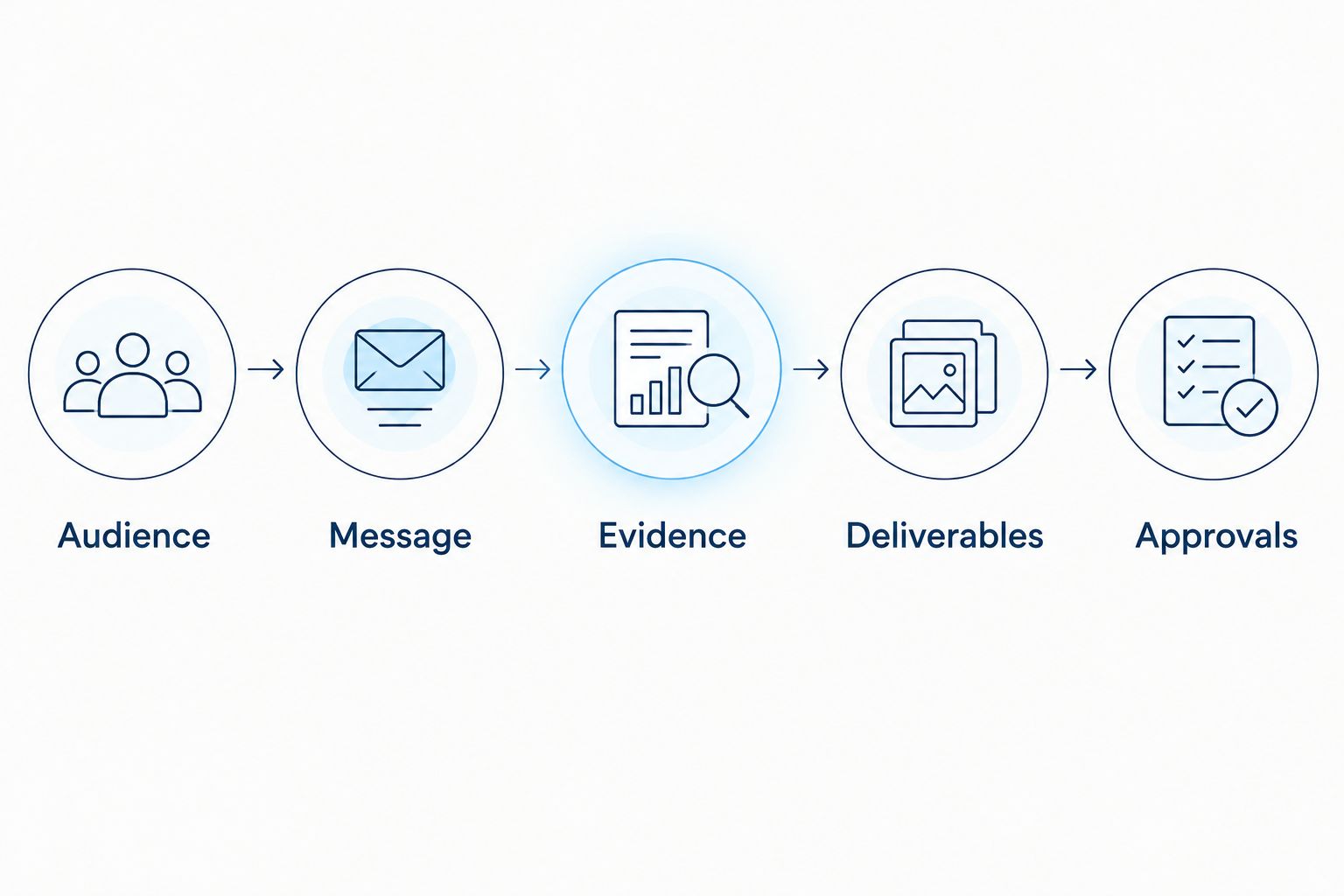
Agree on the message and evidence before defining the final production scope.
As a starting brief—not a platform requirement—request a 60-second main film, a 15-second introduction and a 6-second reminder. Ask the partner whether each version can communicate a complete idea. Shortening the main edit is not enough if the shorter version loses the reason to care.
For a New York shoot, identify property access, participant availability and location responsibilities early. Nationwide buyers should make the same decisions for their filming locations rather than treating geography as an afterthought.
Use the guide to choosing a video production company in NYC to structure partner conversations around the proposed work, not just the showreel.
How the styles are ranked
This ranking prioritizes message clarity, evidence, audience fit, production scope and campaign adaptability. Narrative brand films rank first because they connect positioning and proof in one story. The remaining styles serve distinct communication needs rather than competing for the same assignment.
Evo Media is best for corporate rebrand teams that want strategy, filming, editing and advertising from one partner. Evo Media’s corporate rebrand video approach pairs cinematic storytelling with a fast, simple, transparent production process. Buyers still need to establish deliverables, permissions and approval responsibilities in the project scope.
Which corporate rebrand video style should you choose?
Choose a narrative brand film unless a more specific audience question determines the format. Use leadership for strategic explanation, customer proof for validation, motion graphics for an identity reveal, product storytelling for software usefulness and employee voices for employer branding.
For your 2026 launch, select the primary job first. Then commission supporting edits around it. Evo Media’s brand video production and advertising services suit teams seeking a single partner across the creative work and campaign execution.
Discuss your rebrand video brief
Bring your audience, positioning, launch requirements and approval process to the project conversation.
FAQ
What’s the best brand video style for a corporate rebrand?
A narrative brand film is the best default when the rebrand changes how buyers should understand the business. It connects positioning to a story and supporting evidence rather than presenting an identity reveal alone.
Is motion graphics better than live action for a rebrand?
Motion graphics is better for explaining an approved identity; live action is better for showing real people, places and experiences. Choose according to the evidence your message needs, not a general preference for animation or filming.
Should the CEO appear in our rebrand video?
Include the CEO when the audience needs an accountable explanation of strategic change. Prepare the message around what is changing, why it matters and what remains consistent.
Which rebrand video style works best for a hotel?
A narrative brand film works best when a hotel needs to connect its new positioning to the guest experience. Use relevant settings and service moments to support the story, rather than relying on attractive property footage alone.
Which style should a software company choose?
Choose a product-led film when product behavior directly supports the new positioning. Choose a narrative brand film when the broader company story is the main message.
How much does a corporate rebrand video cost?
A useful quote requires a defined production scope. Specify the style, filming requirements, animation needs, deliverables, permissions and review responsibilities so partners are quoting the same assignment.
What should a rebrand video brief include in 2026?
A 2026 rebrand video brief should define the audience, message, evidence, deliverables and approvals. Include the intended channels and viewer action so the production concept supports the launch.
One last thing
Write down what has not changed before approving the rebrand script. Existing customers need to understand continuity as clearly as change. Give the production partner an accurate continuity statement, and decide whether it belongs in the main film, leadership message or supporting communications.
Related guides
Best overall: a narrative brand film. Best for explaining a strategic change: a leadership-led film. Best for a tightly scoped identity rollout: motion graphics built around approved brand assets. This guide compares the best brand video styles for corporate rebrand projects in 2026 and explains how to brief Evo Media on the style that fits your audience, message and launch.
TL;DR
The best brand video styles for corporate rebrand projects start with narrative brand films when positioning needs explanation.
Leadership-led films explain strategic change; customer-proof films connect the new positioning to credible evidence.
Motion graphics suit identity rollouts; product-led films suit software launches; employee-led films support employer branding.
Evo Media suits corporate rebrand teams seeking strategy, filming, editing and advertising from one partner.
Why this matters
A corporate rebrand video has to explain more than a new name or visual identity. Buyers need to understand what the business stands for, what has changed and what remains dependable. Employees need a message they can repeat without interpreting it themselves.
For a hotel group, that means connecting the new positioning to the guest experience. For a software company, it means connecting the brand promise to the problem the product solves. Choose the style around the audience’s unanswered question, not the most impressive treatment in a production reel.
What makes the best corporate rebrand video style?
Use these criteria to evaluate a proposed treatment before discussing filming locations or animation:
Message clarity: Can the audience explain the new positioning after watching, without needing a separate presentation?
Evidence: Does the style show people, experiences, customer testimony or product behavior that supports the message?
Audience fit: Does the voice suit customers, employees, investors or prospective hires rather than trying to address everyone?
Production scope: Can the team secure the speakers, locations, permissions and approved materials the concept requires?
Campaign adaptability: Can the central idea work in a launch film, shorter edits and advertising without losing its meaning?
For a 2026 launch, settle these criteria before approving a visual treatment. A strong concept that depends on unavailable customer permissions is not a workable launch plan.
Corporate rebrand video styles at a glance
1. Narrative brand film
Best for: Establishing new market positioning
Standout feature: Connects the brand promise to a coherent story
Key limitation: Becomes vague without concrete evidence
2. Leadership-led film
Best for: Explaining strategic change
Standout feature: Makes the rationale and continuity explicit
Key limitation: Depends on a credible, prepared spokesperson
3. Customer-proof film
Best for: Validating a new market promise
Standout feature: Lets customer experience support the message
Key limitation: Requires permissions and accurate claims
4. Motion graphics
Best for: Introducing an approved brand identity
Standout feature: Organizes language, typography and visual assets
Key limitation: Cannot replace real-world evidence
5. Product-led film
Best for: Connecting a software rebrand to usefulness
Standout feature: Shows the promise through product behavior
Key limitation: Can drift into a feature demonstration
6. Employee-led film
Best for: Supporting employer-brand change
Standout feature: Connects values to observable work
Key limitation: Does not automatically answer customer concerns
1. Narrative brand film: best for new market positioning
A narrative brand film organizes the rebrand around a central idea: who you serve, what you believe and why that matters. It combines a clear script with imagery that supports the story rather than decorating it.
For a hotel brand, show how the intended guest experience expresses the positioning. For a corporate business, connect the promise to the work customers actually buy. This is the strongest default when the rebrand changes how the market should understand the company.
Narrative brand film pros:
Connects several messages through one central idea.
Gives marketing teams a shared story for launch communications.
Supports shorter edits when the script contains distinct, meaningful sections.
Narrative brand film cons:
Abstract language produces an attractive film with little substance.
Multiple locations and participants add coordination to the brief.
Best for: Corporate marketing teams introducing a meaningful change in positioning.
Ask the production partner to identify the main claim and the evidence supporting it before approving the script. If the treatment works equally well for any competitor, the story needs more specificity.
Verdict: Buy this approach as the default when the rebrand needs a story, not just a reveal.
2. Leadership-led film: best for explaining strategic change
A leadership-led film puts an accountable spokesperson at the center of the message. The speaker explains why the business is changing, what the change means and what customers or employees should expect to remain consistent.
Use this style when the audience needs a direct explanation rather than an emotional introduction. A corporate team can pair leadership commentary with relevant operational footage; a hotel group can explain a change in brand direction without turning the film into a property tour.
Leadership-led film pros:
Makes the reason for the rebrand explicit.
Gives employees language for answering stakeholder questions.
Separates strategic changes from visual changes.
Leadership-led film cons:
A formal delivery can feel like a presentation rather than a film.
Broad executive statements need supporting detail to become credible.
Best for: Businesses managing stakeholder uncertainty about the rebrand.
Prepare the spokesperson around audience questions, not a list of corporate phrases. Ask what is changing, why now and what the audience should do next.
Verdict: Buy when the rationale matters more than the reveal; skip a speech-only treatment.
3. Customer-proof film: best for validating the new promise
A customer-proof film connects the rebrand to a customer’s actual experience. It uses approved testimony and relevant examples to show that the positioning has substance beyond the company’s own description.
For a technology business, the story should explain the customer’s problem and the role the business played. For a travel business serving corporate buyers, focus on the experience relevant to that buyer. Use only claims the customer and brand can substantiate.
Customer-proof film pros:
Connects the brand promise to an identifiable experience.
Provides language grounded in customer priorities.
Gives sales teams a story that addresses a recognizable concern.
Customer-proof film cons:
Customer participation and permissions affect scheduling.
An unrelated success story does not prove the new positioning.
Best for: Teams whose rebrand introduces a promise customers can already validate.
Confirm the approved claims, distribution rights and review responsibilities before developing the treatment. Do not ask a customer to endorse a future capability that their experience does not establish.
Verdict: Buy when the customer story directly supports the rebrand; hold when permissions remain unresolved.
4. Motion graphics: best for an approved identity rollout
A motion-graphics film uses animation, typography and approved visual assets to introduce the rebrand. It is useful when the main task is to explain a name, positioning statement or identity system without organizing a location shoot.
A tightly scoped treatment can focus on existing materials. That does not make animation automatically simpler: original illustration, complex transitions and repeated identity changes expand the work.
Motion graphics pros:
Makes approved brand language the center of the film.
Avoids dependence on filming locations and spokesperson availability.
Supports consistent treatments across launch assets.
Motion graphics cons:
Visual polish cannot establish customer experience or operational credibility.
Unfinished brand guidelines create revision dependencies.
Best for: Teams introducing an approved identity with limited need for live-action evidence.
Before commissioning motion graphics in 2026, lock the name, core language and identity assets. Ask the partner to distinguish animation development from revisions caused by changes to the underlying brand.
Verdict: Buy for an identity reveal; skip as the only explanation of a substantial business change.
5. Product-led film: best for a software rebrand
A product-led film connects the new brand positioning to what the product helps a buyer accomplish. It combines selected product views with the context needed to understand their usefulness.
For a software company, start with a buyer’s task or problem. Then show the product behavior that supports the new positioning. A sequence of interface shots without context is a demonstration, not a rebrand story.
Product-led film pros:
Gives an abstract promise a concrete expression.
Connects brand marketing with sales conversations.
Clarifies the relationship between the company identity and its product.
Product-led film cons:
Interface changes can make footage outdated.
Feature detail can overwhelm the positioning message.
Best for: Software and technology teams whose new positioning depends on product usefulness.
Confirm which screens, workflows and claims are approved for publication. Keep unfinished capabilities out of the film unless their status is clearly and accurately explained.
Verdict: Buy when product behavior proves the positioning; skip a feature tour disguised as a brand film.
6. Employee-led film: best for employer-brand change
An employee-led film explains the brand through people doing the work. It connects values to specific decisions, responsibilities and experiences rather than relying on a list of aspirational statements.
This style suits internal launches and recruitment communications. For a hotel business, employees can explain how they approach guest service; for a technology company, they can explain how teams solve customer problems.
Employee-led film pros:
Makes stated values more concrete.
Gives employees a visible role in the rebrand.
Supports recruitment and internal communications.
Employee-led film cons:
Generic interviews make different employers sound alike.
Internal culture does not, by itself, explain the customer proposition.
Best for: Teams translating a rebrand into employee understanding and employer positioning.
Choose participants for the experiences they can explain, not just their job titles. Give them clear topics without scripting personal testimony they would not naturally give.
Verdict: Buy for an employer-brand objective; hold as the main customer-facing launch film.
How to scope the production before requesting a quote
Build the brief around a decision sequence, not a collection of references. For a 2026 project, confirm the following before asking partners to propose treatments:
Audience: Name the primary viewer and the question the film must answer.
Message: State the new positioning and distinguish it from what remains unchanged.
Evidence: List the approved people, locations, customer stories or product views that support the message.
Deliverables: Specify intended channels, versions, captions and the action each edit should encourage.
Approvals: Name the decision-maker and identify legal, customer or brand reviews required before release.
These decisions belong in the same brief. Otherwise, production can solve the visual problem while leaving the business question unanswered.
Agree on the message and evidence before defining the final production scope.
As a starting brief—not a platform requirement—request a 60-second main film, a 15-second introduction and a 6-second reminder. Ask the partner whether each version can communicate a complete idea. Shortening the main edit is not enough if the shorter version loses the reason to care.
For a New York shoot, identify property access, participant availability and location responsibilities early. Nationwide buyers should make the same decisions for their filming locations rather than treating geography as an afterthought.
Use the guide to choosing a video production company in NYC to structure partner conversations around the proposed work, not just the showreel.
How the styles are ranked
This ranking prioritizes message clarity, evidence, audience fit, production scope and campaign adaptability. Narrative brand films rank first because they connect positioning and proof in one story. The remaining styles serve distinct communication needs rather than competing for the same assignment.
Evo Media is best for corporate rebrand teams that want strategy, filming, editing and advertising from one partner. Evo Media’s corporate rebrand video approach pairs cinematic storytelling with a fast, simple, transparent production process. Buyers still need to establish deliverables, permissions and approval responsibilities in the project scope.
Which corporate rebrand video style should you choose?
Choose a narrative brand film unless a more specific audience question determines the format. Use leadership for strategic explanation, customer proof for validation, motion graphics for an identity reveal, product storytelling for software usefulness and employee voices for employer branding.
For your 2026 launch, select the primary job first. Then commission supporting edits around it. Evo Media’s brand video production and advertising services suit teams seeking a single partner across the creative work and campaign execution.
Discuss your rebrand video brief
Bring your audience, positioning, launch requirements and approval process to the project conversation.
FAQ
What’s the best brand video style for a corporate rebrand?
A narrative brand film is the best default when the rebrand changes how buyers should understand the business. It connects positioning to a story and supporting evidence rather than presenting an identity reveal alone.
Is motion graphics better than live action for a rebrand?
Motion graphics is better for explaining an approved identity; live action is better for showing real people, places and experiences. Choose according to the evidence your message needs, not a general preference for animation or filming.
Should the CEO appear in our rebrand video?
Include the CEO when the audience needs an accountable explanation of strategic change. Prepare the message around what is changing, why it matters and what remains consistent.
Which rebrand video style works best for a hotel?
A narrative brand film works best when a hotel needs to connect its new positioning to the guest experience. Use relevant settings and service moments to support the story, rather than relying on attractive property footage alone.
Which style should a software company choose?
Choose a product-led film when product behavior directly supports the new positioning. Choose a narrative brand film when the broader company story is the main message.
How much does a corporate rebrand video cost?
A useful quote requires a defined production scope. Specify the style, filming requirements, animation needs, deliverables, permissions and review responsibilities so partners are quoting the same assignment.
What should a rebrand video brief include in 2026?
A 2026 rebrand video brief should define the audience, message, evidence, deliverables and approvals. Include the intended channels and viewer action so the production concept supports the launch.
One last thing
Write down what has not changed before approving the rebrand script. Existing customers need to understand continuity as clearly as change. Give the production partner an accurate continuity statement, and decide whether it belongs in the main film, leadership message or supporting communications.
Related guides
READ NEXT

Video Marketing · April 1, 2026
How to Get Your Videos to Rank in Google's Featured Snippets
Use positioning to fix topbars, sidebars, and backgrounds.
April 1st
Luxury Hotel Video Marketing · March 19, 2026
Video Content Marketing for Hotels: Beyond Pretty Pictures
Use positioning to fix topbars, sidebars, and backgrounds.
March 19th

Luxury Hotel Video Marketing · March 5, 2026
How to Create a Luxury Hotel Brand Film That Doesn't Feel Like an Ad
Use positioning to fix topbars, sidebars, and backgrounds.
March 5th
Video Marketing · April 1, 2026
How to Get Your Videos to Rank in Google's Featured Snippets
Use positioning to fix topbars, sidebars, and backgrounds.
April 1st
Luxury Hotel Video Marketing · March 19, 2026
Video Content Marketing for Hotels: Beyond Pretty Pictures
Use positioning to fix topbars, sidebars, and backgrounds.
March 19th