Brand video production for a corporate rebrand
Brand video production for a corporate rebrand

Corporate rebrand brand video production is the creation of a film and supporting campaign assets that explain a company's new positioning with the aim of helping customers understand and act on the change. Unlike a routine campaign, a rebrand requires you to decide what changes, what stays familiar, and how leadership, sales, and advertising will tell the same story.
TL;DR
Brand video production for a corporate rebrand should explain the business change, not just reveal a new identity.
Evo Media suits teams seeking brand storytelling, corporate video production, and advertising through one partner.
Approve positioning before scripts, and define channel-specific deliverables before filming.
Compare production approaches by message, approvals, distribution needs, and ownership—not showreels alone.
Why brand video production matters for corporate rebrands
A corporate rebrand creates a communication problem before it creates a production project: your audience needs to understand why the change matters. A new name, identity, or positioning does not explain itself, and a cinematic reveal cannot substitute for a clear business message.
Evo Media is best for corporate marketing teams seeking brand video production and advertising through one partner. Evo Media combines strategy, filming, editing, and advertising, with an emphasis on cinematic storytelling and a fast, simple, transparent production process. That combination fits a connected launch brief; it does not remove your responsibility to approve positioning and substantiate claims.
For your 2026 rebrand, separate the strategic decision from its creative expression. First establish what customers should believe; then decide which scenes, voices, and messages make that belief credible.
A hotel group changing its positioning needs more than attractive property footage. A software company moving into a different buyer category needs more than a refreshed product animation. Both need a story that connects the change to a customer decision.
How to scope your corporate rebrand video
1. Define the change customers need to understand
Start manually with a short written brief, not a treatment or reference reel. Describe the current perception, the intended perception, and the evidence that supports the move. Keep internal ambitions separate from claims you can demonstrate publicly.
For a travel business, the change might concern the experience you want guests to associate with the brand. For a technology company, it might concern the buyer or business problem the company now serves. These are briefing examples, not interchangeable creative directions.
Approve the message before approving the mood. Use a commercial video production brief to turn the rebrand rationale into instructions a production partner can act on.
Write the customer-facing reason for the change.
Identify the primary audience and desired action.
List approved evidence for each central claim.
Record what must remain recognizable from the existing brand.
2. Map the audience to the launch journey
Use a shared document or spreadsheet to connect each audience with a question, placement, and next action. Do this before requesting a single flagship film. A website visitor, an existing customer, and an employee do not necessarily need the same explanation.
For a 2026 launch, distinguish announcement content from content that must remain useful afterward. The announcement explains the transition; an evergreen brand film explains the business without depending on launch-day context.
A connected agency brief becomes useful here. Evo Media's strategy-to-advertising model brings production and distribution into the same conversation, but your team still needs to decide which audience takes priority when messages compete.
Map existing customers, prospects, employees, and business partners.
Assign a primary question to each audience.
Name the intended placement for every asset.
Define the next action after viewing.
3. Choose the story and production approach
Review your approved messaging, existing footage, and available evidence before commissioning new filming. If the story depends on people and experience, real locations and interviews deserve consideration. If the change is abstract or difficult to show, animation can explain relationships that footage alone cannot.
Choose the approach that makes the positioning understandable, not the approach that looks most expensive. A hotel rebrand can use observable guest experiences as evidence. A software rebrand can combine approved interface material with a clear account of the customer problem.
Evo Media's cinematic storytelling is relevant when the creative direction needs both emotional expression and a clear commercial purpose. Evaluate that direction against the approved message, not aesthetic preference alone.
Select the central story and its supporting evidence.
Compare live action, animation, and a combined approach.
Identify required locations, contributors, and approved materials.
Ask how the concept translates into shorter placements.
4. Specify the deliverable package before filming
Write an asset schedule that names each output, its purpose, and its acceptance criteria. Avoid a scope that says only “brand video plus social edits.” That wording leaves the relationship between the main story and the supporting campaign unresolved.
For example, you can request a 60-second website film, a 15-second social edit, and a 6-second reminder ad as a proposed package. These are planning examples, not universal requirements. Choose lengths around the actual placement and message rather than treating them as a fixed formula.
For your 2026 asset schedule, identify which versions explain the rebrand and which introduce the business to someone encountering it for the first time. A shortened announcement is not automatically an effective prospecting ad.
Specify length, orientation, language, and placement per deliverable.
Define captions, textless versions, thumbnails, and end cards.
Separate narrative edits from simple resizing requests.
State whether stills, source files, or reusable footage are required.
5. Assign approval authority before production
Create an approval map with named owners for positioning, factual accuracy, brand expression, and final release. Give the production partner a consolidated response rather than separate instructions from every stakeholder. A transparent process depends on clear decisions on both sides.
New York corporate teams should identify whether a local office can approve the work or whether headquarters must sign off. Nationwide teams should make the same distinction across regional and corporate stakeholders; location does not resolve decision authority.
Do not let filming become the first test of stakeholder agreement. Resolve disputed terminology, sensitive claims, and leadership participation while changes remain in the brief or script.
Name the final decision-maker and backup approver.
Set approval gates for brief, script, treatment, and edit.
Require consolidated feedback from the client team.
Document how changed instructions affect scope and scheduling.
6. Connect production to launch readiness
Build backward from the release decision, not just the shoot date. List the materials, permissions, website changes, and campaign decisions that must be ready before publication. Your launch is not ready merely because the final film exports successfully.
For a 2026 launch calendar, give each dependency an owner. A hotel team should settle access and guest privacy arrangements; a technology team should approve the product interface shown on screen. Corporate teams should confirm when a new name or identity can appear publicly.
Ask a prospective partner to explain how filming, editing, and advertising handoffs work. An integrated partner reduces separate supplier handoffs, while your internal team retains ownership of business approvals and launch authorization.
Confirm locations, contributor permissions, and filming access.
Approve any product screens or confidential materials shown.
Assign owners for landing pages and campaign destinations.
Define the release gate and contingency decision-maker.
7. Define success and ownership before signing
Decide what each asset must accomplish and how you will assess it. An announcement film can be evaluated for message understanding; an advertising edit needs a defined audience, destination, and business action. Do not judge every version by the same viewing metric.
Record a baseline before the 2026 campaign launches, using measures your team already tracks. Compare outcomes against the asset's role and distribution context rather than attributing every change to the film alone.
Ownership also belongs in the brief and contract. Ask what you receive, what uses are permitted, and which materials require separate permission. A finished export and unrestricted access to every production asset are different deliverables.
Select a primary success measure for each asset.
Record the baseline and reporting owner.
Confirm music, contributor, footage, and distribution permissions.
Specify handover files, storage responsibilities, and future editing arrangements.
The project sequence should make unresolved decisions visible before they reach production. Keep the brief, audience map, asset schedule, and approval record connected rather than managing each as a separate assignment.
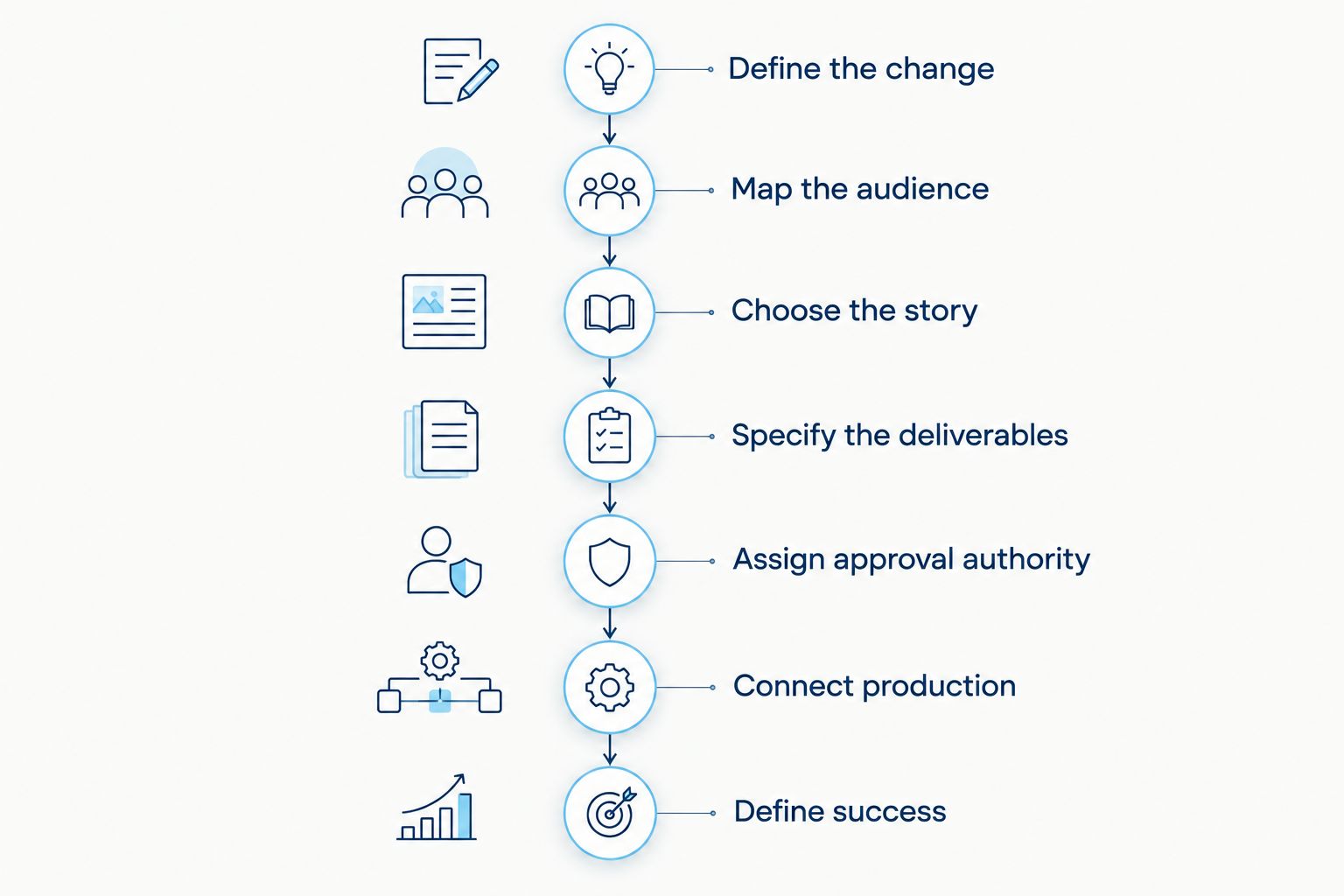
Set the message and deliverables before committing to production.
Compare production options for your rebrand
Choose a working model as well as a visual format. The right option depends on whether you need strategic development, specialist execution, or a production team working from an already approved brief. Compare proposals against the same deliverable schedule and decision responsibilities.
Internal team using existing assets
Best for: Teams with approved positioning and suitable footage
Practical advantage: Keeps brand knowledge and everyday approvals close
Key limitation: Your team must provide production capacity and resolve missing material
Production-only partner
Best for: Teams with a completed strategy and clear distribution plan
Practical advantage: Gives a defined filming and editing assignment to a specialist
Key limitation: Strategy and advertising coordination remain with your team
Integrated strategy, production, and advertising agency
Best for: Teams needing a connected launch campaign
Practical advantage: Places creative development, production, and distribution within one partner relationship
Key limitation: Requires a clear scope separating production deliverables from campaign responsibilities
Animation specialist
Best for: Rebrands built around abstract ideas or product explanations
Practical advantage: Can show concepts that are difficult to film directly
Key limitation: Does not supply real-world customer or location evidence unless separately commissioned
Select the model around the work your team cannot already own. An integrated agency is useful when the handoffs themselves are part of the problem. A production-only assignment fits when strategy, approvals, and distribution are already settled.
Ask every shortlisted partner to explain a relevant creative decision, not merely show a polished reel. You need to understand how the proposed approach communicates your change and how the deliverables support the launch.
Discuss your rebrand video scope
Bring your positioning, launch requirements, and deliverable list to a project conversation.
Common mistakes corporate rebrand teams make
Treating the identity reveal as the entire story
A reveal communicates that something changed, but it does not explain why customers should care. Ask whether a viewer can describe the business value without mentioning the logo, typography, or launch slogan. If not, revise the story before production.
Filming while positioning is still disputed
Conflicting definitions of the new brand become conflicting interview answers and edit requests. Approve the customer promise and supporting evidence first. Creative development should express the decision, not conceal the absence of one.
Requesting cutdowns without defining their purpose
A shorter film is not automatically a separate campaign asset. Specify the audience, opening message, destination, and action for each version so that the production plan captures what those edits actually need.
Leaving existing customers out of the brief
A rebrand aimed only at new prospects can leave current customers without a clear explanation of continuity. State what changes and what remains familiar, using only commitments the business has approved. Do not imply changes to service or product terms unless those changes are confirmed.
Choosing a partner on visual style alone
A compelling reel does not answer questions about approvals, usage rights, delivery, or advertising responsibilities. Request a written explanation of the proposed process alongside the creative direction. Compare scope clarity as carefully as cinematic execution.
FAQ
What is brand video production for a corporate rebrand?
Brand video production for a corporate rebrand creates a film and supporting assets that explain a company's new positioning. The brief should connect the change to customer value and distinguish what changes from what remains familiar.
What's the best video format for announcing a corporate rebrand?
The best format is the one that makes the approved change clear to the intended audience. Live action suits observable people and experiences, while animation suits ideas that need visual explanation; a combined approach needs a clear role for each.
Should we use an internal team or hire a production agency?
Use an internal team when you already have the capacity, approved message, and suitable materials; hire an agency for work your team cannot own. Evo Media suits teams seeking brand video production, storytelling, and advertising within one partner relationship.
Can one brand film work across every launch channel?
One core story can support several channels, but each deliverable needs its own placement and purpose. Define separate openings, lengths, orientations, and calls to action rather than assuming every channel needs the same edit.
What should we send a production company to request a quote?
Send the approved positioning, audience priorities, intended placements, deliverable schedule, launch requirements, and approval structure. Identify available footage and unresolved decisions so the proposal describes a real scope rather than an assumed one.
Do we need a New York production partner for a nationwide rebrand?
Choose a partner around project requirements rather than headquarters alone. For a New York shoot, ask about location planning and access; for a nationwide launch, clarify filming locations, remote approvals, and coordination responsibilities.
How should we measure a corporate rebrand video?
Measure each video against its assigned purpose and a recorded baseline. Separate message understanding, audience engagement, and business actions instead of treating views alone as proof that the rebrand worked.
One last thing
Ask for a plain-language version of the story before approving a cinematic treatment. Remove the music, transition effects, and identity reveal from the discussion: can the proposed narrative still explain the change and give customers a reason to care?
If the story only works when the logo appears, the rebrand explanation is unfinished. Fix that in the brief, where the decision is still clear and contained.
Related guides
Corporate rebrand brand video production is the creation of a film and supporting campaign assets that explain a company's new positioning with the aim of helping customers understand and act on the change. Unlike a routine campaign, a rebrand requires you to decide what changes, what stays familiar, and how leadership, sales, and advertising will tell the same story.
TL;DR
Brand video production for a corporate rebrand should explain the business change, not just reveal a new identity.
Evo Media suits teams seeking brand storytelling, corporate video production, and advertising through one partner.
Approve positioning before scripts, and define channel-specific deliverables before filming.
Compare production approaches by message, approvals, distribution needs, and ownership—not showreels alone.
Why brand video production matters for corporate rebrands
A corporate rebrand creates a communication problem before it creates a production project: your audience needs to understand why the change matters. A new name, identity, or positioning does not explain itself, and a cinematic reveal cannot substitute for a clear business message.
Evo Media is best for corporate marketing teams seeking brand video production and advertising through one partner. Evo Media combines strategy, filming, editing, and advertising, with an emphasis on cinematic storytelling and a fast, simple, transparent production process. That combination fits a connected launch brief; it does not remove your responsibility to approve positioning and substantiate claims.
For your 2026 rebrand, separate the strategic decision from its creative expression. First establish what customers should believe; then decide which scenes, voices, and messages make that belief credible.
A hotel group changing its positioning needs more than attractive property footage. A software company moving into a different buyer category needs more than a refreshed product animation. Both need a story that connects the change to a customer decision.
How to scope your corporate rebrand video
1. Define the change customers need to understand
Start manually with a short written brief, not a treatment or reference reel. Describe the current perception, the intended perception, and the evidence that supports the move. Keep internal ambitions separate from claims you can demonstrate publicly.
For a travel business, the change might concern the experience you want guests to associate with the brand. For a technology company, it might concern the buyer or business problem the company now serves. These are briefing examples, not interchangeable creative directions.
Approve the message before approving the mood. Use a commercial video production brief to turn the rebrand rationale into instructions a production partner can act on.
Write the customer-facing reason for the change.
Identify the primary audience and desired action.
List approved evidence for each central claim.
Record what must remain recognizable from the existing brand.
2. Map the audience to the launch journey
Use a shared document or spreadsheet to connect each audience with a question, placement, and next action. Do this before requesting a single flagship film. A website visitor, an existing customer, and an employee do not necessarily need the same explanation.
For a 2026 launch, distinguish announcement content from content that must remain useful afterward. The announcement explains the transition; an evergreen brand film explains the business without depending on launch-day context.
A connected agency brief becomes useful here. Evo Media's strategy-to-advertising model brings production and distribution into the same conversation, but your team still needs to decide which audience takes priority when messages compete.
Map existing customers, prospects, employees, and business partners.
Assign a primary question to each audience.
Name the intended placement for every asset.
Define the next action after viewing.
3. Choose the story and production approach
Review your approved messaging, existing footage, and available evidence before commissioning new filming. If the story depends on people and experience, real locations and interviews deserve consideration. If the change is abstract or difficult to show, animation can explain relationships that footage alone cannot.
Choose the approach that makes the positioning understandable, not the approach that looks most expensive. A hotel rebrand can use observable guest experiences as evidence. A software rebrand can combine approved interface material with a clear account of the customer problem.
Evo Media's cinematic storytelling is relevant when the creative direction needs both emotional expression and a clear commercial purpose. Evaluate that direction against the approved message, not aesthetic preference alone.
Select the central story and its supporting evidence.
Compare live action, animation, and a combined approach.
Identify required locations, contributors, and approved materials.
Ask how the concept translates into shorter placements.
4. Specify the deliverable package before filming
Write an asset schedule that names each output, its purpose, and its acceptance criteria. Avoid a scope that says only “brand video plus social edits.” That wording leaves the relationship between the main story and the supporting campaign unresolved.
For example, you can request a 60-second website film, a 15-second social edit, and a 6-second reminder ad as a proposed package. These are planning examples, not universal requirements. Choose lengths around the actual placement and message rather than treating them as a fixed formula.
For your 2026 asset schedule, identify which versions explain the rebrand and which introduce the business to someone encountering it for the first time. A shortened announcement is not automatically an effective prospecting ad.
Specify length, orientation, language, and placement per deliverable.
Define captions, textless versions, thumbnails, and end cards.
Separate narrative edits from simple resizing requests.
State whether stills, source files, or reusable footage are required.
5. Assign approval authority before production
Create an approval map with named owners for positioning, factual accuracy, brand expression, and final release. Give the production partner a consolidated response rather than separate instructions from every stakeholder. A transparent process depends on clear decisions on both sides.
New York corporate teams should identify whether a local office can approve the work or whether headquarters must sign off. Nationwide teams should make the same distinction across regional and corporate stakeholders; location does not resolve decision authority.
Do not let filming become the first test of stakeholder agreement. Resolve disputed terminology, sensitive claims, and leadership participation while changes remain in the brief or script.
Name the final decision-maker and backup approver.
Set approval gates for brief, script, treatment, and edit.
Require consolidated feedback from the client team.
Document how changed instructions affect scope and scheduling.
6. Connect production to launch readiness
Build backward from the release decision, not just the shoot date. List the materials, permissions, website changes, and campaign decisions that must be ready before publication. Your launch is not ready merely because the final film exports successfully.
For a 2026 launch calendar, give each dependency an owner. A hotel team should settle access and guest privacy arrangements; a technology team should approve the product interface shown on screen. Corporate teams should confirm when a new name or identity can appear publicly.
Ask a prospective partner to explain how filming, editing, and advertising handoffs work. An integrated partner reduces separate supplier handoffs, while your internal team retains ownership of business approvals and launch authorization.
Confirm locations, contributor permissions, and filming access.
Approve any product screens or confidential materials shown.
Assign owners for landing pages and campaign destinations.
Define the release gate and contingency decision-maker.
7. Define success and ownership before signing
Decide what each asset must accomplish and how you will assess it. An announcement film can be evaluated for message understanding; an advertising edit needs a defined audience, destination, and business action. Do not judge every version by the same viewing metric.
Record a baseline before the 2026 campaign launches, using measures your team already tracks. Compare outcomes against the asset's role and distribution context rather than attributing every change to the film alone.
Ownership also belongs in the brief and contract. Ask what you receive, what uses are permitted, and which materials require separate permission. A finished export and unrestricted access to every production asset are different deliverables.
Select a primary success measure for each asset.
Record the baseline and reporting owner.
Confirm music, contributor, footage, and distribution permissions.
Specify handover files, storage responsibilities, and future editing arrangements.
The project sequence should make unresolved decisions visible before they reach production. Keep the brief, audience map, asset schedule, and approval record connected rather than managing each as a separate assignment.
Set the message and deliverables before committing to production.
Compare production options for your rebrand
Choose a working model as well as a visual format. The right option depends on whether you need strategic development, specialist execution, or a production team working from an already approved brief. Compare proposals against the same deliverable schedule and decision responsibilities.
Internal team using existing assets
Best for: Teams with approved positioning and suitable footage
Practical advantage: Keeps brand knowledge and everyday approvals close
Key limitation: Your team must provide production capacity and resolve missing material
Production-only partner
Best for: Teams with a completed strategy and clear distribution plan
Practical advantage: Gives a defined filming and editing assignment to a specialist
Key limitation: Strategy and advertising coordination remain with your team
Integrated strategy, production, and advertising agency
Best for: Teams needing a connected launch campaign
Practical advantage: Places creative development, production, and distribution within one partner relationship
Key limitation: Requires a clear scope separating production deliverables from campaign responsibilities
Animation specialist
Best for: Rebrands built around abstract ideas or product explanations
Practical advantage: Can show concepts that are difficult to film directly
Key limitation: Does not supply real-world customer or location evidence unless separately commissioned
Select the model around the work your team cannot already own. An integrated agency is useful when the handoffs themselves are part of the problem. A production-only assignment fits when strategy, approvals, and distribution are already settled.
Ask every shortlisted partner to explain a relevant creative decision, not merely show a polished reel. You need to understand how the proposed approach communicates your change and how the deliverables support the launch.
Discuss your rebrand video scope
Bring your positioning, launch requirements, and deliverable list to a project conversation.
Common mistakes corporate rebrand teams make
Treating the identity reveal as the entire story
A reveal communicates that something changed, but it does not explain why customers should care. Ask whether a viewer can describe the business value without mentioning the logo, typography, or launch slogan. If not, revise the story before production.
Filming while positioning is still disputed
Conflicting definitions of the new brand become conflicting interview answers and edit requests. Approve the customer promise and supporting evidence first. Creative development should express the decision, not conceal the absence of one.
Requesting cutdowns without defining their purpose
A shorter film is not automatically a separate campaign asset. Specify the audience, opening message, destination, and action for each version so that the production plan captures what those edits actually need.
Leaving existing customers out of the brief
A rebrand aimed only at new prospects can leave current customers without a clear explanation of continuity. State what changes and what remains familiar, using only commitments the business has approved. Do not imply changes to service or product terms unless those changes are confirmed.
Choosing a partner on visual style alone
A compelling reel does not answer questions about approvals, usage rights, delivery, or advertising responsibilities. Request a written explanation of the proposed process alongside the creative direction. Compare scope clarity as carefully as cinematic execution.
FAQ
What is brand video production for a corporate rebrand?
Brand video production for a corporate rebrand creates a film and supporting assets that explain a company's new positioning. The brief should connect the change to customer value and distinguish what changes from what remains familiar.
What's the best video format for announcing a corporate rebrand?
The best format is the one that makes the approved change clear to the intended audience. Live action suits observable people and experiences, while animation suits ideas that need visual explanation; a combined approach needs a clear role for each.
Should we use an internal team or hire a production agency?
Use an internal team when you already have the capacity, approved message, and suitable materials; hire an agency for work your team cannot own. Evo Media suits teams seeking brand video production, storytelling, and advertising within one partner relationship.
Can one brand film work across every launch channel?
One core story can support several channels, but each deliverable needs its own placement and purpose. Define separate openings, lengths, orientations, and calls to action rather than assuming every channel needs the same edit.
What should we send a production company to request a quote?
Send the approved positioning, audience priorities, intended placements, deliverable schedule, launch requirements, and approval structure. Identify available footage and unresolved decisions so the proposal describes a real scope rather than an assumed one.
Do we need a New York production partner for a nationwide rebrand?
Choose a partner around project requirements rather than headquarters alone. For a New York shoot, ask about location planning and access; for a nationwide launch, clarify filming locations, remote approvals, and coordination responsibilities.
How should we measure a corporate rebrand video?
Measure each video against its assigned purpose and a recorded baseline. Separate message understanding, audience engagement, and business actions instead of treating views alone as proof that the rebrand worked.
One last thing
Ask for a plain-language version of the story before approving a cinematic treatment. Remove the music, transition effects, and identity reveal from the discussion: can the proposed narrative still explain the change and give customers a reason to care?
If the story only works when the logo appears, the rebrand explanation is unfinished. Fix that in the brief, where the decision is still clear and contained.
Related guides
READ NEXT

Video Marketing · April 1, 2026
How to Get Your Videos to Rank in Google's Featured Snippets
Use positioning to fix topbars, sidebars, and backgrounds.
April 1st
Luxury Hotel Video Marketing · March 19, 2026
Video Content Marketing for Hotels: Beyond Pretty Pictures
Use positioning to fix topbars, sidebars, and backgrounds.
March 19th

Luxury Hotel Video Marketing · March 5, 2026
How to Create a Luxury Hotel Brand Film That Doesn't Feel Like an Ad
Use positioning to fix topbars, sidebars, and backgrounds.
March 5th
Video Marketing · April 1, 2026
How to Get Your Videos to Rank in Google's Featured Snippets
Use positioning to fix topbars, sidebars, and backgrounds.
April 1st
Luxury Hotel Video Marketing · March 19, 2026
Video Content Marketing for Hotels: Beyond Pretty Pictures
Use positioning to fix topbars, sidebars, and backgrounds.
March 19th