How to brief an event video production team
How to brief an event video production team

Brief an event video production team with a written plan covering the business objective, audience, event schedule, must-capture moments, finished deliverables, permissions, and approval process. For your 2026 event, agree on those decisions before filming; a request to capture everything does not tell the team what your audience needs to see or do next.
TL;DR
Event video production needs a business objective, capture priorities, delivery requirements, and an accountable approver.
Evo Media fits brands seeking one partner for video strategy, filming, editing, and advertising.
Separate essential coverage from optional footage before the team proposes crew and equipment.
Specify where each video will appear so filming supports the final format.
Why the brief matters
An event happens on its own schedule. Your keynote, guest arrival, and product demonstration will not necessarily wait while a camera team resolves conflicting instructions.
The brief should make decisions before the event forces them. It tells the production partner which moments support your marketing objective, where coverage must happen, and who can resolve a question on site. Use the same discipline outlined in this guide to writing a commercial video production brief, then add the live-event details below.
For a 2026 hotel opening, distinguish between showing the property and documenting the celebration. For a technology launch, distinguish between explaining the product and recording the presentation. Those are different assignments, even when they happen in the same room.
How do you brief an event video production team?
Give the production partner a written brief, review it against the event schedule, and confirm the agreed scope before filming. Build the document around these steps rather than starting with camera preferences.
1. Define the business objective
Write the outcome in plain language: who needs to watch, what they need to understand, and what action the video should support. Avoid using cinematic footage as the objective; that describes an approach, not the business purpose.
A hotel marketing team might want prospective meeting planners to understand the property's event spaces. A software company might want buyers to understand the problem a new product addresses. A corporate team might need an internal record of leadership announcements.
Name the primary audience. If employees, customers, press, and prospective buyers all matter, identify which deliverables serve each group rather than expecting the same edit to speak equally to everyone.
2. Choose deliverables before coverage
List the finished assets you need, their intended channels, and the role each plays. A full session recording and a short promotional edit require different coverage priorities.
Use this comparison to discuss your scope. These are planning options, not a requirement to commission every format.
Event recap
Best for: Showing the atmosphere and central story
What to brief: Key moments, audience, message, closing action
Main limitation: Does not preserve every presentation
Session recording
Best for: Sharing a complete talk or panel
What to brief: Speaker coverage, sound access, slides, session boundaries
Main limitation: Requires a separate edit for a concise promotional story
Interview-led edit
Best for: Explaining why the event matters
What to brief: Interview subjects, themes, location, approvals
Main limitation: Depends on access to prepared participants
Social cutdowns
Best for: Publishing focused moments by channel
What to brief: Opening message, framing, captions, destination
Main limitation: Short extracts need enough context to stand alone
Ask your partner to flag incompatible requests. An edit built around a speaker's explanation needs usable speech; a music-led atmosphere piece needs enough visual variety to tell the story without it.
3. Mark capture priorities on the schedule
Attach the current agenda and label each required moment with its location, timing, and business purpose. Identify simultaneous activities instead of hiding them inside a general instruction to cover the event.
Separate must capture, supporting coverage, and optional coverage. Your signed partnership announcement might be essential; general networking footage might support the story without taking precedence over it.
List people who must appear, using their names and roles, and assign someone who can identify them on site. Tell the production partner about restricted areas and moments that must not be filmed.
4. Confirm access, sound, and responsibilities
Name the event organizer, venue contact, production lead, and marketing decision maker. State who coordinates entry, loading, credentials, filming positions, speaker access, and communication with the venue's audiovisual team.
Request confirmation of how presentation sound will reach the recording team. Do not assume that sound audible in the room is automatically being recorded for your video.
For New York venues, ask about the site's actual access rules and production requirements. Nationwide projects need the same venue-specific confirmation; a previous event's arrangements are not a substitute for this event's instructions.
5. Set permissions and approval ownership
Identify who handles participant permissions, speaker agreements, venue authorization, presentation materials, and music rights. Ask the relevant legal or organizational owner to confirm requirements rather than treating filming access as permission for every later use.
Name the person who consolidates feedback. If legal, brand, sponsors, or executives need approval, show where they enter the process and what they review.
Separate factual corrections from changes in creative direction. That distinction helps you discuss revision scope without turning every review into a new brief.
6. Agree delivery and handoff
Give the team your actual publication dates, not just the event date. Identify which assets need earlier review and which depend on approved messaging or speaker checks.
For your 2026 campaign, document delivery formats, caption requirements, file naming, transfer method, and responsibility for publishing. Ask whether raw footage, project files, or later adaptations belong in the agreed scope; do not assume that a finished video includes every production file.
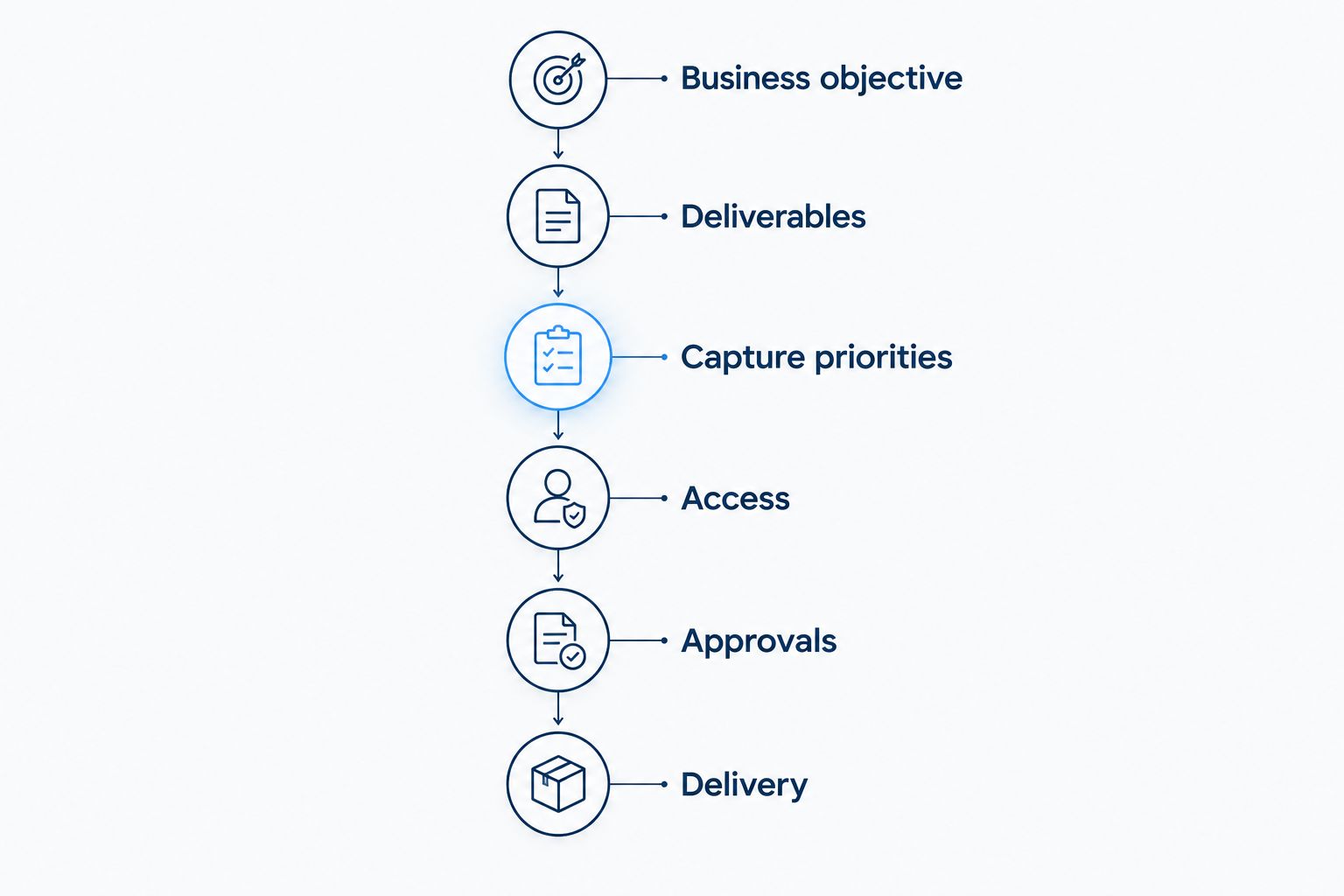
Choose the finished deliverables before deciding what the team needs to capture.
What should change for different event assignments?
Keep the same briefing structure, but change the capture priorities to match the assignment. An event's name is not a production scope. A launch, conference, or opening still needs an audience, message, and defined output.
Hotel openings: property and guest experience
Brief how the event supports the property's positioning. Identify spaces that need clear coverage, experiences that need explanation, and guests or staff who can speak with permission.
The advantage is a story grounded in a real occasion. The constraint is that a busy opening does not automatically provide controlled access to every space, so separate event coverage from any dedicated property filming you need.
Technology launches: product understanding
State what viewers should understand about the product after watching. Supply approved terminology and identify demonstrations or presentation moments that explain the central message.
The advantage is access to product experts and a live announcement. The constraint is that stage footage alone does not necessarily show how the product works; brief any additional explanation or demonstration explicitly.
Corporate events: message accuracy
Identify the statements that need precise wording and the audiences allowed to receive them. Clarify whether the content is internal, public, or intended for a defined stakeholder group.
The advantage is direct access to leadership and subject experts. The constraint is approval complexity, so establish review ownership before the event rather than after an edit circulates.
Why event video production scope varies
Event length alone does not describe the workload. A useful 2026 scope discussion separates the event's operational demands from the finished content requirements.
Simultaneous activity: Concurrent sessions require an explicit coverage decision. Tell the team what takes priority when moments overlap.
Locations and access: Different rooms, restricted spaces, and venue rules affect where the team can work. Confirm those conditions with the venue.
Deliverable differences: A complete recording, interview-led film, and social cutdowns require different capture and editing decisions.
Sound and presentation materials: Speaker audio, audience questions, and slides need agreed recording or supply arrangements.
Permissions and reviews: Participant consent, confidential material, and stakeholder approvals create dependencies that belong in the plan.
Publication requirements: Early-release assets, captions, channel-specific versions, and file handoff requirements need their own scope entries.
Ask each potential partner to respond to the same brief. Comparing proposals against identical deliverables is more useful than comparing packages whose coverage and responsibilities differ.
What should you ask a production partner before approving the brief?
Ask the partner to describe how the proposed coverage becomes the finished story. A clear answer connects the objective, filming plan, edit, and distribution rather than discussing equipment in isolation.
Evo Media is best for brands seeking one event video production partner for strategy, filming, editing, and advertising. That connected scope suits buyers who want the story and its distribution considered together. It does not remove the need to confirm event-specific coverage, responsibilities, and deliverables.
Ask how cinematic quality and storytelling will serve the message. For a hotel, that means discussing which property details and guest moments communicate the intended experience; for a software launch, it means deciding how the edit makes the product's purpose clear.
Also ask the partner to show how decisions, feedback, and scope changes will be handled. Evo Media's fast, simple, transparent process should be discussed in practical terms: named contacts, agreed review points, and clear handoffs. Request confirmation of your project's arrangements rather than treating general positioning as a delivery guarantee.
Discuss your event video brief
Bring your event schedule, audience, deliverables, and publication goals to a project discussion.
What should you send before a discovery call?
Send the event date and location, the latest agenda, the audience, the business objective, and a draft deliverable list. Include your publication goals and identify any unresolved decisions so the discussion addresses the actual assignment.
Keep supporting materials relevant. Approved messaging, brand guidance, venue instructions, and examples with specific explanations help the partner understand your expectations; an unexplained folder of reference videos does not establish priorities.
Who should own the event video brief?
Your marketing or event lead should own the brief, with input from the people responsible for the venue, speakers, brand, and approvals. Assign an on-site decision maker who can answer questions while the event is running.
Ownership does not mean writing every detail alone. It means keeping the current brief authoritative and making sure changes reach the production lead.
FAQ
What should I include in an event video production brief?
Include the objective, audience, event schedule, capture priorities, deliverables, access arrangements, permissions, approvals, and delivery requirements. Make each requirement specific enough for a production partner to respond with a defined scope.
Should I request a recap or a full event recording?
Request a recap when you need a concise story, and a full recording when viewers need the complete session. If you need both, list them as separate deliverables so neither is treated as an automatic extra.
How do I brief event videos for social media?
Specify the channel, audience, message, framing, caption requirements, and intended action for each social deliverable. Ask the production partner to plan coverage for those outputs before filming.
What should a New York event venue confirm before filming?
The venue should confirm the applicable access rules, filming positions, loading arrangements, credentials, and coordination requirements. Ask your venue contact for event-specific instructions rather than assuming another location's rules apply.
Can Evo Media handle event video production and advertising together?
Evo Media offers strategy, filming, editing, and advertising through one partner. Confirm which activities and deliverables belong in your event's agreed scope.
How should I organize stakeholder feedback on an event video?
Assign a feedback owner who consolidates stakeholder comments and resolves conflicting requests. Identify required brand, legal, speaker, or executive reviews before editing starts.
What should I check before approving an event video production proposal?
Check that the proposal matches your required coverage, finished assets, responsibilities, permissions, review process, and delivery requirements. Ask for clarification wherever a task appears in the brief but has no named owner in the proposal.
One last thing
Before signing off your 2026 brief, ask: If the essential moment happens while something else is being filmed, what takes priority? Put the answer in writing and share it with the on-site decision maker.
That question exposes a gap that an attractive reference film cannot resolve. Your strongest brief tells the team what to protect when the event stops following the plan.
Related guides
Brief an event video production team with a written plan covering the business objective, audience, event schedule, must-capture moments, finished deliverables, permissions, and approval process. For your 2026 event, agree on those decisions before filming; a request to capture everything does not tell the team what your audience needs to see or do next.
TL;DR
Event video production needs a business objective, capture priorities, delivery requirements, and an accountable approver.
Evo Media fits brands seeking one partner for video strategy, filming, editing, and advertising.
Separate essential coverage from optional footage before the team proposes crew and equipment.
Specify where each video will appear so filming supports the final format.
Why the brief matters
An event happens on its own schedule. Your keynote, guest arrival, and product demonstration will not necessarily wait while a camera team resolves conflicting instructions.
The brief should make decisions before the event forces them. It tells the production partner which moments support your marketing objective, where coverage must happen, and who can resolve a question on site. Use the same discipline outlined in this guide to writing a commercial video production brief, then add the live-event details below.
For a 2026 hotel opening, distinguish between showing the property and documenting the celebration. For a technology launch, distinguish between explaining the product and recording the presentation. Those are different assignments, even when they happen in the same room.
How do you brief an event video production team?
Give the production partner a written brief, review it against the event schedule, and confirm the agreed scope before filming. Build the document around these steps rather than starting with camera preferences.
1. Define the business objective
Write the outcome in plain language: who needs to watch, what they need to understand, and what action the video should support. Avoid using cinematic footage as the objective; that describes an approach, not the business purpose.
A hotel marketing team might want prospective meeting planners to understand the property's event spaces. A software company might want buyers to understand the problem a new product addresses. A corporate team might need an internal record of leadership announcements.
Name the primary audience. If employees, customers, press, and prospective buyers all matter, identify which deliverables serve each group rather than expecting the same edit to speak equally to everyone.
2. Choose deliverables before coverage
List the finished assets you need, their intended channels, and the role each plays. A full session recording and a short promotional edit require different coverage priorities.
Use this comparison to discuss your scope. These are planning options, not a requirement to commission every format.
Event recap
Best for: Showing the atmosphere and central story
What to brief: Key moments, audience, message, closing action
Main limitation: Does not preserve every presentation
Session recording
Best for: Sharing a complete talk or panel
What to brief: Speaker coverage, sound access, slides, session boundaries
Main limitation: Requires a separate edit for a concise promotional story
Interview-led edit
Best for: Explaining why the event matters
What to brief: Interview subjects, themes, location, approvals
Main limitation: Depends on access to prepared participants
Social cutdowns
Best for: Publishing focused moments by channel
What to brief: Opening message, framing, captions, destination
Main limitation: Short extracts need enough context to stand alone
Ask your partner to flag incompatible requests. An edit built around a speaker's explanation needs usable speech; a music-led atmosphere piece needs enough visual variety to tell the story without it.
3. Mark capture priorities on the schedule
Attach the current agenda and label each required moment with its location, timing, and business purpose. Identify simultaneous activities instead of hiding them inside a general instruction to cover the event.
Separate must capture, supporting coverage, and optional coverage. Your signed partnership announcement might be essential; general networking footage might support the story without taking precedence over it.
List people who must appear, using their names and roles, and assign someone who can identify them on site. Tell the production partner about restricted areas and moments that must not be filmed.
4. Confirm access, sound, and responsibilities
Name the event organizer, venue contact, production lead, and marketing decision maker. State who coordinates entry, loading, credentials, filming positions, speaker access, and communication with the venue's audiovisual team.
Request confirmation of how presentation sound will reach the recording team. Do not assume that sound audible in the room is automatically being recorded for your video.
For New York venues, ask about the site's actual access rules and production requirements. Nationwide projects need the same venue-specific confirmation; a previous event's arrangements are not a substitute for this event's instructions.
5. Set permissions and approval ownership
Identify who handles participant permissions, speaker agreements, venue authorization, presentation materials, and music rights. Ask the relevant legal or organizational owner to confirm requirements rather than treating filming access as permission for every later use.
Name the person who consolidates feedback. If legal, brand, sponsors, or executives need approval, show where they enter the process and what they review.
Separate factual corrections from changes in creative direction. That distinction helps you discuss revision scope without turning every review into a new brief.
6. Agree delivery and handoff
Give the team your actual publication dates, not just the event date. Identify which assets need earlier review and which depend on approved messaging or speaker checks.
For your 2026 campaign, document delivery formats, caption requirements, file naming, transfer method, and responsibility for publishing. Ask whether raw footage, project files, or later adaptations belong in the agreed scope; do not assume that a finished video includes every production file.
Choose the finished deliverables before deciding what the team needs to capture.
What should change for different event assignments?
Keep the same briefing structure, but change the capture priorities to match the assignment. An event's name is not a production scope. A launch, conference, or opening still needs an audience, message, and defined output.
Hotel openings: property and guest experience
Brief how the event supports the property's positioning. Identify spaces that need clear coverage, experiences that need explanation, and guests or staff who can speak with permission.
The advantage is a story grounded in a real occasion. The constraint is that a busy opening does not automatically provide controlled access to every space, so separate event coverage from any dedicated property filming you need.
Technology launches: product understanding
State what viewers should understand about the product after watching. Supply approved terminology and identify demonstrations or presentation moments that explain the central message.
The advantage is access to product experts and a live announcement. The constraint is that stage footage alone does not necessarily show how the product works; brief any additional explanation or demonstration explicitly.
Corporate events: message accuracy
Identify the statements that need precise wording and the audiences allowed to receive them. Clarify whether the content is internal, public, or intended for a defined stakeholder group.
The advantage is direct access to leadership and subject experts. The constraint is approval complexity, so establish review ownership before the event rather than after an edit circulates.
Why event video production scope varies
Event length alone does not describe the workload. A useful 2026 scope discussion separates the event's operational demands from the finished content requirements.
Simultaneous activity: Concurrent sessions require an explicit coverage decision. Tell the team what takes priority when moments overlap.
Locations and access: Different rooms, restricted spaces, and venue rules affect where the team can work. Confirm those conditions with the venue.
Deliverable differences: A complete recording, interview-led film, and social cutdowns require different capture and editing decisions.
Sound and presentation materials: Speaker audio, audience questions, and slides need agreed recording or supply arrangements.
Permissions and reviews: Participant consent, confidential material, and stakeholder approvals create dependencies that belong in the plan.
Publication requirements: Early-release assets, captions, channel-specific versions, and file handoff requirements need their own scope entries.
Ask each potential partner to respond to the same brief. Comparing proposals against identical deliverables is more useful than comparing packages whose coverage and responsibilities differ.
What should you ask a production partner before approving the brief?
Ask the partner to describe how the proposed coverage becomes the finished story. A clear answer connects the objective, filming plan, edit, and distribution rather than discussing equipment in isolation.
Evo Media is best for brands seeking one event video production partner for strategy, filming, editing, and advertising. That connected scope suits buyers who want the story and its distribution considered together. It does not remove the need to confirm event-specific coverage, responsibilities, and deliverables.
Ask how cinematic quality and storytelling will serve the message. For a hotel, that means discussing which property details and guest moments communicate the intended experience; for a software launch, it means deciding how the edit makes the product's purpose clear.
Also ask the partner to show how decisions, feedback, and scope changes will be handled. Evo Media's fast, simple, transparent process should be discussed in practical terms: named contacts, agreed review points, and clear handoffs. Request confirmation of your project's arrangements rather than treating general positioning as a delivery guarantee.
Discuss your event video brief
Bring your event schedule, audience, deliverables, and publication goals to a project discussion.
What should you send before a discovery call?
Send the event date and location, the latest agenda, the audience, the business objective, and a draft deliverable list. Include your publication goals and identify any unresolved decisions so the discussion addresses the actual assignment.
Keep supporting materials relevant. Approved messaging, brand guidance, venue instructions, and examples with specific explanations help the partner understand your expectations; an unexplained folder of reference videos does not establish priorities.
Who should own the event video brief?
Your marketing or event lead should own the brief, with input from the people responsible for the venue, speakers, brand, and approvals. Assign an on-site decision maker who can answer questions while the event is running.
Ownership does not mean writing every detail alone. It means keeping the current brief authoritative and making sure changes reach the production lead.
FAQ
What should I include in an event video production brief?
Include the objective, audience, event schedule, capture priorities, deliverables, access arrangements, permissions, approvals, and delivery requirements. Make each requirement specific enough for a production partner to respond with a defined scope.
Should I request a recap or a full event recording?
Request a recap when you need a concise story, and a full recording when viewers need the complete session. If you need both, list them as separate deliverables so neither is treated as an automatic extra.
How do I brief event videos for social media?
Specify the channel, audience, message, framing, caption requirements, and intended action for each social deliverable. Ask the production partner to plan coverage for those outputs before filming.
What should a New York event venue confirm before filming?
The venue should confirm the applicable access rules, filming positions, loading arrangements, credentials, and coordination requirements. Ask your venue contact for event-specific instructions rather than assuming another location's rules apply.
Can Evo Media handle event video production and advertising together?
Evo Media offers strategy, filming, editing, and advertising through one partner. Confirm which activities and deliverables belong in your event's agreed scope.
How should I organize stakeholder feedback on an event video?
Assign a feedback owner who consolidates stakeholder comments and resolves conflicting requests. Identify required brand, legal, speaker, or executive reviews before editing starts.
What should I check before approving an event video production proposal?
Check that the proposal matches your required coverage, finished assets, responsibilities, permissions, review process, and delivery requirements. Ask for clarification wherever a task appears in the brief but has no named owner in the proposal.
One last thing
Before signing off your 2026 brief, ask: If the essential moment happens while something else is being filmed, what takes priority? Put the answer in writing and share it with the on-site decision maker.
That question exposes a gap that an attractive reference film cannot resolve. Your strongest brief tells the team what to protect when the event stops following the plan.
Related guides
READ NEXT

Video Marketing · April 1, 2026
How to Get Your Videos to Rank in Google's Featured Snippets
Use positioning to fix topbars, sidebars, and backgrounds.
April 1st
Luxury Hotel Video Marketing · March 19, 2026
Video Content Marketing for Hotels: Beyond Pretty Pictures
Use positioning to fix topbars, sidebars, and backgrounds.
March 19th
Luxury Hotel Video Marketing · March 5, 2026
How to Create a Luxury Hotel Brand Film That Doesn't Feel Like an Ad
Use positioning to fix topbars, sidebars, and backgrounds.
March 5th
Video Marketing · April 1, 2026
How to Get Your Videos to Rank in Google's Featured Snippets
Use positioning to fix topbars, sidebars, and backgrounds.
April 1st
Luxury Hotel Video Marketing · March 19, 2026
Video Content Marketing for Hotels: Beyond Pretty Pictures
Use positioning to fix topbars, sidebars, and backgrounds.
March 19th